Exclusive: Cape Verde World Cup hero Vozinha’s mother travels to capital to apply for US visa, Chinese Wenzhou businessman shares behind-the-scenes story
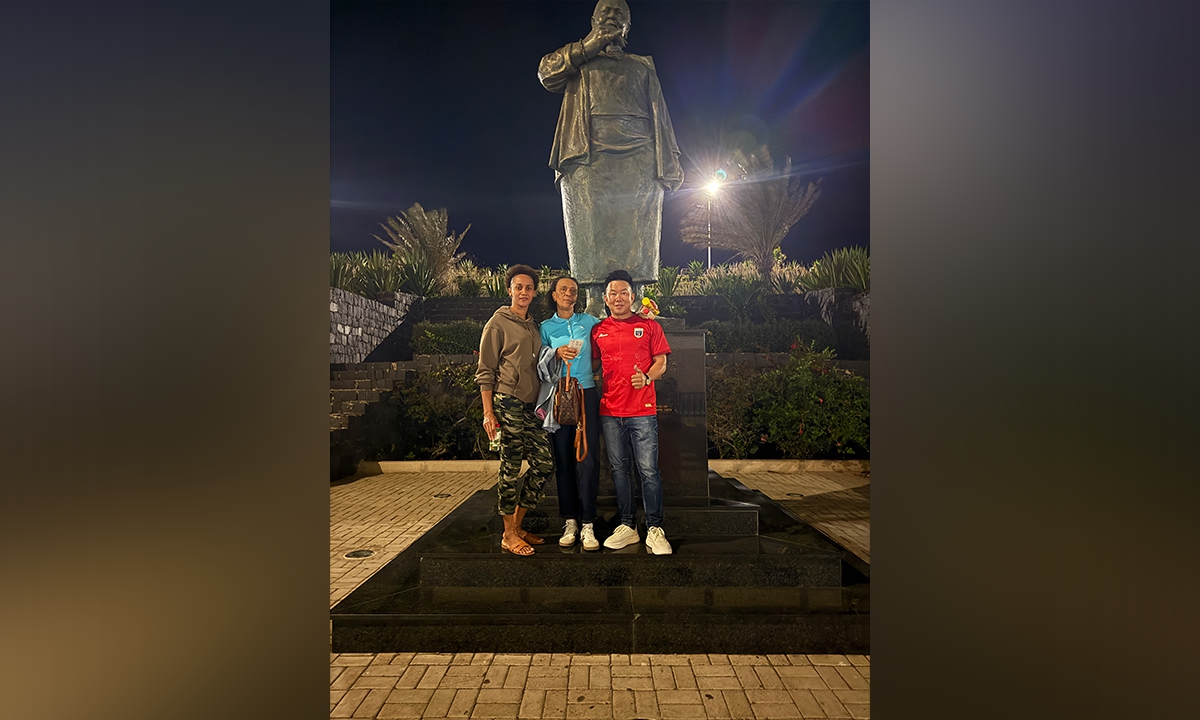
Lin Jie (right) poses with Cape Verde goalkeeper Vozinha’s cousin (left) and mother on June 17, 2026. Photo: Courtesy of Lin Jie
The veteran goalkeeper, whose real name is Josimar José Évora Dias, became an overnight sensation for keeping Cape Verde in the game against one of football’s strongest teams. The word “vozinha” is actually Portuguese for “little grandmother,” according to Yahoo News Australia.
In a post-match interview, Vozinha said that his mother had been unable to travel to watch his historic World Cup appearance due to visa and financial barriers. His story quickly drew widespread attention online and sparked international media interest in his family.
As coverage of the emotional storyline spread, before international reporters and media outlets reached Vozinha’s mother, a local Chinese businessman based in Cape Verde had already made contact with the family.
The businessman, Lin Jie, a Wenzhou-born entrepreneur who has lived in the country for more than two decades, told the Global Times that he decided to visit the goalkeeper’s family shortly after the match. Through a local connection, his wife’s clothing store, where Vozinha’s cousin worked, Lin was able to establish contact with the family.
Lin later shared videos on Chinese social media platform Douyin showing Vozinha’s mother and cousin celebrating the goalkeeper’s performance and preparing gifts for his return. Another video showed Lin accompanying Vozinha’s mother to a local airport as she departed for the US.
According to Lin, she was scheduled to complete visa-related procedures at the US Embassy in the capital city of Praia in Cape Verde before traveling to the US in order to watch Cape Verde’s match against Uruguay on Sunday.
Lin told the Global Times that Josina Freitas, a member of Cape Verde’s National Assembly helped facilitate the process. The Cape Verde National Football Association covered the cost of her visa and her flights to the capital and onward to the US.
For the trip, Lin said he provided some basic travel essentials including a suitcase, clothing, and shoes.
According to Reuters, Vozinha’s mother will be granted a visa and is expected to attend Cape Verde’s next World Cup match in the US.
“No mother should miss the chance to see her child make history,” US Congressman Hakeem Jeffries said in a statement on Wednesday. A US State Department official also told Reuters that the visa team in Praia were in close contact with her and providing the needed services.
For many Cape Verdeans, the draw against Spain was a moment of national celebration, Lin told the Global Times.
“The whole country was in a state of celebration, with every city erupting in festivities,” Lin said. “People poured into the streets waving national flags. Cars were honking everywhere to celebrate.”
In Lin’s view, the excitement reflects the country’s deep-rooted football culture.
“Football is a truly national sport here,” he said. “If people buy gifts for boys, a football is almost always one of them. Children can play anywhere — at home, in the streets, or any other places.”
Although Cape Verde’s sporting infrastructure is not highly developed, Lin said football facilities can be found in every region of the country. Many of these pitches have been built by the government, while others were constructed through foreign aid or private investment.
The nation’s largest stadium with 15,000 seats, meanwhile, is the National Stadium, a Chinese-aided project completed and handed over in 2014, according to the Xinhua News Agency.
According to Lin, on São Vicente Island, Vozinha’s hometown city, Chinese-funded projects are relatively prominent, including hospitals as well as residential housing developments.
“Many of my local friends told me that relations between China and Cape Verde are very good,” Lin said. The two countries are marking 50 years of diplomatic ties this year, and China has provided significant assistance and aid to Cape Verde over the years, and they expressed appreciation for Chinese contributions.
Asked which side he would support if China and Cape Verde were ever to meet on the football field, Lin said that he has deep feelings for both countries. “As a Chinese citizen, I would definitely support China. But I also hope Chinese football can continue to improve.”
Having spent more than two decades in Cape Verde, Lin said he has witnessed the close relationship between the two countries firsthand. He estimated that more than 3,000 Chinese business people currently live and work in the country.
“I wish for lasting friendship between our two countries,” Lin said. “I also hope more Chinese companies and products will find opportunities in Cape Verde in the future.”
RELATED ARTICLES