China is preparing for territorial spatial planning in waters east of Taiwan island: Yuyuantantian
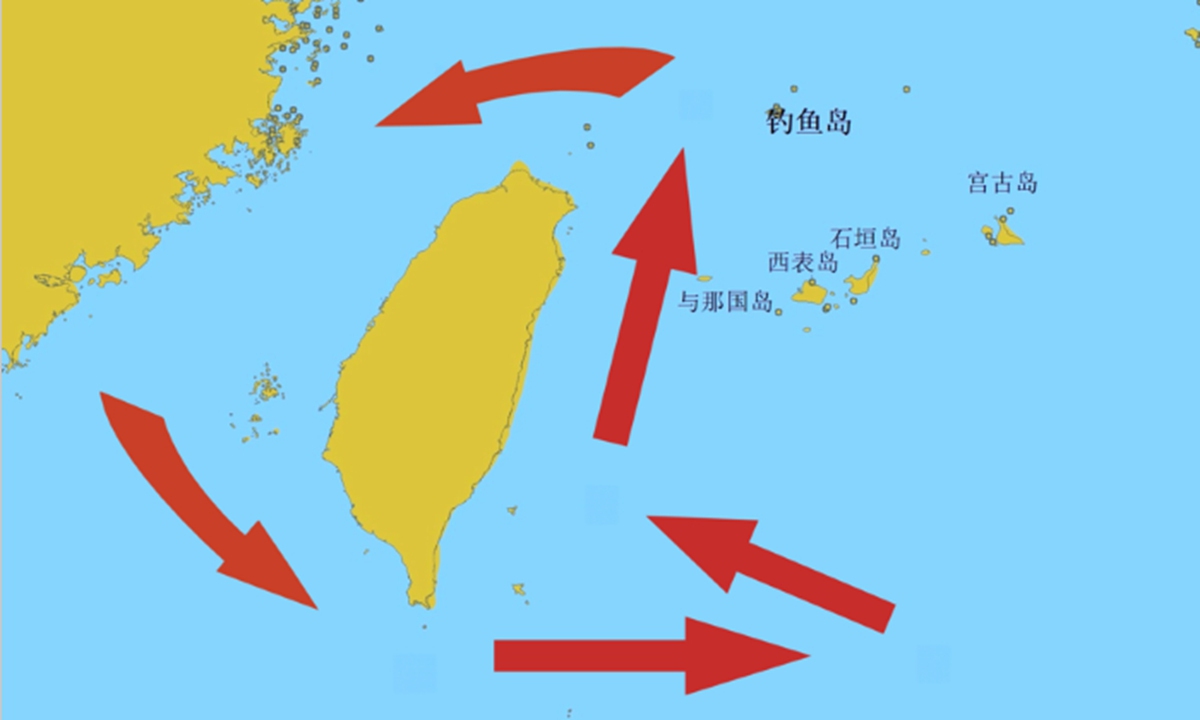
A schematic map of the special maritime traffic law enforcement and hydrographic survey operation in waters east of Taiwan island. Photo: Xinhua News Agency, courtesy of the Fujian Maritime Safety Administration
China's Ministry of Natural Resources organized a marine environmental survey in waters under China's jurisdiction east of China's Taiwan island from June 16 to 18 to gain a full understanding of the natural ecological conditions of the country's jurisdictional sea areas, Xinhua reported. According to Yuyuantantian, a social media account affiliated with China Media Group, this operation signifies that China's "nearshore governance model" now encompasses the natural resources sector, and that China is preparing for territorial spatial planning of the waters east of Taiwan island.The survey is designed to assess the natural resources of the waters east of Taiwan island and lay the foundation for the development and conservation of marine territorial space. In the past, China's marine research activities in these waters were mostly one-time, specialized missions; however, this survey is being carried out as an annual routine survey, which in itself is a concrete measure for China to exercise its jurisdiction over these waters and take stock of all national natural resources. A full resource stocktaking will lay the groundwork for territorial spatial development and conservation.
As reported by Yuyuantantian, the operation featured China's first targeted surveys of avian and cetacean species in the area. This signals a shift from broad general surveys to detailed surveys targeting specific species and regions. It is foreseeable that more such in-depth surveys will be carried out in the years ahead.
Yuyuantantian cited experts as saying that future marine development will span marine industries, oil and gas exploration and development, and marine biopharmaceuticals and bioproducts. For conservation work, it will include marine ecological and environmental protection, source control of marine environmental hazards, and integrated governance of key sea areas.
Moving forward, authorities will also advance multi-dimensional tiered planning for marine economic utilization, including marine aquaculture at the surface-water and water-column levels, as well as cross-sea bridges, undersea cables and pipelines, and undersea tunnels at the seabed and subsoil levels.
The report noted that China is systematically carrying out and entrenching its lawful rights in the waters east of Taiwan island in line with exclusive economic zone provisions. The relevant waters east of Taiwan island and its affiliated islands fall within China's exclusive economic zone. All activities carried out by China in these waters are entirely legitimate acts within the scope of its sovereignty.
In recent times, China's approaches to exercising jurisdiction over these waters have kept expanding, including joint island encirclement drills, China Coast Guard law enforcement patrols, special maritime traffic law enforcement organized by the Ministry of Transport, to hydrographic surveys as well as regular resource surveys conducted by the Ministry of Natural Resources. The routine surveys conducted by the Ministry of Natural Resources serve the specific purpose of exercising China's sovereign rights over natural resources.
It is noteworthy that Japan and the Philippines recently bypassed China in launching the so-called maritime delimitation talks, which attempts to manipulate matters within the framework of exclusive economic zones. Through bilateral arrangements, the Philippines and Japan seek to establish fait accompli within China's waters and violate China's legitimate maritime rights and interests.
In addition, as reported by Yuyuantantian, during the routine surveys, certain forces even attempted to interfere with China's normal survey operations. Experts note that the PLA Navy and China Coast Guard serve as strong backing, and that various departments are coordinating their efforts to ensure the surveys proceed safely and in an orderly manner.
Yuyuantantian said that the Coast Guard undertakes maritime law enforcement tasks, while the Ministry of Natural Resources oversees resource and ecological management; each fulfills its respective duties and works in coordination to incorporate the waters east of Taiwan island into routine, systematic management. In the future, this coordinated governance model will be further refined, ensuring that every activity in the waters east of Taiwan island is conducted in a manner that is more lawful, compliant, standardized, and orderly, thereby providing solid support for safeguarding the nation's maritime rights and interests and promoting high-quality maritime development.
Global Times
RELATED ARTICLES