Takaichi cabinet’s approval rate reportedly sinks to 54.3%, lowest level since taking office; economic woes, neo-militarism agenda undermine public backing, fuel division: Chinese expert
By Published: Jun 20, 2026 06:40 PM

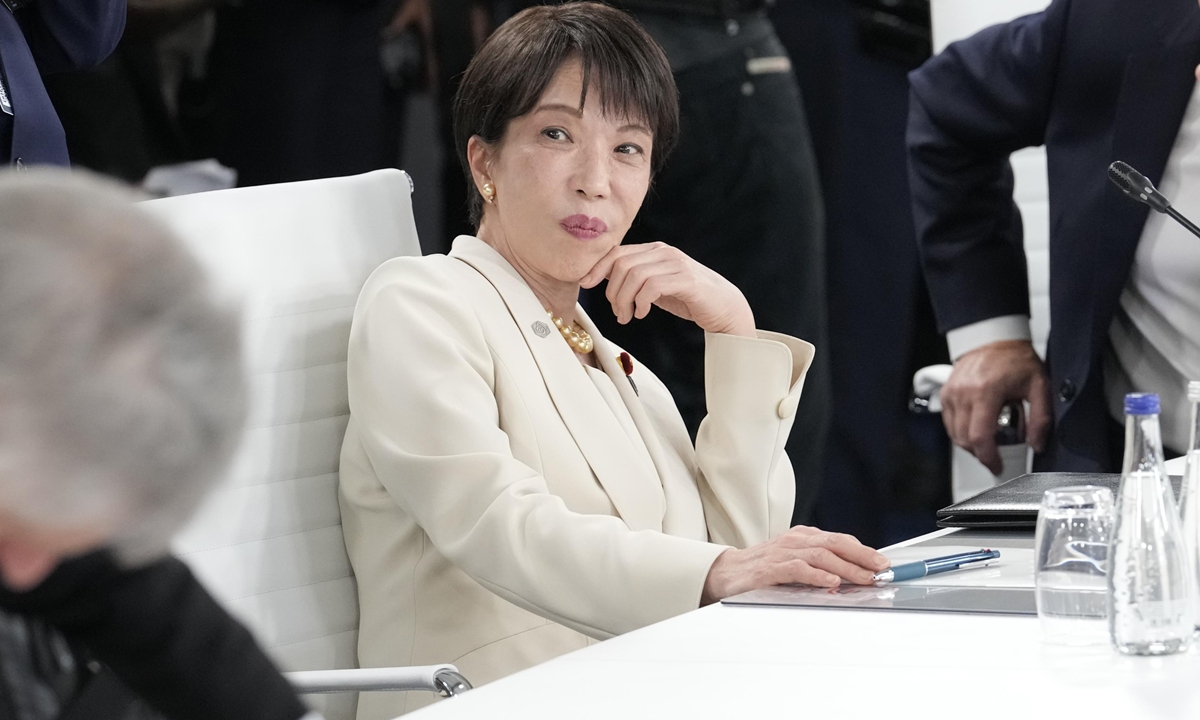
Japanese Prime Minister Sanae Takaichi attends a working session at the Group of Seven summit in Evian-les-Bains, France, on June 16, 2026. Photo: VCG
Public approval rate for Japanese Prime Minister Sanae Takaichi's cabinet fell by 5.1 percentage points from the previous month to 54.3 percent in June, hitting the lowest level since she took office last October, a poll by Jiji Press showed.
Conducted from June 12 to 15 with 2000 people aged 18 or over nationwide, the June survey by the Japanese news outlet also suggested that the proportion of respondents who oppose the Takaichi cabinet rose by 2.5 percentage points to 22.2 percent, the highest since Takaichi took office.
In terms of the political parties, the ruling Liberal Democratic Party (LDP) maintained the top support rate at 22.8 percent, but the figure fell by 5.0 points from the previous month.
Besides Jiji Press, multiple Japanese media outlets have noted the downward trend in approval ratings for Takaichi's cabinet.
Earlier this month, an NHK poll released on June 8 shows that the approval rate for Takaichi cabinet dropped 1 percentage point from last month to 60 percent. The disapproval rate is 26 percent, up 3 percentage points.
A nationwide opinion poll carried out by the Mainichi Shimbun on May 23 and 24 put cabinet support at 50 percent, logging the third straight monthly decline.
"While Takaichi's top-line support levels remain robust, though, the nature of support for the prime minister is nevertheless changing," Katsuhiro Yoneshige, president of news venture JX Press Corp, wrote in an opinion piece for Nippon.com.
Citing surveys from political survey website Go2senkyo.com and the JX News Agency, the article noted that since Takaichi's inauguration, the level of enthusiasm for Takaichi's cabinet has dropped among the working-age generation (those in their twenties to fifties). In May, those who "strongly support" the government registered only 30 percent, down from 50 percent six months prior in this broad and critically important demographic.
The Jiji Press attributed the sliding approval figures to social media videos released by Takaichi's campaign that smeared rival candidates during electoral races, including last year's LDP leadership contest. There are some other Japanese media outlets attributed the decline in Takaichi's approval ratings in recent months to Japan's pervasive cost-of-living crunch and growing alarm over surging energy prices fueled by tensions across the Middle East.
Earlier this month, a Mainichi Shimbun survey found that the young age group, which once held high hopes for the Takaichi administration, has turned critical of her leadership.
While the Takaichi cabinet is mulling a consumption tax cut on food and beverages to tackle soaring prices, the measure has sparked worries that it may fail to deliver its intended effects. Even if rolled out as a temporary policy, critics fear it could become permanent and trigger deterioration in public finances, according to the Bloomberg Japan.
Lü Chao, a professor at the Liaoning Academy of Social Sciences, told the Global Times on Saturday that economic and livelihood concerns remain the core benchmark for Japanese voters to assess the performance of the Takaichi cabinet.
"Takaichi made sweeping campaign promises to improve public livelihood and address economic hardships, but she has largely failed to deliver the commitment," the expert pointed out. "Furthermore, her provocative policies toward China have inflicted substantial economic losses on Japan's business sector, fueling discontent among local industrial and commercial communities."
Takaichi's awkward showing on the diplomatic circuit has also drawn fierce backlash from Japanese citizens. On June 18, a clip capturing Takaichi being largely ignored by fellow world leaders ahead of an official G7 group photo went viral across X.
"Takaichi is isolated, barely able to hold a conversation with anyone. At one point, she even pretended people were talking to her when no one had approached her at all—utterly deranged behavior… All her multiple scandals have become widely known overseas… There is no way world leaders will treat her with genuine respect," commented Japanese netizen with account named Yuma Tsuhara.
Separately, citing France Inter, Japan's Nikkan Gendai reported on Friday that US President Donald Trump clashed with Takaichi during a working dinner at the recently concluded G7 Summit, prompting other world leaders to step in and mediate. The tense exchange erupted after Trump talked about a US strike on Iran and drew a direct parallel between the operation and Japan's attack on Pearl Harbor in 1941.
Ichiro Ozawa, a former member of Japan's House of Representatives, pinned a June 5 report from the Mainichi Shimbun to the top of his X timeline. The article noted approval ratings for the Takaichi cabinet had slipped below 50 percent among young voters for the first time.
His accompanying comment read: "Drive prices ever higher, let the population dwindle further, line pockets with unending illicit slush funds, wear away public morality little by little, dismantle this nation piece by piece, and ultimately lead it to collapse… This is precisely what supporting the LDP means. You are simply tightening the noose around your own neck… It is time people wake up."
According to Lü, while achieving negligible progress in economic recovery and public welfare improvement, the Takaichi cabinet has aggressively advanced far-right and neo-militarist agendas. "Such radical policies have not only exacerbated domestic social divisions and damaged Japan's international reputation, but also undermined the country's overall security environment."
RELATED ARTICLES