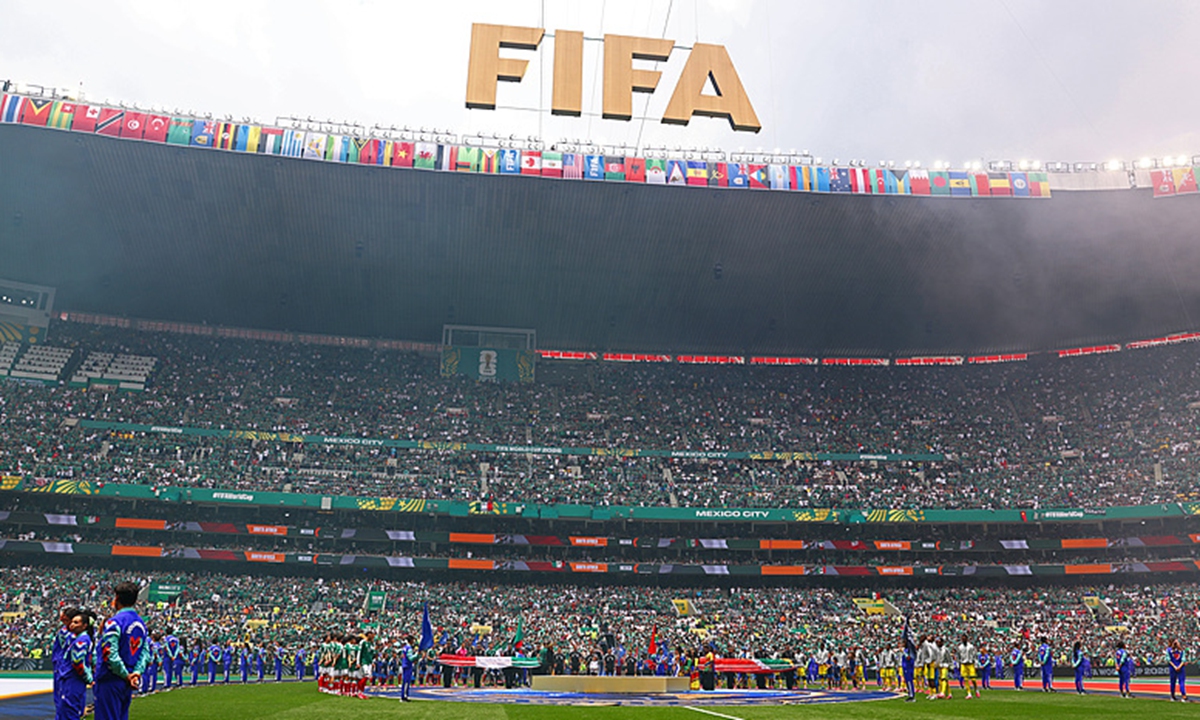
FIFA World Cup Photo: VCG
After returning from a business trip, Beijing office worker Yang found himself with an extra day off. It happened to coincide with Portugal's June 18 World Cup match against the Democratic Republic of the Congo. The 1 am Beijing-time kickoff meant a late night for Yang, but it was worth it, and more importantly, his idol Cristiano Ronaldo was set to take the field.
That same day, on the other side of the Pacific, Terry and Connie, a Chinese couple born in the 1990s, were in the stands of AT&T Stadium in Arlington, Texas, cheering on England striker Harry Kane. They traveled to every World Cup host nation, and for this tournament, their flights and hotels had been booked a full year in advance.
Both mega-events are watched by billions worldwide. But while the Olympics now struggles to find any country willing to take it on, the World Cup is fought over by nations desperate for the chance to host it. That contrast raises an obvious question: What explains such a stark financial gap between the two?
To answer that question, it helps first understand how the tournament's finances actually work — and where host countries fit into the equation.
FIFA releases financial reports on a four-year cycle. Taking the 2019-22 cycle for Qatar World Cup as example, FIFA generated total revenue of $7.568 billion, up 18 percent, or $1.147 billion, from the $6.421 billion recorded during the 2015-18 cycle. The largest share came from television broadcasting rights, which accounted for 45 percent of total revenue. Other major sources included marketing rights, licensing rights, hospitality rights, ticket sales and other income.
On the expenditure side, FIFA invested $6.302 billion during the cycle, including $5.266 billion in football-related activities and $1.036 billion in administrative and commercial operations.
Zhang Jiayuan, a partner at Beijing Ransen Huizhi Investment Fund Management Co, whose company has made football one of its investment focuses, told the Global Times that the World Cup's operating model can be summarized as: FIFA handles global branding and commercial monetization, while host cities cover event security and public services in exchange for spillover gains from tourism, city exposure and service-sector growth.
She noted that the biggest characteristic of the 2026 US-Canada-Mexico World Cup is that major international sporting events are clearly shifting from "infrastructure-driven" to "operations-driven." Since kickoff, match popularity, fans' cross-city movement, hotel and dining spending, and public viewing events have all confirmed the World Cup's boost to the service sector and urban consumption, said Zhang Jiayuan.
To assess the financial profile involved, the Olympics serve as a useful benchmark — as a mega-event that has repeatedly tested the limits of host nations' ambitions and budgets, its lessons are worth drawing on.
According to The Guardian, World Cup revenue trailed that of the Olympics until before the 2010 South Africa World Cup. FIFA's latest financial report shows the world governing body will earn $13 billion from the four-year cycle culminating in this summer's tournament. By comparison, the 2024 Paris Olympics generated 4.48 billion euros ($5.24 billion) in revenue.
Another report by The Guardian said that several venues built for the 2004 Athens Olympics remain abandoned and have become symbols of "white elephant" projects. Following the 2016 Rio Olympics, numerous venues in Rio de Janeiro fell into disrepair. Even in developed countries, post-Games operations can be challenging: E20 Stadium LLP, the operator of London's Olympic Stadium, recorded a loss of 20.9 million pounds in the fiscal year ending May 2024. Some smaller venues from the Sydney Olympics, however, continue to operate normally.
Zhang Qing, founder of a Beijing-based sport consultancy Key-Solution, told the Global Times that the Olympics, as a comprehensive multi-sport event, are far more difficult and demanding to host than the World Cup. One key reason is the diversity of events and venue requirements: The Olympics encompass aquatic sports, winter sports and a wide range of indoor and outdoor competitions, placing enormous demands on host cities in terms of venue quantity, specifications and standards, said Zhang Qing.
In a 2020 paper, Bent Flyvbjerg, a scholar from University of Oxford, quantified the pattern: Since 1960, every Olympic Games has exceeded its budget, with actual costs averaging 172 percent above initial estimates in real terms.
The World Cup, by contrast, presents a more manageable financial profile, said Li Hai, dean of the School of Economics and Management of Shanghai University of Sport, noting that the tournament involves only a single sport, making venue construction and supporting infrastructure comparatively simple. Crucially, FIFA itself bears a considerable share of organization and operating costs. Direct operational spending on the 2026 World Cup will reach approximately $3.756 billion — a record that Li said helps ease the fiscal burden on host countries to an extent.
"The US, Canada and Mexico already have mature stadiums, airports, hotels and urban services, so new fixed-asset investment has dropped significantly." Zhang Jiayuan added.
He Wenyi, secretary of the Peking University National Sports Industry Research Foundation, added that football fans possess strong spending power and highly concentrated interest in the tournament, allowing sponsorship investments to be more targeted and broadcasters to have greater willingness to pay. Advertising, media rights and commercial partnerships are generally easier to monetize at a single-sport event than across the sprawling portfolio of an Olympics, He said.
Then came the final whistle. Portugal and the Democratic Republic of the Congo finished level at 1-1. Thousands of miles away in Beijing, Yang turned off the television, quietly disappointed, because Ronaldo had hinted this could be his final World Cup.
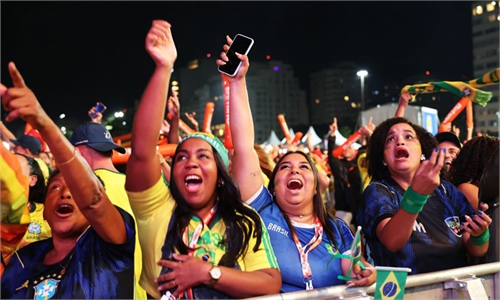
Meanwhile, in Texas, Harry Kane scored twice as England cruised to victory — to the delight of Terry and Connie, who joined the slow, jubilant stream of supporters filing out of the stadium and made their way back to their hotel through the night, already talking about the next match.
This is the demand FIFA's business model is built on: Viewers like Yang, who stay up past midnight just to watch 90 minutes unfold on a screen, and fans like Terry and Connie, who fly across an ocean and book hotels a year in advance. One fuels broadcasting rights, the other fills stadiums and hotel rooms — together, they're the kind of certainty no Olympic host can promise.
RELATED ARTICLES