Intl travelers immerse in Dragon Boat Festival traditions, gaining deeper appreciation of Chinese culture
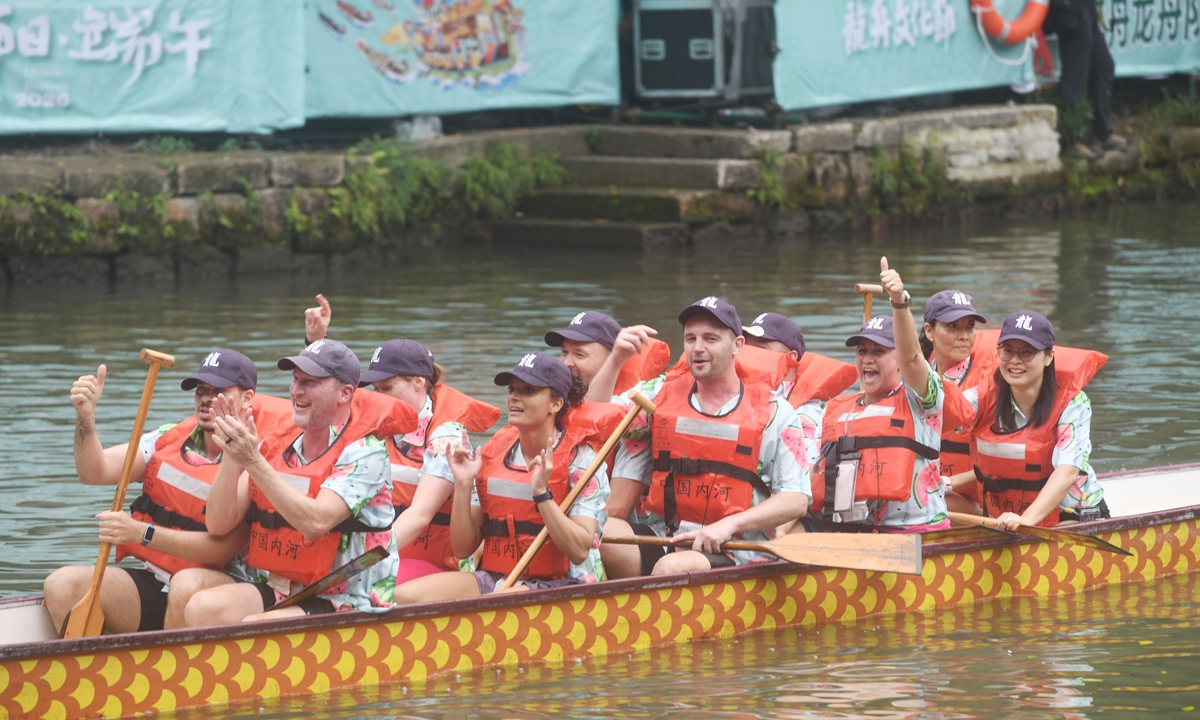
Foreign participants compete in the 2026 Xixi International Dragon Boat Race at the Xixi National Wetland Park in Hangzhou, East China's Zhejiang Province, on June 19, 2026, the Dragon Boat Festival. Photo: VCG
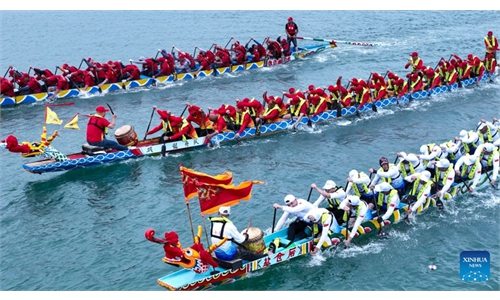
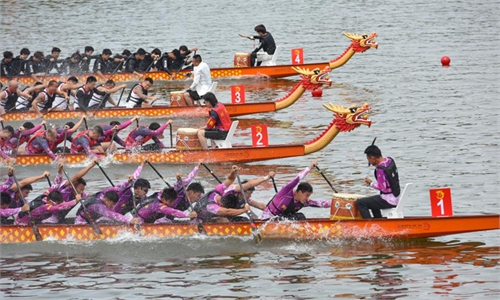
From joining dragon boat race to making the sticky zongzi, a traditional Chinese food made of glutinous rice wrapped in bamboo leaves, international tourists across China joined local residents in celebrating the Dragon Boat Festival in 2026, offering a glimpse into how centuries-old traditions continue to resonate with people from around the world today.
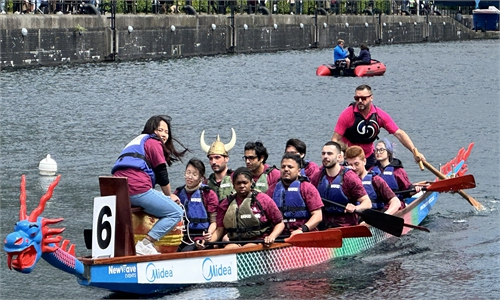
In Foshan, South China's Guangdong Province, a dragon boat drifting course famous for its sharp turns and high degree of difficulty not only attracted domestic visitors but also welcomed its first overseas team.
According to CCTV News, the captain of New Zealand's Four Seasons Dragon Boat Team said his knees and calves were sore after the race, "but it actually felt pretty good." "We're getting better and better. This is something very unusual for us, and it's amazing. We really love it," he said.
The excitement was shared by many other overseas visitors who found themselves drawn to both the festive atmosphere and the local culture for Dragon Boat Festival, which falls on June 19 this year, with the holidays spanning until Sunday.
A British tourist who has visited China multiple times, said the country's diverse festivals have become one of the main reasons he keeps returning. He noted that China has a rich culinary culture and a wide variety of festivals, each with its own characteristics. Especially in southern China, Guangdong is a very special place with a profound history and a very open environment.
Another international dragon boat tournament held in Guangzhou, capital city of Guangdong, brought together more than 3,800 athletes from 105 teams representing 20 countries and regions to compete on the Pearl River.
According to chinanews.com, by the end of Saturday, the Guangzhou Baiyun border inspection station processed more than 20,000 inbound foreign travelers during the holiday period, a 35 percent increase year-on-year. The top three source countries were Malaysia, Singapore and Russia. Among them, around 9,700 eligible foreign travelers entered Guangzhou through visa-free and transit visa exemption policies.
AP News also reported on the enthusiasm surrounding the festival, noting that "the more than 2,000-year-old holiday is best known for its sporting events, but its origins are rooted in ancient beliefs about health, protection and harmony with nature."
While AP focused on the festival's history and cultural significance in the long-form report, CNN focused on a more futuristic scene: humanoid robots joining dragon boat races in China.
The coverage prompted discussions among overseas audiences. "You touch on something that most in the West are only marginally aware of. There were once scores of cultural groups in China, each with their own traditions and unique culture," a netizen using the name JackO wrote in the comments section of the AP's report.
Beyond headline-grabbing dragon boat races, many foreign visitors encountered Chinese traditions in more intimate and unexpected ways.
Finn, a tourist from the Netherlands, experienced this firsthand while traveling in Dali, Southwest China's Yunnan Province during the holidays. He unexpectedly came across a Dragon Boat Festival activity at a local museum, where visitors could wear traditional Chinese attire and make five-colored bracelets.
Traditionally woven from blue, red, white, black and yellow threads, the bracelets symbolize praying for good fortune and wishing for peace and good health, making them one of the festival's iconic cultural symbols.
"At first, I wasn't sure whether the bracelet had some kind of religious meaning because many local people wearing them were dressed in traditional Chinese clothing," Finn told the Global Times.
"Later, local residents warmly placed the bracelet on my wrist and offered me their blessings. That's when I learned it was related to the festival and represented wishes for peace and safety," he said.
For US tourist Omar, meanwhile, what stood out most was not a particular activity, but the sense of continuity he observed across different cities.
"In my country, people from different religious backgrounds celebrate different festivals in different ways. But in recent days, I visited Southwest China's Chengdu, Shanghai and Beijing, and I found that people everywhere eat zongzi for the holidays. It seems to have become a shared custom," Omar told the Global Times.
He said he was also surprised by the affordability of food in China, which, in his view, helps make it easier for traditional customs to be preserved and passed down through generations.
"People are incredibly warm and friendly. In Beijing, I saw someone sitting on a bench by the roadside eating zongzi. I was simply curious, and they ended up giving me an entire bag," he said.
RELATED ARTICLES