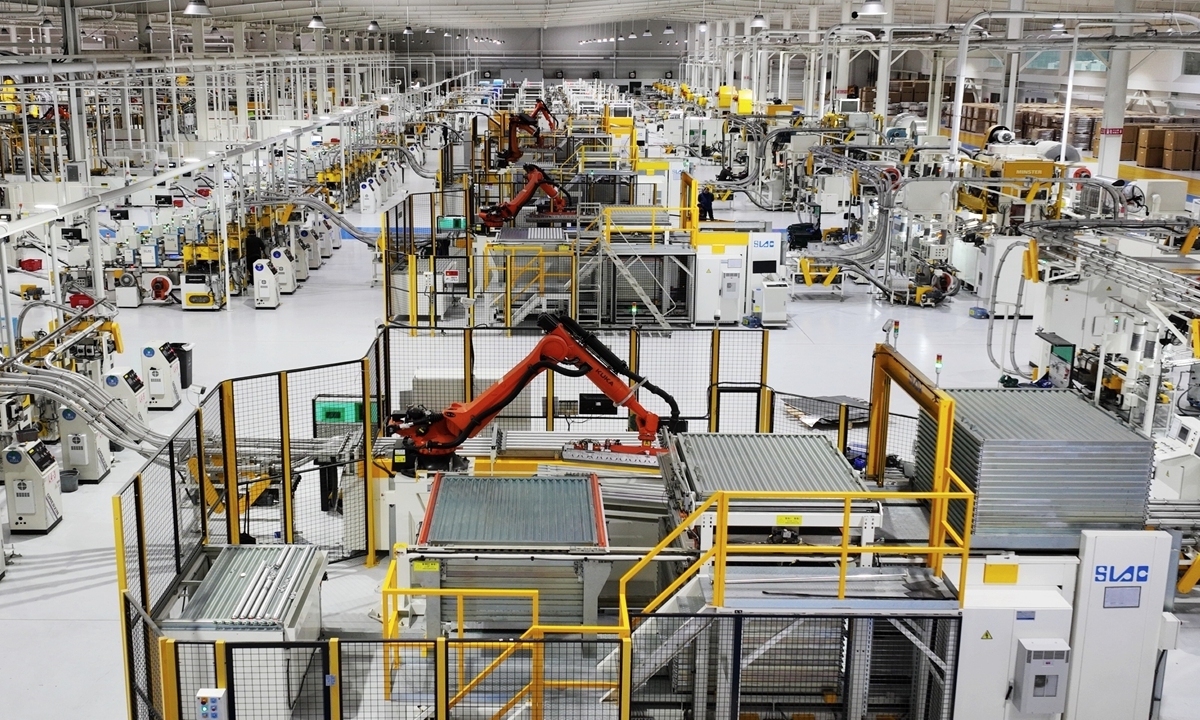
Industrial robots are operating on an intelligent production line in a smart manufacturing enterprise in Yangzhou, East China's Jiangsu Province. Photo: VCG
Since China's ZXMOTO secured multiple wins on the racetrack, the Chinese motorcycle industry has gained widespread attention over its rapid global expansion. According to the China Chamber of Commerce for Motorcycle, China's motorcycle exports to Europe reached about $1.68 billion last year, up 38.72 percent year-on-year, the Xinhua News Agency reported on Saturday.That growth is striking not because of its sheer size, but because of where it was achieved. Europe boasts a storied motorcycle industry, governed by stringent safety, environmental, and efficiency standards. Renowned local brands have deep roots, and European consumers demand high levels of performance and craftsmanship. For Chinese motorcycles to gain a foothold in such a market is more than just a shift in market trend - it is a microcosm of the growing global recognition of "Made in China" as a technologically competitive force.
Yet, as Chinese-made products gain global traction through technological innovation, some Western media outlets and politicians continue to view the rise of China's manufacturing sector through the lens of prejudice. They often label Chinese exports as "unfair competition" or "overcapacity," baselessly claiming that any success of Chinese manufacturing must stem from non-market factors. This biased judgment is essentially a blend of protectionist thinking and a deep-seated reluctance to accept that a former technological follower can now demonstrate systemic innovative capacity and compete on equal footing across an ever-expanding range of industries.
The reality is that China's export structure has undergone profound change. The share of high-value-added products has been rising steadily, a direct outcome of booming domestic innovation and continuous industrial upgrading. In the first five months of this year, China's exports of mechanical and electrical products rose by 18.4 percent year-on-year, accounting for more than 60 percent of total exports, according to the National Bureau of Statistics.
From Chinese new-energy vehicles spreading overseas, to photovoltaic and wind-power equipment supporting the green transitions of various nations, to industrial robots empowering manufacturing upgrades - Chinese products spanning the globe all testify to the same truth: Chinese manufacturing now competes on unique technological solutions, well-integrated industrial chains, and the ability to precisely address local needs. This is the export profile of a country competing on innovation.
The foundation of this competitiveness lies in sustained research and development (R&D) investment and a large-scale pool of technical talent. China's R&D intensity - measured as R&D spending as a share of GDP - reached 2.8 percent in 2025, exceeding the average level of OECD countries for the first time. In the first five months of the year, the number of invention patents granted rose 12.1 percent year-on-year to 372,000, according to a report on people.cn.
More importantly, Chinese manufacturing innovation is not self-entertainment in the laboratory, but applied innovation directly targeting market needs. This kind of innovation is characterized by a relentless pursuit of product performance in real-world scenarios. This is the most underestimated advantage of Chinese manufacturing: the huge domestic market provides enough opportunities for trial and error, the fierce competitive environment forces companies to continuously change and adapt, and the complete supply chain system allows innovation to land quickly.
The innovation strength of Chinese manufacturing has been verified not only in the European and American markets, but also across the globe. In Southeast Asia, Chinese electric vehicles are redefining regional mobility experiences through smart features and cost-effectiveness. In the Middle East and Latin America, Chinese photovoltaic and energy-storage products are gaining strong demand by effectively addressing energy-transition challenges. And in Africa, Chinese communications equipment and digital infrastructure are helping to leapfrog traditional development stages. What these diverse markets share is a common feature: Chinese products respond to genuine needs with tangible technological solutions.
The global expansion of Chinese manufacturing is a continuous process where innovation capabilities are tested by global markets. Every market breakthrough overseas represents a precise match between technologies and real demand. When industrial upgrading reaches a certain threshold, market doors open on their own.
RELATED ARTICLES