ARTS / CULTURE & LEISURE
Ancient horse skull found in E.China sheds light on Yue State rituals
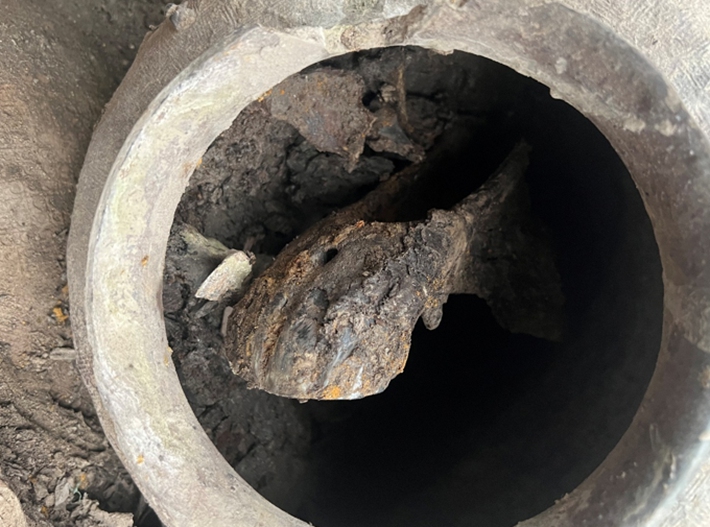
Ancient horse skull discovered in Shaoxing, East China's Zhejiang Province Photo: Courtesy of Luo Peng
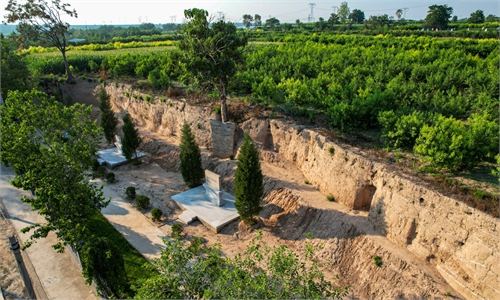
Archaeologists in eastern China have uncovered a horse skull sealed inside a pottery vessel at a local ancient ritual site. This is key evidence of high-level state sacrificial practices in the Yue State about 2,500 years ago, according to the Shaoxing Institute of Cultural Relics and Archaeology.The horse skull was found during excavations at the Tashan and Changfang site in Shaoxing, East China's Zhejiang Province.
According to Luo Peng, deputy director of the Shaoxing Institute of Cultural Relics and Archaeology, the Yue State (2032BC-222BC) was an ancient kingdom centered in present-day Shaoxing.
The unearthed horse skull is relatively well preserved, with a measured length of nearly 30 centimeters. It is notably large, with clearly discernible dental features.
"A horse was an extremely valuable strategic resource in southern China before the Qin Dynasty (221BC-206BC)," said Mao Linlin, an archaeologist with the institute. "The placement of an entire horse head inside a pottery vessel as an offering reflects the exceptionally high status of the ritual."
Previously, horse bones unearthed from the Yue State had typically been found placed individually in sacrificial ditches or ritual pits. The discovery of horse remains sealed inside a pottery vessel marks the first find of its kind at the ritual complex, offering clear evidence of the Yue State's distinctive system of animal sacrifice and ceremonial practices, noted Mao.
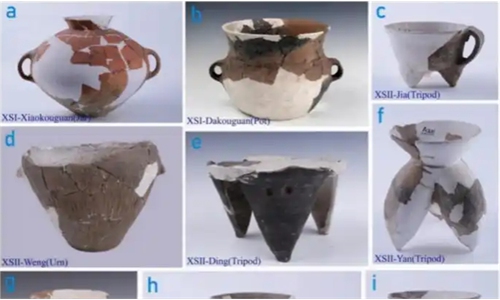
Since excavations began in 2024, archaeologists have uncovered a roughly 2,100-square-meter high-ranking ritual complex dating to the Eastern Zhou Dynasty (770BC-256BC). Considered the largest and highest-ranking ritual area yet discovered in the core area of the ancient Yue capital, the site has yielded more than 100 orderly arranged pottery vessels, according to the institute.
Historical records revealed that Tashan was a ceremonial center where Goujian, King of Yue, once conducted state rituals and divination ceremonies.
"The Yue State regarded ritual sacrifice as one of the most important affairs of the state, making it a central component of state governance," Luo told the Global Times.
The burial process itself also appears highly elaborate. Large stones had been placed at the bottom of the pit to support the pottery vessels. After offerings were deposited, the vessels were covered with extensive woven materials resembling bamboo mats before being sealed underground.
"The multiple layers of preparation and the sealed burial method indicate that the ceremony was conducted with extraordinary formality and prestige," said Luo.
Archaeologists are continuing to excavate ritual pits and recover artifacts at the site. More than 30 pits have been identified, arranged in two orderly rows running north to south. Nearly half have been excavated.
The pit containing the horse skull lies near the center of the site and is regarded as the most significant discovered so far. It has yielded five impressed hard-pottery vessels, the highest number recovered from a single pit so far.
In addition to the horse skull, archaeologists found deer bones, fish remains, grains and fruit remains inside pottery vessels from the same pit, further corroborating evidence from previously discovered ritual deposits at the site.
"The discovery further enriches our understanding of the site and, together with the nearby Jizhong site, provides important evidence for the study of the ancient Yue capital," Luo said.
Researchers plan to reconstruct the horse skull and determine the animal's age through dental analysis. Plant remains and soil samples recovered from the pit and pottery vessels will also be tested to shed more light on the composition of ritual offerings and the Yue State's sacrificial practices, according to Luo.
RELATED ARTICLES