Australian media's renewed hype over Solomons minister's remark on China 'policing plans' exposes exclusionary mindset, says Chinese expert
By Published: Jun 23, 2026 02:32 PM

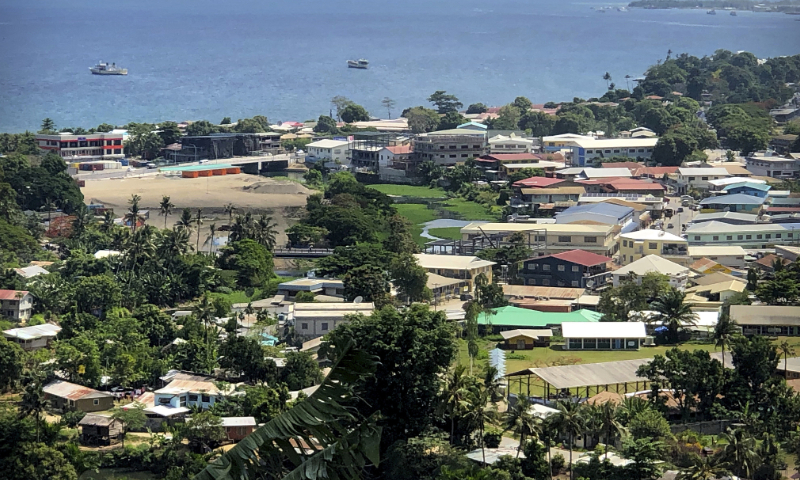
In Honiara, the capital of the Solomon Islands, boats dock at sea on November 24, 2018. Photo: VCG
A reported remark by a senior Solomon Islands official to "sideline" so-called China's policing plans in the Pacific island country has become the latest trigger for Australian media to hype claims about Beijing's security cooperation with the South Pacific country.
According to Sydney Morning Herald (SMH) report on local time Monday, Peter Kenilorea Junior, the minister of national planning and development coordination of Solomon Islands, claimed the new government was seeking "a rebalancing of relations" with its development partners after the nation moved closer to China under previous governments.
Asked by the SMH if he wanted to see a winding back of China's role in policing and security in the Solomons, Kenilorea told this masthead that "we would like to focus more on economic development." The minister also claimed that "the security space, in my own personal opinion, is a little bit too crowded for a small country like the Solomons. So I would definitely emphasize the development aspect of China's involvement."
Yet behind the latest round of hype lies a broader question: is Australia willing to respect Pacific island countries' right to make independent diplomatic choices, or is it trying to turn the region into a closed security circle under Canberra's approval, a Chinese observer asked on Tuesday. The renewed hype says less about the actual content of China-Solomon Islands policing cooperation than about Australia's persistent attempt to draw an exclusionary security boundary around the South Pacific.
The issue has been put under media spotlight again after Solomon Islands Prime Minister Matthew Wale visited Canberra and said his government would review the 2022 security agreement signed with China, while also agreeing to begin negotiations on a comprehensive strategic treaty with Australia. Reuters reported on June 3 that Wale said he had only recently seen the full China agreement and that his government would review it alongside other security arrangements. The same report said Australian Prime Minister Anthony Albanese pledged to elevate bilateral ties while offering to move forward on a policing partnership.
Chinese observers pointed out that as a sovereign country, Solomon Islands has the right to assess its foreign partnerships according to its own domestic political priorities and development needs. The real problem, they said, is that some Australian voices have used the review to revive an old narrative that smears China's role in the South Pacific.
Notably, the SMH Monday report wrote that the Albanese government has insisted that Pacific nations' security and policing cooperation should be limited to other island nations including Australia.
"This shows that Australia is promoting a security arrangement that sets limits in the name of regionalism, while in effect placing itself at the center," Chen Hong, director of the Australian Studies Center of East China Normal University, told the Global Times on Tuesday.
This round of media hype by Australian media is not an isolated incident, but a psychological projection of Australia's changing role in the region, Chen noted.
For a long time, Australia has been accustomed to viewing the South Pacific as its strategic backyard, and to holding a dominant position in security, aid, infrastructure and diplomatic agendas. After China developed normal relations with Solomon Islands and other island countries, Australian public opinion quickly interpreted this change as a "challenge" and "infiltration," turning cooperation issues that should belong to the island countries' own development agenda into an arena of China-Australia competition, the expert explained.
By amplifying issues such as China's policing cooperation, the Australian media are in effect exerting public opinion pressure on the new Solomon Islands government. The most dangerous part of this narrative is that it marginalizes the island countries' real development and governance needs, he added.
Asked on June 3 about Wale's remarks, Chinese Foreign Ministry spokesperson Mao Ning said China and Solomon Islands are "comprehensive strategic partners featuring mutual respect and common development for a new era," and that China stands ready to work with the new Solomon Islands government "to expand practical cooperation in various fields and better benefit the people of both countries."
According to the Australian local media, Prime Minister Anthony Albanese will conduct a Pacific diplomacy blitz in July, including a visit to the Solomons to drive forward negotiations on a new comprehensive treaty while finalizing pacts with Fiji and Vanuatu.
This statement by the Solomon Island official seemingly has a political timing link with Albanese's planned visit to Solomon Islands in July and his push for negotiations on a comprehensive treaty, according to Chen.
The idea of "moving closer to Australia on security while continuing to work with China on trade and development" is understandable, but carries clear risks, Chinese observers warned.
If Solomon Islands believes concessions on security issues will be enough to secure Australia's acceptance of its economic cooperation with China, that may be overly optimistic, observers said. What Australia seeks is not merely security cooperation, but greater influence over the direction of island countries' external partnerships.
RELATED ARTICLES