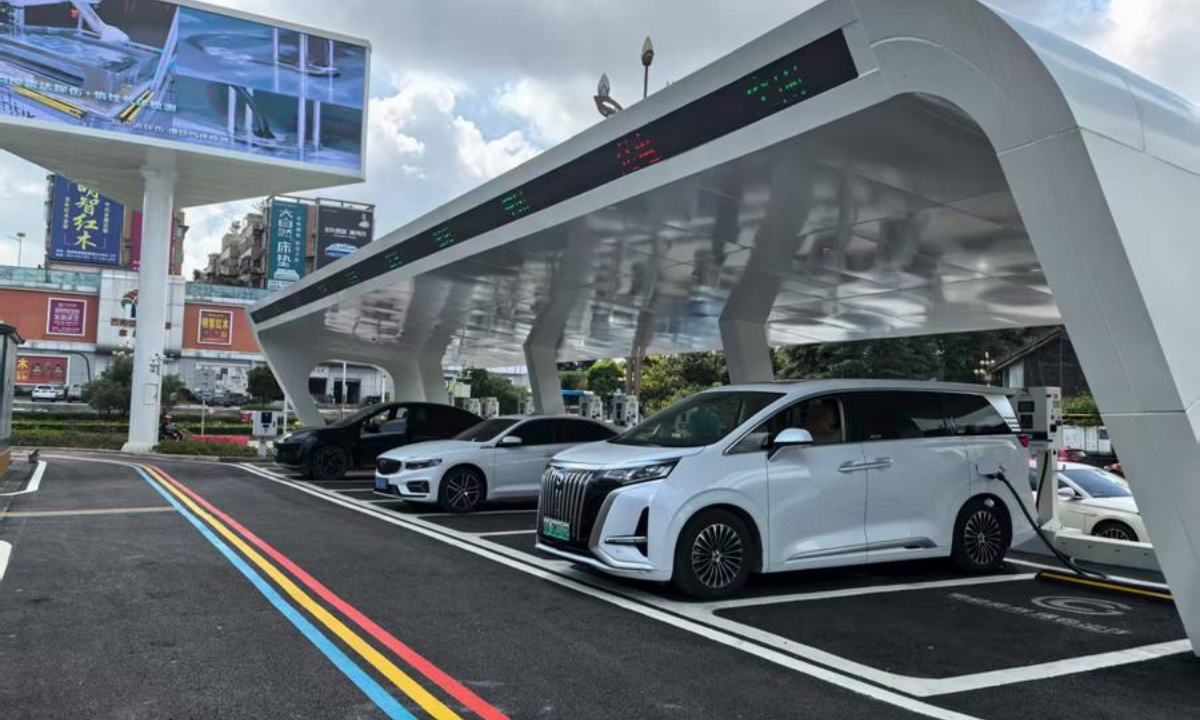
Electric vehicles are charged at the Quanhu Park station equipped with ultra-fast liquid-cooled chargers in Guiyang, southwest China's Guizhou Province, June 13, 2025. (Xinhua)
China unveiled a fresh package of policies on Tuesday aimed at expanding automobile consumption across the full industry chain and foster growth in the automotive after-market, as part of broader efforts to support high-quality development in the sector. Industry experts said pilot reforms are important measures to stimulate automobile consumption across the value chain, and to cultivate new growth drivers for the automobile industry.
The Ministry of Commerce (MOFCOM), together with seven other government departments, announced 40 pilot cities for the reform of automobile circulation and consumption, along with their respective priority reform areas, the Xinhua News Agency reported.
Local governments are being encouraged to play a leading role in key areas, including vehicle purchase and usage management, used-car circulation, end-of-life vehicle recycling, and aftermarket sectors such as auto modification, recreational vehicle (RV) camping, and car rental services.
The notice said that pilot cities should tailor reform measures to local industrial strengths, market conditions, resource endowments and geographic advantages, with a focus on removing bottlenecks and unreasonable restrictions in auto circulation and consumption, according to Xinhua.
Local authorities were also urged to strengthen support in land and funding, coordinate existing policy tools, and develop new consumption scenarios and business models that integrate commerce, tourism, culture, sports and the health sector, said the notice.
Several cities have already identified distinct focus areas. Tianjin Municipality will prioritize auto modification, classic cars and auto racing. Shenyang in Northeast China's Liaoning Province will focus on used-car circulation. Yangzhou in East Jiangsu Province will emphasize RV camping, while Weinan in Northwest Shaanxi Province will work on end-of-life vehicle recycling, according to Xinhua.
In a separate notice on the MOFCOM's website on Tuesday, nine government departments jointly issued a set of measures to foster and expand auto aftermarket consumption. The policy package targets six areas — auto modification, RV camping, classic cars, maintenance and insurance services, auto racing and car rental — and sets out 17 specific measures.
According to the ministry, these new measures are designed to remove unnecessary restrictions in the auto aftermarket, improve the supply of products and services, and cultivate new consumption formats and scenarios. The ministry said the package is intended to better meet consumer's diversified and multi-level demand for automobile-related services.
Going forward, the MOFCOM said it will work with relevant departments to implement the measures, coordinate with the pilot reform program, track policy outcomes, and resolve obstacles facing the sector. The ministry said the effort aims to expand the auto aftermarket, improve its structure and quality, and further unlock the potential of China's automobile market by connecting production, circulation, consumption and recycling across the entire chain.
"The consumer potential of the automotive aftermarket is currently enormous. Reforming automobile circulation and consumption is a key step in cultivating and expanding automotive aftermarket consumption and removing bottlenecks in the full automotive consumption chain. The two policies are complementary," said Wang Du, a vice president of the China Automobile Dealers Association, the Xinhua reported.
These initiatives are highly targeted and reflect clear regional characteristics. They are expected to be based on thorough research, aligned with local development plans, and backed by solid infrastructure, and could help drive local growth, better meet consumers' increasingly diverse and personalized needs, and deliver stronger policy results, Sun Xiaohong, secretary-general of the automotive branch of the China Chamber of Commerce for Import and Export of Machinery and Electronic Products, told the Global Times on Tuesday.
Against the backdrop of slowing domestic auto sales and a market shifting from "competition for incremental growth" to "competition for existing stock," the government's new measures are not merely aimed at triggering another round of car purchases. Instead, they represent a more precise response to new developments in the auto industry and consumer market, Sun said.
According to the China Passenger Car Association, retail passenger vehicle sales reached 1.51 million units in May, down 22.1 percent year-on-year although up 9.2 percent from April. So far this year, cumulative retail sales have reached 7.099 million units, down 19.5 percent year-on-year, the Securities Times reported.
Promoting the expansion of automobile consumption across the entire value chain is not only a practical measure to address the current slowdown in auto sales, but also an important step toward cultivating new growth drivers for the automobile industry and reshaping the value chain of the sector, according to Wu Shuocheng, a veteran automobile industry analyst.
According to Sun, Chinese consumers are no longer buying cars simply as a means of transportation. They are paying more attention to practicality, value for money, intelligence and whether a vehicle can meet their individual needs. Trade-ins, used-car circulation, auto customization, self-driving tours and camping trips have all emerged as new consumption scenarios, he said.
By shifting car consumption from a one-time purchase to sustained, circular and scenario-based consumption, these measures are expected to support the development of the auto sector, keep pace with changing consumption trends and spur growth in personalized customization, experiential tourism and other auto-related industries, Sun added.
China's automotive industry is moving in a healthy direction, Wu told the Global Times. The decline in the domestic market from January to May this year was mainly affected by a combination of factors, including the halving of tax incentives for new energy vehicles, fluctuations in oil prices, and adjustments to national and local subsidy policies. In the second half of the year, the market is expected to gradually return to normal, Wu said.
RELATED ARTICLES