Chinese travel insiders see further decline for travel willingness to Japan; resurgent militarism, safety risks, visa fee hikes erode Japan’s tourism attraction: Chinese experts
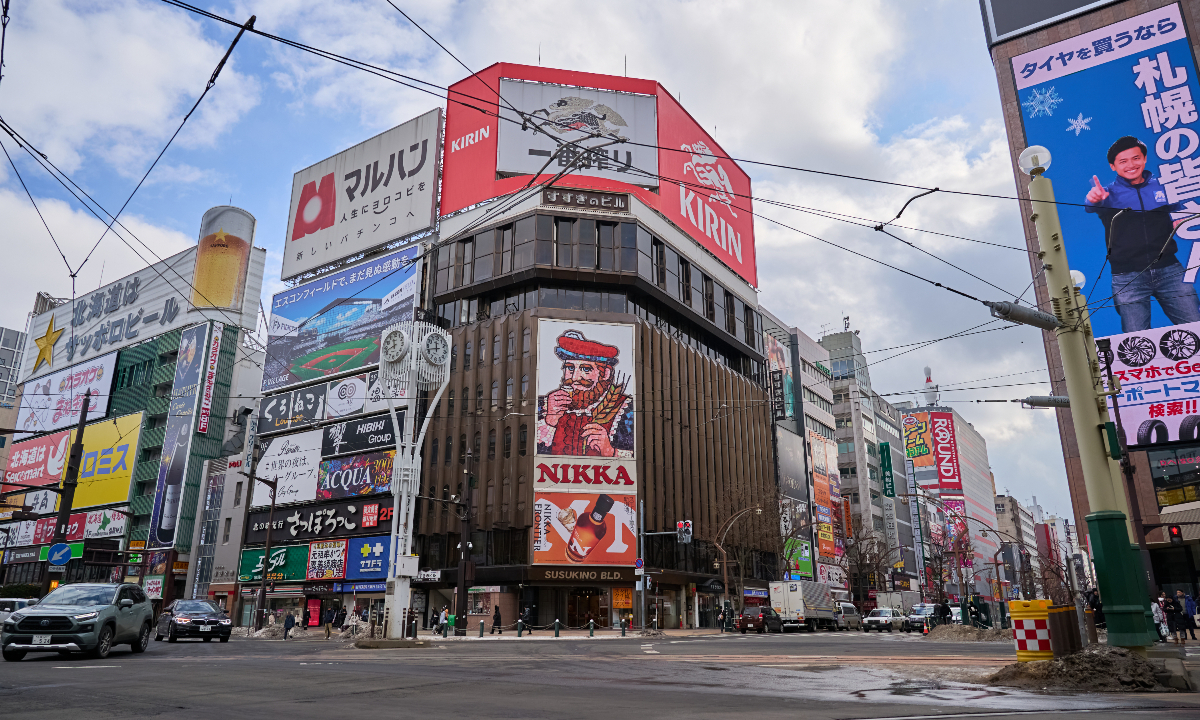
A commercial street in Sapporo city, Hokkaido, Japan Photo: VCG
Against the backdrop of cooled bilateral ties, travel insiders in China confirmed to the Global Times on Tuesday a further decline in both bookings and inquiries for trips to Japan, with Japanese media reports also citing government data showing six consecutive months of declining Chinese tourist arrivals.
The downward trend also comes as the government decided to raise visa fees for foreign nationals fivefold starting from July, according to media reports. Chinese experts stated that resurgent militarism in Japan has strained bilateral exchanges, while higher entry barriers risk further eroding its share of the regional tourism market, ultimately undermining Tokyo's own interests.
Japanese government data showed that the number of tourists from China fell for six consecutive months, plunging 60.4 percent over the year to 313,000, according to a previous report by Mainichi Shimbun in June. The report also noted that the number of foreign visitors to Japan in May fell 3.6 percent from a year earlier to 3.56 million due to a drop in travelers from China.
Since Japanese Prime Minister Sanae Takaichi made erroneous remarks on Taiwan, the number of Chinese mainland tourists traveling to Japan has continued to decline, putting pressure on Japan's retail, accommodation and catering sectors, the Xinhua News Agency reported.
A staff member from CYTS told the Global Times on Tuesday that the gradual drop began since late last year. Although its agency service for Japanese tourist visas remains in normal operation, inquiries in May were half the figure recorded in the same period last year.
Another industry insider, Xu Fengwei, a staff member from the marketing department of Tongcheng Travel, also told the Global Times on Tuesday that both bookings and inquiries for group tours to Japan have dropped markedly year-on-year, with weak demand for Japanese travel becoming a dominant trend among Chinese consumers.
Among tourists who previously enquired about trips to Japan, destinations including Thailand, Spain and Brazil have emerged as alternatives, Xu added. Flight bookings to Thailand surged over 30 percent year-on-year for the same period in May. Demand also saw substantial growth for long-haul hotspots including Central Asia, Brazil, Spain and Portugal.
The continued decline in Chinese tourist arrivals to Japan is primarily attributed to the current state of China-Japan relations, with strained bilateral ties sharply reducing travel demand from China. Domestic social instability in Japan has also weighed on visitor numbers, further undermining its appeal as a travel destination, Lü Chao, an expert at the Liaoning Academy of Social Sciences, told the Global Times.
In recent months, the Chinese Embassy in Japan has issued a series of safety advisories reminding Chinese nationals to safeguard personal security, citing multiple incidents where Chinese visitors suffered harassment or physical assaults.
The Chinese Embassy in Japan issued a statement on its official WeChat account in April, citing a series of recent incidents involving Chinese nationals. These include a case in which an active-duty member of Japan's Self-Defense Forces scaled a wall and broke into the Chinese embassy while carrying a knife, as well as reports of right-wing individuals harassing Chinese spectators at a marathon event. In addition, Chinese students were targeted in "bumping assault" on the streets in Tokyo, while a Hong Kong tourist was assaulted at a restaurant in Hokkaido.
The embassy noted that these cases reflect a growing presence of rampant right-wing activities in Japan, a noticeable increase in discriminatory incidents targeting Chinese nationals, and a continuously rising safety risk for Chinese citizens in Japan, Xinhua reported.
More broadly, resurgent militarism in Japan, along with provocative actions toward China, has contributed to a deterioration in bilateral people-to-people and economic exchanges, and the moves resulted in significant losses for Japan itself, Lü said.
The decline also coincided with a government decision to raise the fees for visas for foreign nationals by revising a related Cabinet order, according to the Japan Times on Saturday. The decision, made at a Cabinet meeting, marks the first revision of the visa fees in 48 years, since 1978.
The fee will be increased from the current 3,000 yen ($18.5) to 15,000 yen for a single-entry visa and from 6,000 yen to 30,000 yen for a multiple-entry visa. The new fees will apply to applications submitted on or after July 1, per the report.
Japanese Foreign Minister Motegi Toshimitsu told reporters that the current visa fees were reviewed in response to rising prices and changes in foreign exchange rates, according to the report by NHK.
Higher visa fees are likely to deter price-sensitive and short-stay visitors, with smaller regional cities and rural areas—those most reliant on inbound tourism—expected to be the first to feel the impact. These destinations risk losing a key source of visitors as a result of a short-sighted approach, Sun Shengnan, associate professor at Shanghai University of Political Science and Law, told the Global Times.
At the same time, in an increasingly competitive global tourism market, neighboring countries such as South Korea and Thailand are well positioned to absorb diverted demand, Sun said, adding that by raising barriers to entry, Japan risks ceding a significant share of the regional tourism market.
Sun added that this policy move by Japan's government may provide a short-term boost to government revenues, yet sacrifices the country's open international reputation and dynamism of regional industries in the process.
RELATED ARTICLES