Is China's growth in car exports due to stagnant domestic sales?: Global Times editorial
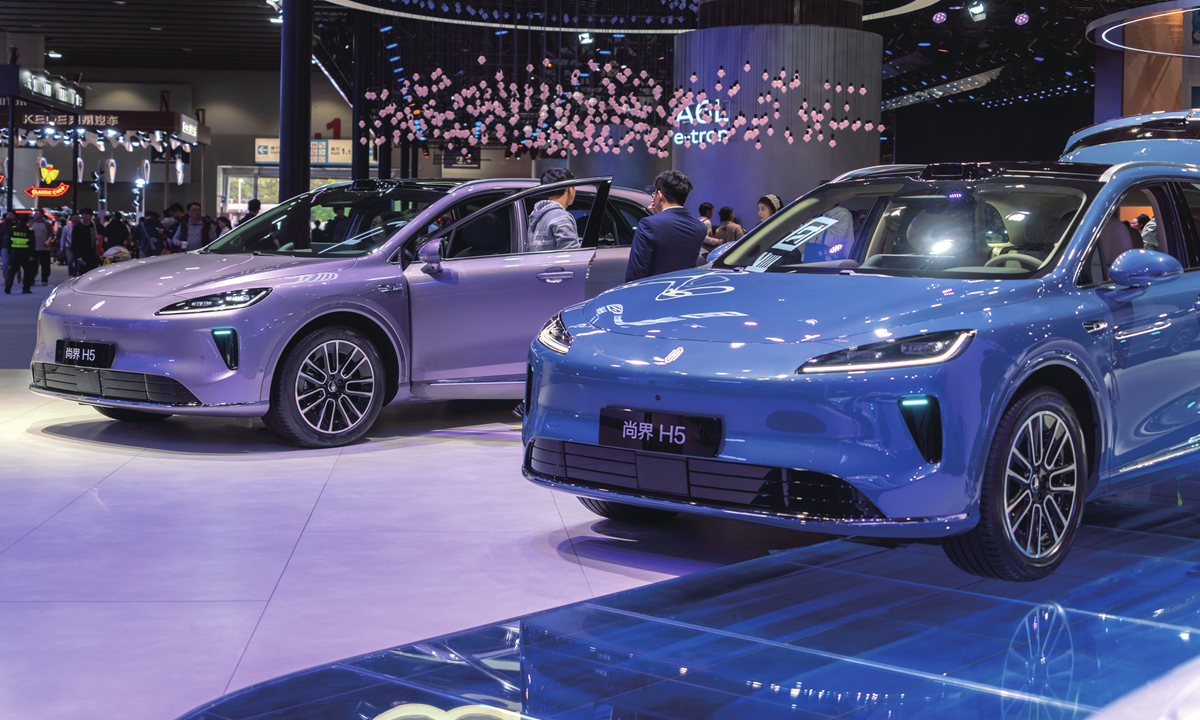
Shangjie, a brand jointly developed by SAIC Motor and Huawei, are showcased at the Guangzhou International Auto Show in South China's Guangdong Province, on November 28, 2025. Photo: VCG
Editor's Note:Currently, China's economy is steadily advancing along the path of high-quality development, even as domestic and international circumstances become increasingly complex. Some Western media, due to misunderstanding or bias, have repeatedly questioned or even distorted China's economic development. Accordingly, the Global Times launches the "Q&A on China's Economy" column to publish opinion pieces to present facts and clarify perceptions.
Recently, The Wall Street Journal (WSJ) published an article titled "Everyone loves Chinese cars, except the Chinese," which presents two seemingly contradictory phenomena: On one hand, the sales of latest Chinese vehicles are "surging almost everywhere the cars are available;" on the other hand, China's new-car sales "fell 22 percent in May compared with the same month a year earlier," putting pressure on automaker profits. The article concludes that "the troubles at home are pushing Chinese carmakers - including foreign brands that manufacture there - into an even more aggressive expansion overseas," and somewhat happily notes that the US is "among the few countries not experiencing an influx of Chinese cars," while "the rapid growth of Chinese vehicle exports has raised alarm bells and prompted moves to restrict trade" in other countries.
Is China's explosive growth in car exports really due to stagnant domestic sales, forcing a passive shift of "overcapacity" abroad?
If you take a close look at the data on China's passenger car market, it's not hard to see that this argument is actually cobbling together two incompatible sets of figures, trying to dress up the "overcapacity" smear as a credible story. Taking the May data released by the China Passenger Car Association as an example, in May, the core reason for the retail decline was the collapse of fuel vehicle sales, with fuel vehicles accounting for 37.1 percent of market share. However, the reduction compared to the previous year accounted for 82 percent of the total reduction in passenger vehicles. The primary cause of this change was the strong impact of the situation in the Middle East on oil prices, which significantly reduced demand for fuel vehicles. Meanwhile, the shift in consumption patterns is accelerating the process of "oil-to-electric conversion," with all top 10 best-selling models in May being new-energy vehicles (NEVs). Fuel vehicles even completely dropped out of the top 10 for the first time, and the retail penetration rate of NEVs hit a record 62.9 percent.
This development aligns with the global green transition. Geopolitical tensions in the Middle East, coupled with emission reduction pressures, have led to a surge in global demand for NEVs. Domestic automakers in many countries face supply shortages in electrification and intelligent features, and the high transformation costs, slow model updates, and difficulty in reducing prices make it challenging for traditional multinational car companies to keep pace. Against this backdrop, Chinese automakers, especially in the NEV sector, have formed systemic advantages in batteries, vehicle platforms, electronic and electrical architectures, and supply chain coordination. They are able to quickly deliver higher-spec, more reasonably priced, and lower-cost products. Ultra-high-voltage fast-charging at 800V, long-range capabilities, advanced intelligent driving, and large intelligent cabins are rare configurations at comparable prices overseas, naturally attracting global consumers. In May, China exported 446,000 NEVs, a year-on-year increase of 110 percent, accounting for nearly half of total passenger vehicle exports - a figure that comes as no surprise.
In other words, the two points in the WSJ article appear to be misleading. The decline in China's domestic passenger vehicle sales is primarily due to a drop in fuel vehicle sales, while the explosive growth in overseas sales is mainly driven by NEVs. The logic of "domestic decline leading to overseas surge" essentially demonizes China's competitiveness as a "China problem," distorting global demand into "Chinese dumping." In recent years, Chinese automakers have established factories, R&D and sales networks, and local partnerships in Europe, Southeast Asia, Latin America, and the Middle East, customizing products according to local regulations, roads, climate, charging infrastructure, and consumer habits. If they were simply shipping unsold domestic cars abroad, why would they make localized investments? And how can such a one-off deal allow Chinese NEVs to gain sustained recognition from overseas market regulators, distribution channels, and consumers?
Another question is: Do Chinese people really "not love Chinese cars"? Admittedly, data from January to May this year show that domestic sales of NEVs have experienced negative growth. This decline is mainly due to short-term policy impacts such as the reduction in subsidies for trade-ins and the cooling of price wars in the industry under the "anti-involution" drive. This process involves the government, under conditions of full market competition, guiding inefficient enterprises to exit the market, eliminating outdated production capacity, allowing advantageous enterprises to grow, and concentrating resources on advanced production capacity. It is the result of a combination of an effective market and a proactive government, and has nothing to do with so-called structural overcapacity. Statistics from the China Association of Automobile Manufacturers show that from January to May, sales of mini and compact NEVs both declined year-on-year, while other vehicle segments achieved positive growth. Among these, luxury NEVs led the sales growth across all categories, reflecting that market demand is gradually shifting from low-end transportation to mid-to-high-end quality travel.
In fact, since the beginning of the year, nearly 20 brands have collectively increased prices or actively cut discounts, with higher-end intelligent models seeing price hikes of over 20 percent. Some new entrants have begun to see profits, and the industry is shifting from "who can cut prices more" to "who can survive longer." Industry insiders admit that the original idea that "lower prices lead to higher sales" has been broken; now, higher-priced models account for a larger proportion of orders.
Therefore, the WSJ article, while seemingly analyzing according to the data, actually conflates China's cyclical domestic fluctuations, energy price shocks, and policy adjustments with its rising global competitiveness. China's auto industry chain is moving from "manufacturing advantages" toward "standards, brands, services, and ecological advantages" - a key part of the global industrial chain's reorganization under new demands, technologies, and rules. Countries can only expand markets, optimize division of labor, improve standards, and share innovation through open cooperation. This way, industry scale will continue to grow, product quality will steadily improve, and consumers will enjoy safer, smarter, and greener mobility at more reasonable prices.
RELATED ARTICLES