Morgan Stanley doubles China humanoid robot shipment forecast again, driven by scaling and commercial deployment: expert
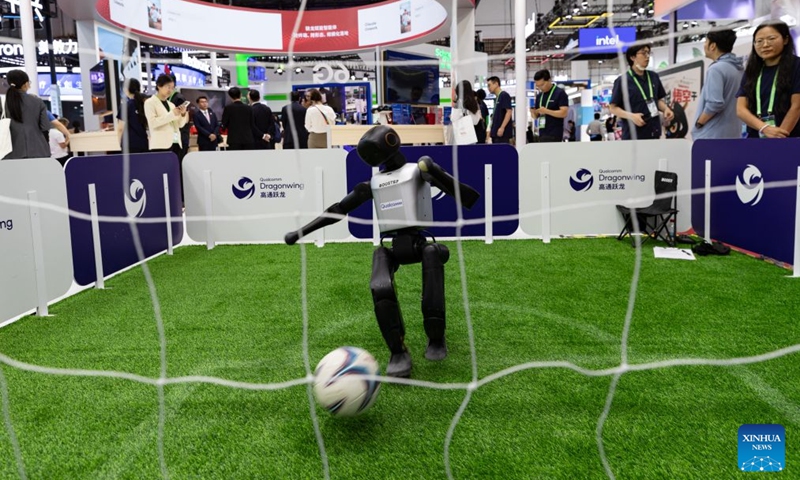
A robot plays football at the exhibition area of Digital Technology during the Fourth China International Supply Chain Expo (CISCE) in Beijing, capital of China, June 23, 2026. The fourth CISCE is held in Beijing from June 22 to 26. Launched in 2023, CISCE is the world's first national-level exhibition focused on supply chains. The fourth CISCE maintains its full-industry-chain perspective, featuring six major chains along with the Supply Chain Service Exhibition Area. The Digital Technology section also introduces a dedicated artificial intelligence zone for the first time. (Photo: Xinhua)
Morgan Stanley has sharply raised its outlook for China's humanoid robotics market, citing the industry's shift from demonstration to commercial deployment that has proved faster than expected, CNBC reported on Wednesday.
The Wall Street bank upgraded its forecast for China's humanoid robot shipments for a second time this year on Tuesday, expecting 50,000 units to ship this year, nearly double its previous projection of 28,000. The bank had already doubled its initial January forecast of 14,000 units, CNBC reported.
A Chinese expert said the upgrade reflects China's growing advantage in the global robotics value chain, driven by a complete industrial ecosystem, strong manufacturing capacity and rapid iteration from pilot applications to large-scale deployment. He noted that China's edge in industrial and service robot production, together with a deep supply base for key components, has helped lower costs and accelerate commercialization. At the same time, expanding overseas demand and competitive product performance are supporting the steady rise of China's robot exports.
Morgan Stanley estimated China's humanoid robot market will reach $2 billion this year and grow to $15 billion by 2030. Annual shipments are forecast to reach 446,000 units by then. The forecast includes only external sales, excluding those produced for prototypes, pre-order trials, or internal use, CNBC reported.
Wang Peng, an associate research fellow at the Beijing Academy of Social Sciences, told the Global Times that Morgan Stanley's repeated upward revisions of its humanoid robotics shipment forecasts reflect a broader recalibration by global investors on the industry's development trajectory, marking a shift in sentiment from initial caution to growing confidence in China's long-term competitiveness in this sector.
"Commercial verification, policy support, and supply-chain feedback point to faster humanoid adoption in China," Sheng Zhong, an equity analyst at Morgan Stanley, said in a note Tuesday, according to CNBC.
China has accelerated its push to dominate the industry, with a growing roster of domestic manufacturers racing to scale production and deploy robots in real-world settings such as factories, convenience stores and restaurants. Beijing has also made developing "embodied AI" — artificial intelligence embedded in physical systems such as robots — a priority for the coming five years, directing local governments to subsidize startups with land and office space while ordering banks to extend favorable lending terms, according to CNBC.
Wang noted that China's robotics industry is benefiting from the synergy between a complete manufacturing supply chain and supportive policy measures, which is accelerating the transition from technology demonstration to large-scale commercial deployment. The faster-than-expected rollout across industrial and service scenarios has created a reinforcing cycle of innovation, application, and supply chain maturity.
He added that the sector is also being shaped by a dual-circulation growth pattern, where domestic industrial upgrading provides abundant real-world application scenarios and data feedback to improve product performance, while rising external demand and cost advantages are helping Chinese robotics firms expand rapidly in global markets, making exports an increasingly important growth driver.
Chinese manufacturers have emerged as the dominant force in the humanoid robotics industry. According to data from Omdia, the top six brands by shipment volume in 2025 are all based in China, namely Agibot Robotics, Unitree Robotics, UBTECH Robotics, Leju Robotics, EngineAI Robotics, and Fourier Intelligence.
In recent years, China's exports of robots and related components have continued to accelerate. According to customs data, in the first quarter of 2026, China's robotics industry saw faster expansion in overseas markets. The total export value of separately listed robot products reached 11.32 billion yuan ($1.675 billion), with shipments going to 148 countries and regions worldwide.
Among different segments, cleaning robots stood out. As a newly added customs category this year, cleaning robots recorded export value of 7.75 billion yuan in the first quarter, accounting for 68.5 percent of total robot exports, making them the dominant driver of China's robot exports. During the same period, exports of industrial robots reached 3.16 billion yuan, up 42 percent year-on-year.
According to Shanghai Customs, in the first five months of this year, exports of separately listed robot products through Shanghai port reached 8.36 billion yuan. These products were shipped to 113 countries and regions worldwide, accounting for more than 40 percent of China's total robot exports.
A report by the National Data Administration on June 8 showed that China's industrial robot exports grew 48.7 percent in 2025 and, for the first time, surpassed imports, making the country a net exporter of industrial robots.
In 2025, China had more than 140 domestic complete-machine robot manufacturers, which launched over 330 humanoid robot models, said the report. Industrial robot output rose 28 percent year-on-year, while service robot production reached 18.581 million units, up 16.1 percent from a year earlier.
Meanwhile, there are around 1 million active and operating robot-related enterprises nationwide. By the end of 2025, the number of investment deals in embodied intelligence and robotics reached 744, with total financing amounting to 73.543 billion yuan.
RELATED ARTICLES