‘China First’ a clumsy linguistic transplant of Western self-projection
By Published: Jun 24, 2026 09:01 PM
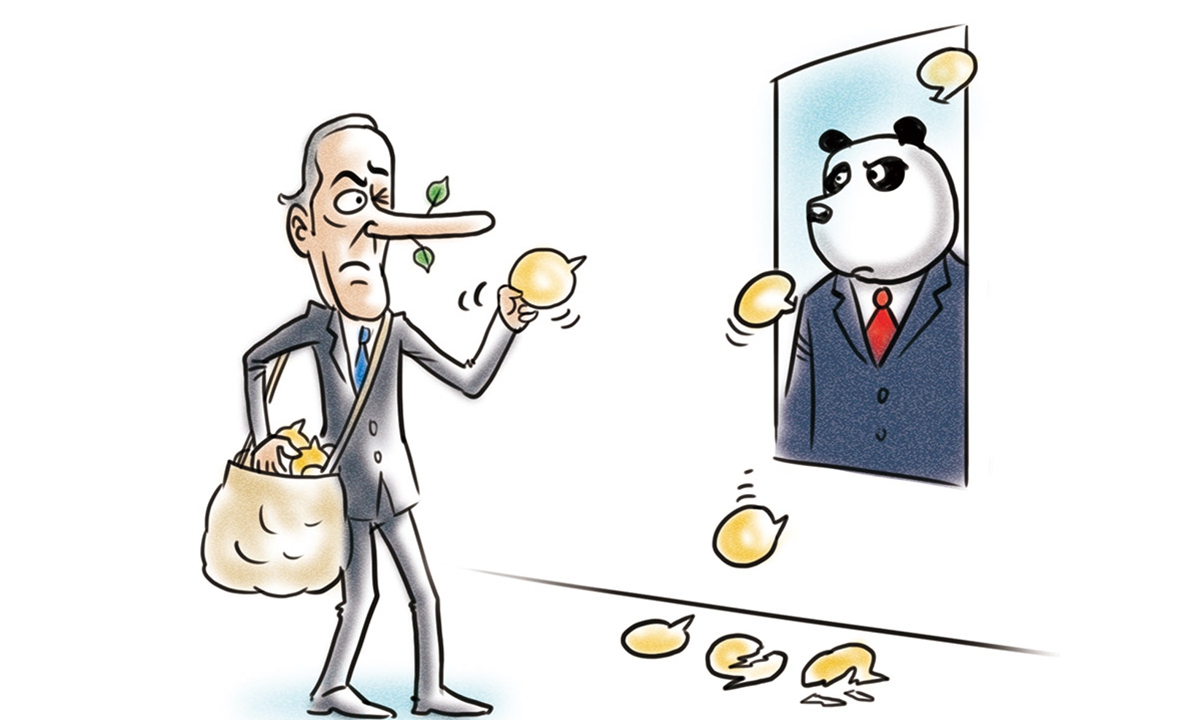
Western smear Illustration: Liu Rui/GT
Reading the latest issue of Foreign Affairs, I stumbled upon an article titled "Why 'China First' will fail: The limits and lessons of a transactional foreign policy." The headline immediately caught my eye. At first glance, it seemed as if a Western policy adviser had accidentally written "China" instead of "America." After all, the term "first" has been beaten to death by American leaders over the last decade. It has been used, abused, and recycled to the point of absolute political fatigue. It seems someone was desperate to find a new subject for it.The irony is that Beijing has never once uttered the phrase "China First." It has not demanded that its strategic partners pay protection money under the guise of "increasing defense spending." It does not habitually wield the big stick of unilateral sanctions, nor does it hold the global trading system hostage as a bargaining chip.
The title, therefore, feels like a clumsy linguistic transplant - taking a highly specific, homegrown American concept and forcing it onto an entity that operates on a completely different blueprint.
For years, the "America First" experiment has stumbled along, occasionally losing its footing entirely. Yet, instead of self-reflection, Western eyes have turned with renewed intensity toward China. Why?
People need an enemy when their own story crumbles. Blaming "them" replaces "we are the rules." "China First" becomes an easy, convenient narrative: observe a few actions, fit them to a framework, and the story shifts.
China's adherence to non-alliance, its UN-centered approach, and its restrained use of sanctions are labeled "evading responsibility," "foot-dragging" and "selective engagement." This paints China as a self-serving free rider, benefiting from the global community without contributing to stability.
China indeed refuses to entangle itself in foreign conflicts and actively avoids offering the rigid military alliance structures that define Western security. But are these choices truly an "evasion of duty," or do they stem from a fundamentally different philosophy of what "responsibility" actually means?
The crux of the debate is not whether one possesses a sense of responsibility, but rather: Who gets to define it?
Western thought views public security as a status quo enforced by force, while Beijing-backed thought prioritizes predictability and international law.
We have seen this play out repeatedly over the last few decades. Several high-profile interventions that bypassed UN protocols started with immense, decisive force. Yet, their long-term consequences proved devastatingly complex. The actions designed to "solve the problem" ended up manufacturing far worse ones.
This creates a deep divide. Pro-UN adherence sees avoiding power politics as not just necessary but essential; critics call it an excuse for inaction. Both parties observe the same actions but interpret them differently.
Reducing this deep-seated debate to a simplistic accusation of "a transactional foreign policy that maximizes self-interest at the expense of public safety" completely bypasses the most crucial intellectual question: How do we define public security in the first place? And who determines if that definition is universal?
If one standard is dogmatically assumed to be the sole objective truth, then any deviation from it is naturally viewed as a defect. However, if we acknowledge that there is a legitimate competition of ideas, the question shifts from a moral trial to a practical inquiry: Which model of responsibility is actually more sustainable?
"Why 'China First' will fail" reflects Western analytical bias, applying "America First" frameworks to Beijing. This stems from a reluctance to re-evaluate one's own problems. The core issue isn't morality, but differing views on global order: interventionism versus institutional restraint, immediate outcomes versus procedural integrity.
Until a consensus is reached, headlines such as "China First" will continue to appear in Western accusations against China. These accusations often carry an unconscious self-projection. Such individuals believe that only when China acts according to their vision of the world order is it correct. However, the reality is that the current turmoil and chaos in the world are closely linked to the Western perspective on interpreting the world.
The author is a senior editor with the People's Daily and currently a senior fellow with the Chongyang Institute for Financial Studies at Renmin University of China. dinggang@globaltimes.com.cn. Follow him on X @dinggangchina
RELATED ARTICLES