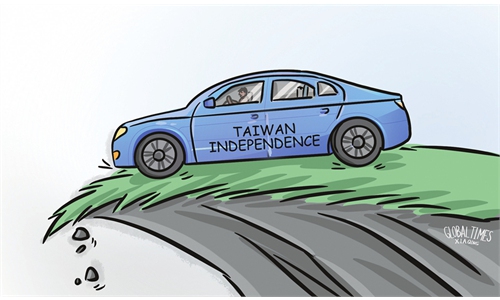
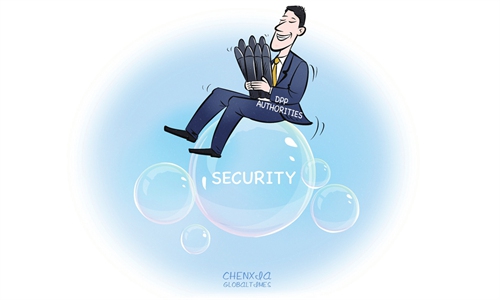
US claims its policy toward Taiwan region has not changed, but its attitude toward ‘Taiwan independence’ has
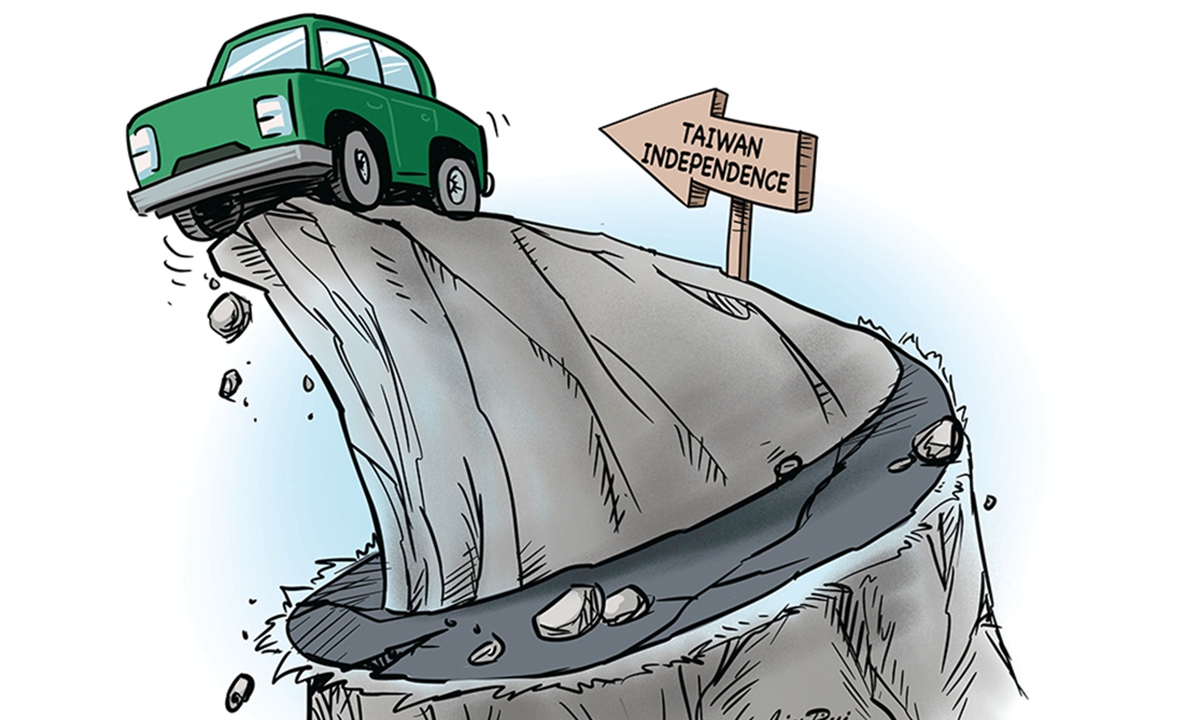
Illustration: Liu Rui/GT
Following the China-US leaders' meeting in Beijing, a noteworthy shift has emerged in Washington's remarks regarding the Taiwan question: While the US claims that the fundamental framework of its policy toward Taiwan island remains unchanged, its attitude and approach toward "Taiwan independence" separatist forces are undergoing a practical adjustment. Seeing this clearly can help avoid misinterpreting the US' "unchanged" policy as "support" for the Taiwan authorities, and avoid misreading the US' "change" as "turning over a new leaf."
Why US policy toward Taiwan island won't change in the short term?
During a Senate Foreign Relations Committee hearing on Tuesday, US Secretary of State Marco Rubio stated that there has been no change in US policy on Taiwan region and that the $14 billion arms sales to the island remains "under review." The facts are clear: The US will not abandon its "Taiwan card" in the short term, nor will it voluntarily relinquish its key strategic lever in the Western Pacific.
The reasons are not complicated. First, the US has long considered the Taiwan question as a crucial bargaining chip to contain China. For the US, maintaining arms sales to Taiwan region, preserving so-called "strategic ambiguity," and continuing to play the "security card" are all components of its "Indo-Pacific Strategy." Second, US domestic politics, the interests of its military-industrial complex, and its framework of competition with China collectively determine that Washington would not suddenly stop meddling in the Taiwan question. Third, even if US President Donald Trump places greater emphasis on strategic stability of China-US relations, it does not mean he has abandoned his transactional mindset. As he suggested, arms sales to the island constitute a "very good negotiating chip."
For these reasons, one cannot simply conclude that "the US has stopped playing the Taiwan card" from its recent statements. The basic skeleton of the US' policy toward Taiwan region remains: continued intervention, continued arms sales, continued strategic ambiguity, and continued use of the Taiwan question as part of Washington's overall China strategy. We must harbor no illusions or unwarranted optimism about this.
How has US attitude toward 'Taiwan independence' changed, and why has it changed?
What has truly changed is Washington's perception of and approach toward the risks posed by "Taiwan independence." This change can be clearly seen in remarks by Rubio, US Defense Secretary Pete Hegseth, and Trump himself. Behind this lies the changing times and circumstances of great power competition.
Rubio's emphasis on preserving "the status quo," coming after Trump explicitly stated he is not looking to see Taiwan region go independent, serves as a reaffirmation of Trump's remarks and implicitly contains an element of restraining reckless "Taiwan independence" moves. Hegseth's change in tone is even more noteworthy. At last year's Shangri-La Dialogue, he loudly proclaimed the "China threat theory," with the Taiwan question and South China Sea issues being his primary talking points. However, at this year's Shangri-La Dialogue, he noticeably moderated his tone, not only reducing Taiwan-related hypes, but also publicly affirming the outcomes of the China-US leaders' meeting and the significance of building a "constructive China-US relationship of strategic stability."
This indicates that under Trump's current policy, the US is more concerned about the Taiwan question getting out of control and undermining the hard-won atmosphere of strategic stability with China. In other words, on the Taiwan question, the US can no longer act solely on its own accord; it must take China's stance into consideration.
More importantly, the signal from Trump himself is even more direct: He does not want anyone to go "independent," nor will he fight a war for "Taiwan independence." The meaning is clear: The US will still exploit Taiwan region but does not want to be hijacked by "Taiwan independence"; it will still play the "Taiwan card" but does not want that card to drag it into a direct conflict with China. In other words, whereas in the past the US might have been more tolerant, acquiescent, and ambiguously exploitative toward "Taiwan independence," it is now beginning to increase elements for preventing rash actions, preventing loss of control, and preventing being hijacked.
How to view 'changes' and 'non-changes' in US' policy toward Taiwan region?
Ultimately, what remains "unchanged" is the US' fundamental objective of safeguarding its hegemonic interests, and what has "changed" is Washington's strategic focus and methods for achieving this goal. It is not about abandoning Taiwan region as a bargaining chip, but about adjusting how it uses it; it is not about stopping intervention, but about emphasizing risk management; it is not about adopting China's position, but about being increasingly unwilling to charge forward and bear the costs for "Taiwan independence" separatist forces.
This precisely illustrates that in the process of building a constructive China-US relationship of strategic stability, the Taiwan question is being re-evaluated within the broader context of China-US relations. The US is aware that competition with China can continue, but if provocations by "Taiwan independence" forces are allowed to continue unchecked, pushing the Taiwan question out of control, it could trigger a clash between China and the US, the costs of which would far outweigh the benefits. Therefore, for the US, while Taiwan region remains an important strategic chip, "Taiwan independence" is increasingly becoming a problem that could invite disaster. For China, the unchanged aspect of the basic framework of US policy toward Taiwan region warrants vigilance, but the changing aspect of its policy toward "Taiwan independence" is equally a new signal worthy of attention and leverage. As the Chinese saying goes, opportunities multiply as they are seized. There is still much we can do.
RELATED ARTICLES