Officials elaborate on Ethnic Unity and Progress Promotion Law, dismiss ‘assimilation’ allegations
Facts debunk Western smears on ethnic legislation; critics urged to visit China’s ethnic regions for facts
By , and Zhang Han Published: Jun 24, 2026 09:47 PM


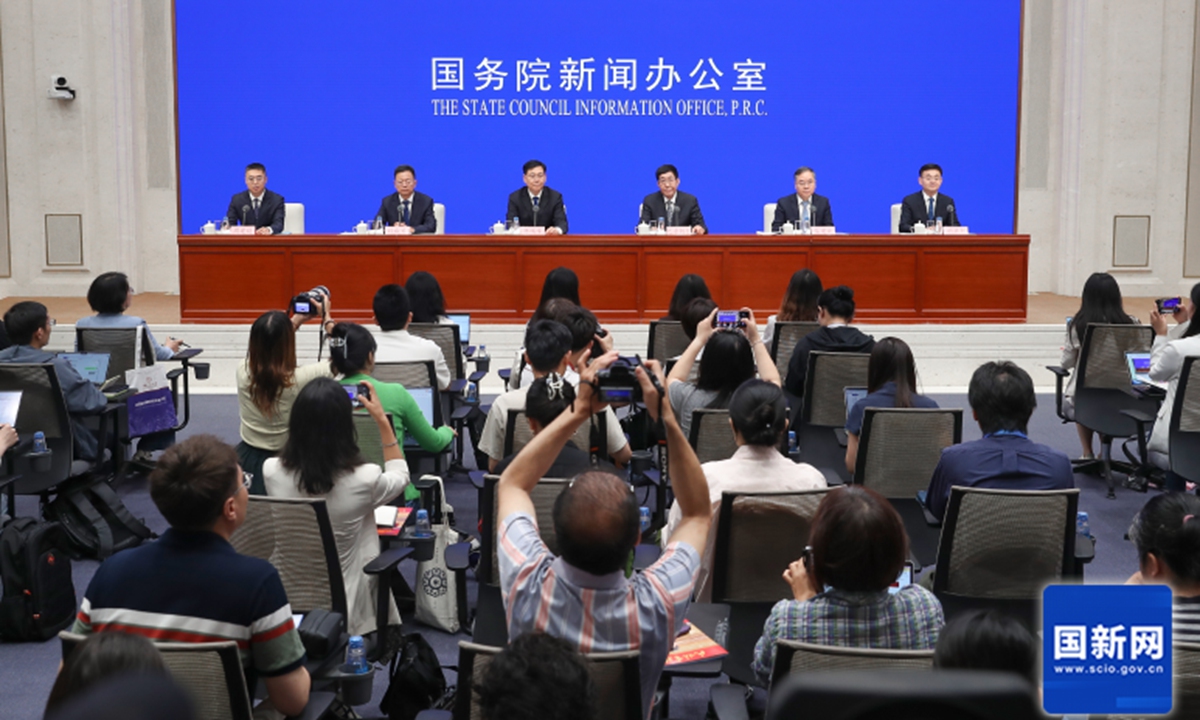
The State Council Information Office (SCIO) holds a press conference about the Ethnic Unity and Progress Promotion Law as well as China's work on ethnic affairs in Beijing, China, on June 24, 2026. Photo: SCIO
At a State Council Information Office press conference on Wednesday, senior officials responsible for ethnic affairs provided a systematic interpretation of the Ethnic Unity and Progress Promotion Law, which was adopted at China's annual "two sessions" in March this year and will take effect on July 1. Responding to Western narratives that have mischaracterized the law as an attempt to "assimilate ethnic minorities," one senior official pushed back with a series of pointed questions."As China advances modernization, not a single ethnic group and not a single individual has been left behind. What other country or political party has achieved such results?" asked Bayanqolu, member of the Standing Committee of the National People's Congress (NPC) and chairman of the NPC ethnic affairs committee.
He also urged critics to see the reality for themselves: "People should travel more, see more, and judge based on facts, because seeing is believing. What is the point of fabricating stories and sensationalizing issues out of prejudice? These achievements are the very foundation of ethnic equality and common development. Can they really not see them?"
Chinese experts said some Western media outlets have misrepresented China's efforts to foster a strong sense of community for the Chinese nation as "cultural assimilation" or "de-ethnicization," a distortion that reflects confines of Western-style ethnic nationalism and an absolutist view of minority rights.
Far-reaching significance
China's top legislature on March 12 adopted the law to promote ethnic unity and progress, reinforcing the legal foundation for national cohesion and common prosperity among 56 ethnic groups as the country enters the final decade in its drive to basically achieve modernization by 2035, the Xinhua News Agency reported.
The new law embeds the vision of "fostering a strong sense of community for the Chinese nation" into the country's legal framework and advances the law-based governance of ethnic affairs, said Li Hongzhong, vice chairman of the NPC Standing Committee, in his explanatory remarks on the draft, Xinhua said.
The law dedicates chapters to fostering a shared sense of belonging for the Chinese nation, promoting interaction, exchange and integration, and advancing common prosperity and development among all ethnic groups, Xinhua reported.
Specific provisions direct central and local governments to strengthen infrastructure, foster industrial growth, ensure better access to public services, and intensify efforts to protect the environment, among other measures, per Xinhua.
This law is an important piece of legislation that declares the Party and the state's major policies on ethnic affairs, Chen Ruifeng, vice minister of the United Front Work Department of the Communist Party of China Central Committee and director of the National Ethnic Affairs Commission, said during the press conference.
It elevates the successful experiences gained since the 18th CPC National Congress in advancing a sense of community for the Chinese nation and promoting ethnic unity and progress into legal provisions, Chen said.
This is the first legislative bill in more than 30 years to be deliberated by a meeting of the Political Bureau of the CPC Central Committee. The centralized and unified leadership of the CPC Central Committee was reflected throughout the entire legislative process, according to the press conference.
At every stage of the legislative process, opinions from all sectors of society were extensively solicited. The full text of the draft law was released twice for public consultation, attracting comments and suggestions from nearly 50,000 participants. These efforts helped build the broadest possible consensus around the legislation.
Structurally, the law includes a preamble - a feature that makes it the first Chinese law in more than 30 years to do so. This arrangement, he said, further highlights the law's political, principled, declaratory, and guiding nature, Bayanqolu said, noting that it gives the legislation a clear orientation and a distinct central theme, combining political significance, historical depth, theoretical substance, and broad practical relevance.
"As the only newly enacted law since the 18th CPC National Congress to include a standalone preamble, the Ethnic Unity and Progress Promotion Law represents a significant innovation in legislative structure, carrying profound legal and political significance," Zhou Shaoqing, a researcher at the Institute of Ethnology and Anthropology of the Chinese Academy of Social Sciences and a distinguished professor at Southwest Minzu University, told the Global Times on Wednesday.
Facts speak louder than words
Not surprisingly, some Western narratives have misinterpreted the Ethnic Unity and Progress Promotion Law, claiming, for example, that its purpose is to "assimilate ethnic minorities."
Although the law explicitly safeguards the lawful rights and interests of citizens who seek employment or start businesses across regions under the chapter on promoting exchanges, interactions, and integration among ethnic groups, allegations of "forced labor" and "forced relocation" of ethnic minorities continue to appear in some Western media's reporting on Xinjiang.
Similarly, in coverage related to Xizang, some Western commentators and media outlets have distorted relevant policies and practices as "forced assimilation," "compulsory boarding," and "human rights violations."
In response, officials systematically refuted these smears at the press conference.
Regarding statements issued by some overseas organizations claiming that the law is intended to "assimilate ethnic minorities" and calling for "sanctions" against China over human rights, Bayanqolu called on people to visit the country's ethnic regions and see for themselves, as facts speak louder than prejudice and fabrication.
Across Xizang, boarding schools visited by Global Times reporters have shown how education is organized around the region's vast territory, scattered communities and long travel distances.
At Lhasa Middle School, one of the top schools in Xizang, Zongcuo, a second-year high school student from Biru county in Nagqu, told the Global Times that the trip from home to school takes about eight hours by car. Many students at the school come from remote counties and villages across Xizang, making daily commuting unrealistic. For them, boarding provides a stable routine for classes, meals and study, while reducing the time and safety risks of long-distance travel.
Their campus life is supported by policies such as Xizang's "three guarantees," which cover food, accommodation and study expenses for eligible students.
At the same time, Tibetan-language and -culture education remains part of school life. At Lhasa Middle School, Tibetan-language teacher Danzeng told the Global Times that students begin systematic Tibetan-language study in primary school and can read and write proficiently by high school.
Taking the second-year high school grade as an example, 12 out of 17 classes offer Tibetan-language courses, accounting for about 70 percent. Studying Tibetan also keeps open future academic paths for students who want to apply for majors such as Tibetan language and literature, translation, Tibetan medicine and pharmacology.
These facts strongly refute a BBC report in March which claimed that under the law, the children of the next generation "are now isolated and brutally forced to forget their own language and culture."
Regarding Xinjiang-related questions, Chen Ruifeng said during the press conference on Wednesday that there is absolutely no "forced relocation" or "forced labor" and such claims are extremely absurd.
In a recent visit to Xinjiang Uygur Autonomous Region, the Global Times learned from a local beef production company that they recruit people from diverse ethnic backgrounds, including Uygurs, Kazaks and Mongolians. "People create a better life through decent employment, that is glorious labor, not 'forced labor,'" the company manager said.
At Bole city in Bortala Mongolian Autonomous Prefecture, Uygur taxi driver Alimu told the Global Times that in recent years, the social security and infrastructure in Xinjiang have largely improved, and the city has welcomed an increasing number of visitors.
Bole used to be a "little-known" city, but the popularity of road trip gave it a chance to thrive and prosper due to its vicinity of several scenic spots including the famous Sayram Lake, and the convenient highway system.
"I run two restaurants, my sister runs a local specialty and souvenir shop, my aunt has a dried fruits store in the bazaar complex; All these businesses are going well, therefore my own family tells a story that favorable policies and hard work together create happy life," Alimu said.
RELATED ARTICLES