IN-DEPTH / IN-DEPTH
Through blood donation, medical practice, and policy consultation, I experience CPC-led social welfare development in Shanghai for years: Nepali Magnolia Gold Award recipient
Love felt, love given
By in Shanghai Published: Jun 24, 2026 10:23 PM

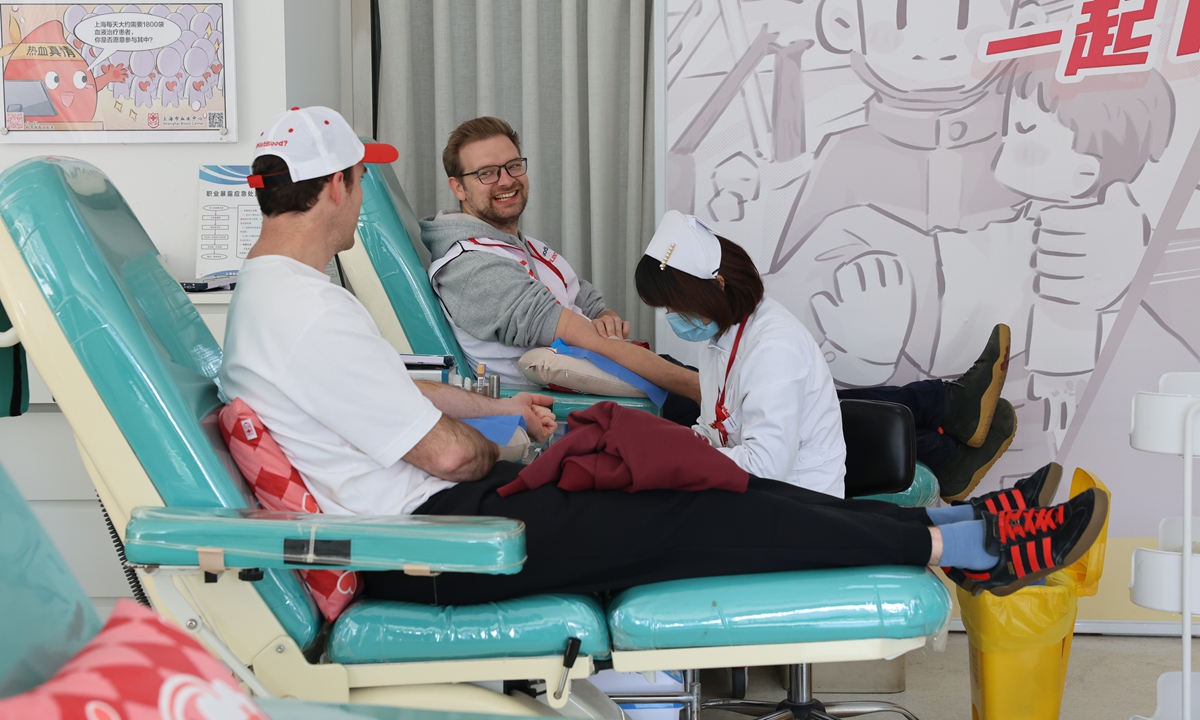
Two expats donate their blood at a voluntary blood donation event of Bloodline in Shanghai on December 14, 2025. Photo: Chen Xia/GT
Editor's Note:
Chinese President Xi Jinping has pointed out, "to understand China today, one must learn to understand the Communist Party of China (CPC)." With the rapid development of China's economy and society, and the steady advancement of the Chinese path to modernization, the notable achievements of the CPC have drawn extensive international attention and scholarly interest. Against this backdrop, the Global Times has launched the "CPC in Global Eyes" column, focusing on the feelings, perspectives and insights of international friends from various fields regarding the CPC's historical path and achievements.
They include those who have toured China, who deeply study the CPC in academic fields, who work, live, study, seek employment or do business in various fields in China, and who, pay close attention to the CPC's policies and trends, although they haven't visited the country in person. Through their vivid personal experiences, we aim to present a multifaceted overseas view of the CPC.
In the 14th installment of this series, we talk with Ashish Maskay, a Nepali orthopedics and sports medicine doctor and dedicated volunteer who has lived in Shanghai for over two decades. Leading the foreign blood donation volunteer group Bloodline, he shares his personal experiences of working, living and doing charity in China, and his insights into how the CPC puts the people-centered philosophy into practice across public welfare, medical security, grassroots governance and global humanitarian efforts.
Sunlight streams through a glass window into a consultation room at a private hospital in Shanghai. On a table by the window sit an array of trophies and certificates: the "Magnolia Gold Award" of Shanghai, the national "Most Beautiful Volunteer," and more. These honors belong to the room's owner, Ashish Maskay, an orthopedic surgeon from Nepal.
Maskay is also known by another, perhaps even more familiar, identity: the founder of Bloodline, Shanghai's volunteer group of expats dedicated to unpaid voluntary blood donation.
Since arriving in Shanghai in 2003, Maskay has lived in the city for more than two decades. As both a witness to and participant in the growth of public welfare in Shanghai and across China, Maskay feels that under the leadership of the Communist Party of China (CPC), the country has made steady progress in advancing charitable causes, improving social welfare and taking part in international aid efforts. In his view, this is one of the clearest and most vivid expressions of the CPC's people-oriented philosophy.
"It has been very instrumental and at the forefront in [governing] the country, and one thing from the beginning [for the Party] is serving the people," Maskay told the Global Times.
'Bloodline' volunteers
Maskay's impulse to do public good in China began taking shape more than a decade ago.
One day in 2011, he took part in his first voluntary blood donation in Shanghai. As a surgeon, he understood better than most what blood means to life, and the experience planted in him the idea of building a volunteer blood donation team.
Sometime later, an emergency rescue case made his resolve even firmer. A young French woman visiting Shanghai was involved in a serious car accident and urgently needed the rare "panda blood" - Rh-negative blood. When Maskay learned of her situation, he posted a plea for help on the social media platform WeChat, and what happened next moved him deeply: in a very short time, more than 80 people came from all directions, willing to donate "panda blood" for the woman.
"Over 80 strangers, 80 complete strangers, wanted to come and help her," Maskay recalled, his eyes still glistening with emotion. "That's when we had the concept [of building a voluntary team]: why don't we start doing something meaningful?"
It was this surge of goodwill that gave birth to "Bloodline." What began with just five people in 2017 has since grown into a vast network spanning 14 Chinese cities, bringing together participants from 68 countries, more than a hundred online WeChat groups, and thousands of volunteers who actively participated in blood donations and other charity activities.
Maskay and Bloodline's efforts have also earned high recognition from Chinese official authorities. Trophy after trophy, medal after medal, certificate after certificate bears witness to the mutual support between the government and this foreign-led public welfare team.
Maskay said his philanthropic work has depended on the support and openness of the CPC and various government departments. From the Shanghai Blood Center, under the patronage of which Bloodline functions, to the various units involved in providing venues, media outreach and policy guidance, he has deeply felt that under the leadership of the Party, a public-welfare ecosystem is taking shape - one that encourages participation from all sectors of society and promotes shared governance.
"I always say Shanghai is not only a cosmopolitan hub, a trade center of China. The city [is being] known in the world as a charity center," Maskay said. "I'm very blessed to have seen all the Party and government units, and local and foreign charities working together. To me, this is really a dream come true."
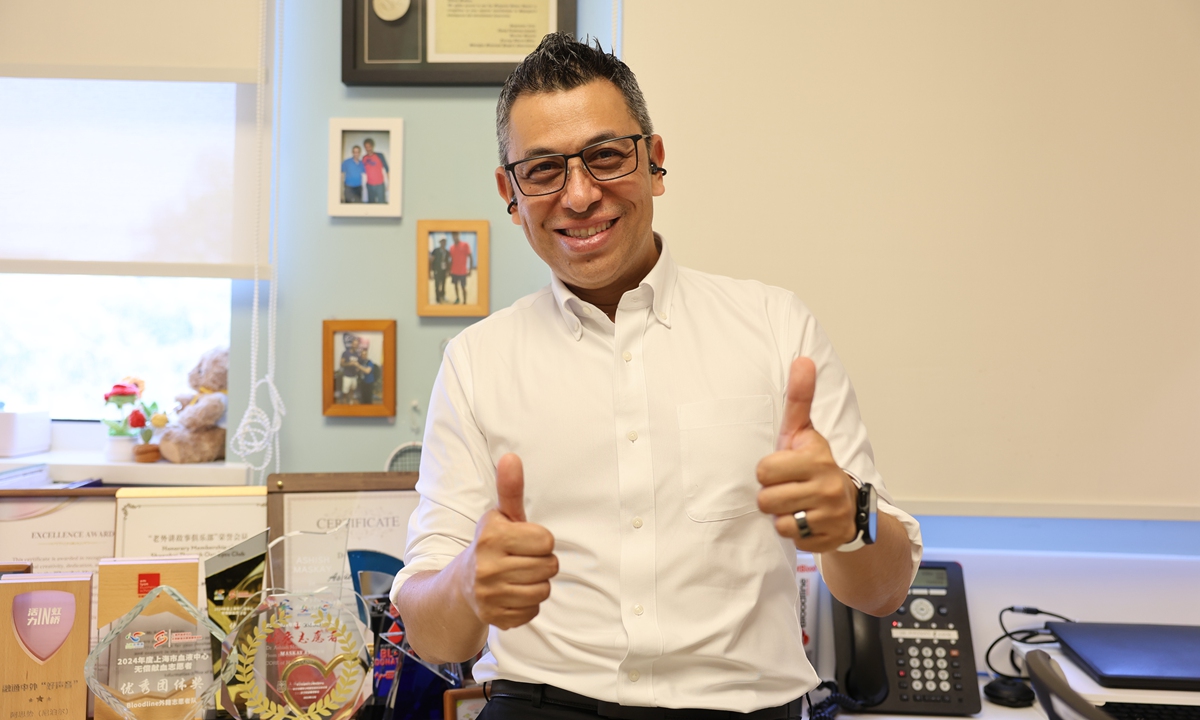
Ashish Maskay, a Nepali orthopedics and sports medicine doctor Photo: Chen Xia/GT
Witness to progress
Maskay's connection with China began with his family. In 2003, encouraged by his father, who had once been to Beijing as a Nepali government official, Maskay headed to Shanghai to pursue a master's degree in medicine.
"My father told me, 'You have to go and see this amazing country. The people there are so diligent,'" Maskay recalled. "So, I made the choice to come."
More than two decades later, Maskay not only speaks Chinese fluently, but has also become a true connoisseur of China. A doctor who has spent years working in private hospitals, frequently interacts with public hospitals and builds deep bonds with countless Chinese and foreign patients and their families through his charitable work, Maskay said he has witnessed firsthand the progress China's medical security system has made under the leadership of the CPC.
Looking back on his early days in Shanghai, Maskay remembers how even a simple consultation at a public hospital could feel daunting for an expat. Today, however, everything has changed dramatically. "Public hospitals in China have seen significant improvements in facilities and management," he told the Global Times, saying this improvement is seen by the whole world. "I have a few patients, some not even in China now, saying [to me that], 'Can you please help me connect to a hospital in Shanghai? I need treatment. I need to come to China.'"
Even more admirable to him are China's concrete efforts to improve social security and care for vulnerable groups. He has witnessed the expansion of medical insurance coverage, seen the growing attention paid by the CPC and the government to people with rare diseases, and felt the increasing support extended by society to children with leukemia and other patients in need. All of this, in his view, is a vivid reflection of the Party's people-centered philosophy.
Based on these observations, Maskay came to a deeper understanding of "human rights." To him, the foundation of human rights is not empty slogans, but tangible guarantees in everyday life.
"When I can have a meal on the table, when my children can have education, when I have a roof over my head, when my wife gets home late at night after work and I don't have to worry about her safety - these are what human rights looks like," said Maskay.
"So, in that sense, I think China has delivered a lot for many people in this country," he added.
Under the leadership of the CPC, China's development model, especially its achievements in poverty alleviation and inclusive healthcare, offers valuable lessons for global human rights governance, Maskay said. He has observed China's involvement in building roads, hospitals and agricultural projects in many countries and regions, as well as its presence in disaster relief efforts when calamity strikes. He recalled a devastating earthquake in Nepal that brought down many historic monuments, and said he saw "China Aid" signs at several historical sites undergoing restoration.
"In my 23 years of living here, I have never seen Chinese mainstream media openly say, '[China is] going to sell weapons,'" he told the Global Times. "Instead, what I've seen this country do again and again is support a lot of other developing countries, reach out a hand, and say to them, 'Let's do business together,' 'Let's prosper together,' 'Let's have a bright future together.'"
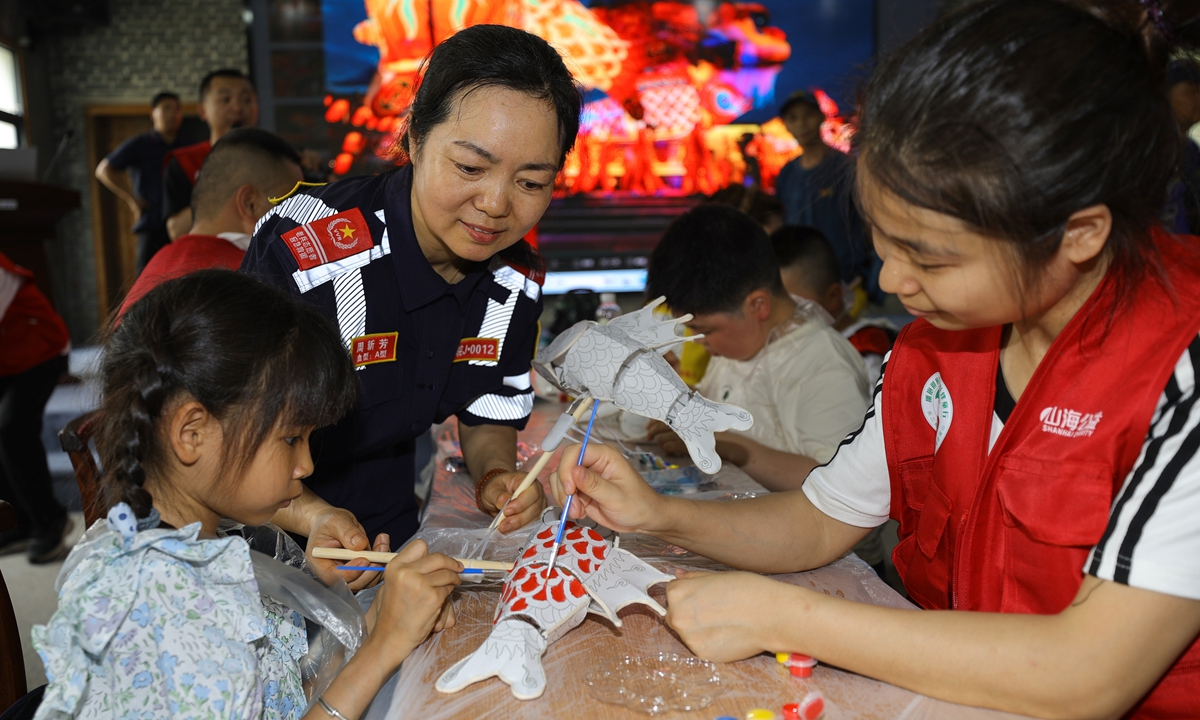
Children with rare diseases learn to make fish-shaped lanterns at a scenic spot in Huangshan, East China's Anhui Province, on May 26, 2026. Photo: VCG
Voices being heard, respected
Looking back, Maskay's early years in Shanghai were full of challenges from food to language barrier. Though he occasionally thought about going back, Maskay said he chose to stay because he found warmth in this city that felt like home.
That sense of belonging transformed Maskay from an outsider in Shanghai into an active participant in - and builder of - the city. In recent years, with his growing influence in public interest work, he has been increasingly invited to join roundtable discussions hosted by local CPC and government departments. From revisions to blood donation regulations, to community pet management, to improving public services, his views have been taken seriously, listened to attentively and carefully recorded.
"Before I came to China, [I'd never thought] that one day I'd be sitting at this table, and my voice would be heard in the government legislation. This was hard to imagine," he told the Global Times. "And many times, I was sitting alongside a deliveryman, a police officer, a student, a doctor or a professor. We were all discussing and giving our views on how to solve a problem."
These experiences have given Maskay a vivid and profound understanding of China's whole-process people's democracy. "While democracy in many countries happens on the election day, I see here in China, it's constantly happening every single day at every grassroots level." Maskay believes that it is precisely this mechanism - one in which ordinary people participate on an almost daily basis - that makes grassroots governance under the CPC truly people-centered.
The voices of people at the grassroots level, along with their feedback and suggestions, are taken seriously and treated with respect. "Overall, [the CPC's grassroots governance] develops with the times, and develops with the needs of the people," he concluded.
Standing by the window, gazing out at the streets of Shanghai, Maskay's eyes were filled with both reflection and anticipation. What began as the uncertainty of a foreigner afraid of getting lost has turned into the confidence of someone who can now offer ideas for the governance of the city that he has come to call his own. In his view, the key to the CPC's success lies in its ability to listen to the people and continuously adjust its governance approach as the times change - while its core principle, being "people-oriented," has never changed.
"My view is very simple about Shanghai and about China," he said. "Do not believe any media. You do not even have to believe me either. You just need to come here yourself, see it with your own eyes, walk the roads, breathe the air, eat the delicious food, talk to the Chinese people, see China first hand and then you will really understand what China is, what the CPC is."
RELATED ARTICLES