How long can Tokyo pretend not to hear Japan's growing voices against neo-militarism?
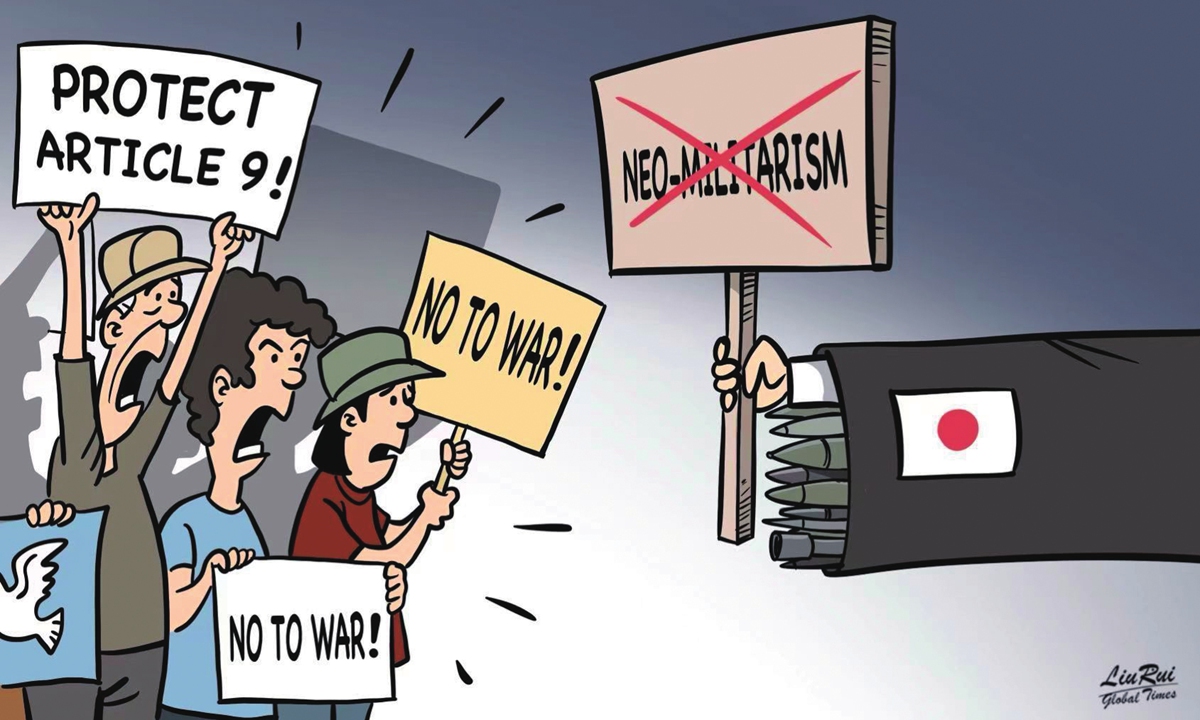
Illustration: Liu Rui/GT
Japanese Prime Minister Sanae Takaichi found herself in an awkward position on Tuesday at a memorial ceremony purportedly commemorating the victims of the Battle of Okinawa. While she was delivering her remarks in Okinawa, protesters chanted anti-war slogans such as "No to war" and "Protect Article 9," with their voices at times drowning out portions of Takaichi's speech.Not long ago, Japanese Defense Minister Shinjiro Koizumi sought to publicly push back against criticism that Japan is moving toward "neo-militarism," claiming that a country possessing neither nuclear weapons nor strategic bombers should not be labeled with the term. Some Japanese media outlets likewise attempt to dismiss concerns about "neo-militarism" as a "cognitive warfare" in the realm of international public opinion.
However, rhetoric from Japanese politicians, the media, or a few so-called allies cannot hide Japan's actions, which clearly show that the country is straying from its postwar pacifist path and edging back toward militarism. Nor can they silence concerned citizens.
The concerns over Japan's trajectory nowadays are no longer confined to warnings from neighboring countries, but increasingly shared by Japanese citizens themselves. The anti-war chants that rang out at Okinawa's World War II memorial event pierced the carefully crafted image of Japan as a "peaceful nation" and made its denials of "neo-militarism" ring increasingly hollow.
Da Zhigang, a research fellow at the Institute of Northeast Asian Studies at the Heilongjiang Provincial Academy of Social Sciences, told the Global Times on Wednesday that Okinawa is one of the regions in Japan that suffered the deepest scars of war and possesses the strongest anti-war consciousness, particularly sensitive to any resurgence of militarist tendencies. Yet as Japan steadily expands its military capabilities, Okinawa is being pushed to the forefront of military deployments and turned into a bridgehead for the country's growing militarization, he said.
According to Japanese media, 81 years ago, over 200,000 people lost their lives and one out of four local residents died in the Battle of Okinawa. Because of the traumatic history, local people in the region have long maintained a strong anti-war sentiment and commitment to peace. Ironically, it is this very region that best understands the cost of war that is now being pushed by the Japanese government toward the forefront of military confrontation.
Okinawa Prefecture, which accounts for only about 0.6 percent of Japan's total land area, is home to roughly 70 percent of US military facilities in Japan, according to a local report. Since Takaichi's erroneous remarks regarding China's Taiwan, Tokyo has accelerated military deployments across the southwestern islands, including Okinawa. It is reported that Japan's Ground Self-Defense Force and the US Marine Corps commenced the military exercise and plan to deploy V-22 Osprey transport aircraft based at Camp Saga in Okinawa prefecture.
For some Okinawa residents, what they oppose is not merely the noise from military bases, land expropriation, or missile deployments, but rather the dangerous trajectory of Japan's push to revise the constitution and continued violations of the "exclusively defense-oriented" principle. They understand that if regional tensions spiral out of control and escalate to war, Okinawa will once again be among the first places to pay the price.
The Japanese government may be able to convince certain ill-intentioned countries, through diplomatic rhetoric and foreign aid, that Japan remains a "peaceful nation," but it is finding it increasingly difficult to persuade its own citizens - those who live closest to the military frontlines and know the dangers of war firsthand. The protest chants at the Okinawa memorial ceremony were particularly striking precisely because they came from people who have personally borne the costs of militarization. Some observers farther away may still try to determine where Japan's train is headed, but the Japanese people sitting on board have already felt it accelerating at full throttle down the road of neo-militarism.
Even more troubling is the fact that the Japanese government appears largely deaf to these concerns. As Takaichi claimed that she "did not clearly hear it" when asked after the ceremony about the protest chants, she also blatantly ignored many Okinawa residents' calls for retracting the erroneous remarks regarding Taiwan, opposition to Japan's accelerating militarization, and appeals to safeguard the pacifist constitution. Instead of listening to voices of reflection and restraint, Japan has determined to press ahead with militarization.
But how long can the Takaichi government continue pretending not to hear? Since taking office, her administration has faced large-scale anti-war demonstrations across Japan. On May 3, Japan's Constitution Memorial Day, approximately 50,000 people reportedly took to the streets to oppose increased military spending and attempts to revise the pacifist constitution. As more and more Japanese are raising concerns, how much longer can Japan's neo-militarist train continue racing forward unchecked?
RELATED ARTICLES