Illustration: Liu Xiangya/GT
US Trade Representative Jamieson Greer and Indian officials on Tuesday held high-level negotiations, pushing to conclude an interim trade pact before July 24, when Washington's temporary 10 percent global tariff on imports expires, the Economic Times reported on Wednesday.The US market remains an indispensable export destination for Indian commodities and Indian exporters urgently need a formal bilateral trade arrangement to offset rising tariff costs and stabilize overseas sales. But domestic opposition to the India‑US trade negotiations continues to intensify.
Several organizations of farmers, fishery workers, poultry traders, and winemakers and trade unions have written to India's Prime Minister Narendra Modi demanding that those trade negotiations be stopped as the proposals are against the interests of workers and peasants, The Hindu reported on Monday.
An Indian coalition of farmer unions staged a symbolic protest at Jantar Mantar on Tuesday against the proposed India-US trade deal, alleging that the agreement could have an adverse impact on farmers, the dairy sector and the poultry industry, according to a report by ETV Bharat.
Their concerns are not unfounded. India's agriculture sector supports hundreds of millions of jobs in the country. If India further lowers import tariffs and opens its agricultural market to the US as required by Washington, local small farmers could suffer a blow. So whether India and the US finalize a temporary trade pact before July 24, the real test for the Modi government lies in striking a delicate balance between safeguarding domestic industrial interests and fulfilling external trade needs.
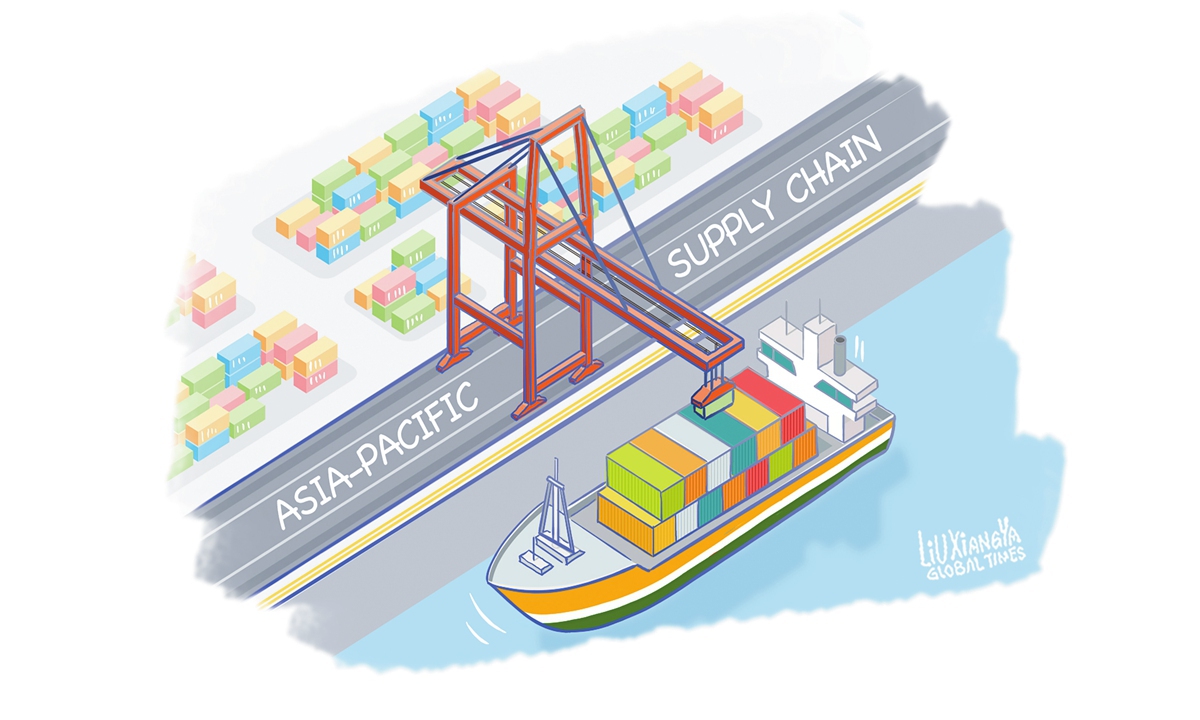
Such a balance can never be achieved merely through diplomatic compromises or tough stances during negotiations; instead, India needs more diversified leeway in the global trade landscape. That is increasingly where Asia's industrial chain comes into play.
Since Indian exports to the US suffered tariff shocks last year, New Delhi has accelerated its trade diversification efforts. Many Indian companies have thus turned to regional markets instead of waiting for Washington.
For instance, China overtook the US to emerge as India's largest trading partner in 2025-26, with bilateral trade reaching $151.1 billion. India's merchandise exports to Singapore rose 124 percent year-on-year to $5.07 billion in April and May, according to Indian media reports. Apparently, Asia's increasingly mature industrial network provides a vital cushion for India's foreign trade amid a volatile environment.
India has long drawn support from Asia's industrial chain through trade in intermediate goods and supply chain collaboration. When trade barriers rise in the US, the region's dense industrial networks offer India viable alternative export channels. In the longer run, deeper integration into regional production networks provides a pathway for India to upgrade its manufacturing base, moving beyond raw materials and primary products toward higher value-added segments.
Vietnam has already shown that active participation in the regional division of labor is one of the most effective routes to industrial development. With its vast labor force and improving infrastructure, India possesses the conditions to follow a similar trajectory, provided it seizes the opportunity.
As global trade undergoes profound realignment with unilateralism and protectionism on the rise, India's actual participation in regional supply chains has continued to grow. If New Delhi proactively aligns its policies with regional cooperation frameworks, it stands to gain more dividends from regional development.
Regional industrial cooperation should be framed as a long-term national development strategy rather than a temporary fix to tackle external trade pressures. Asian economic integration will not stop due to the hesitation of a single country.
Whether India secures a favorable position in this ongoing regional industrial integration process hinges on its own decisions. Ultimately, what can truly strengthen India's economic resilience is not a tariff figure but a diversified and mutually beneficial regional trade network that is rooted in Asia's complete industrial ecosystems.
RELATED ARTICLES