ByteDance launches paid Doubao Pro plans with AI agent capabilities
By Published: Jun 25, 2026 01:17 AM

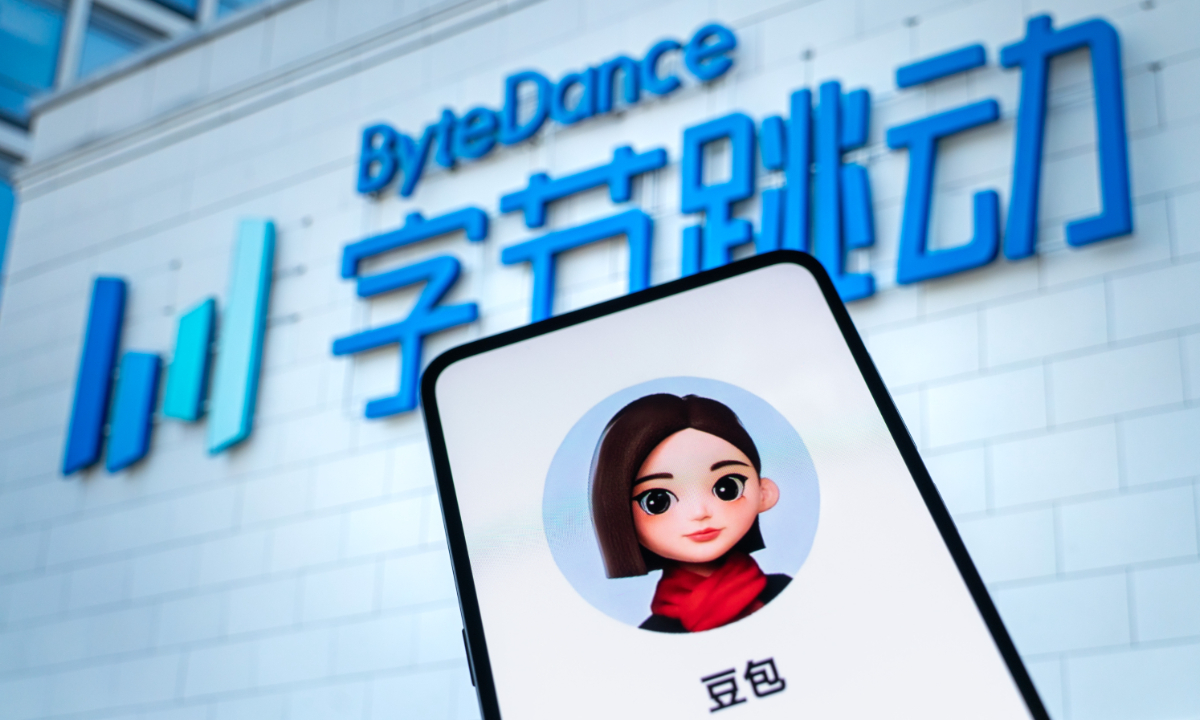
Chinese technology company ByteDance's artificial intelligence (AI) chatbot Doubao Photo: VCG
ByteDance's Doubao on Wednesday launched a professional subscription tier based on its latest Doubao 2.1 family of artificial intelligence (AI) models, introducing paid plans that offer AI agent capabilities and higher usage limits.By offering the paid service, the company is taking a further step toward commercialization as it seeks to capitalize on the AI boom.
Netizens expressed on social media platforms mixed views about the paid plans.
The Doubao Pro service provides access to the Doubao 2.1 Pro model and can perform agent-based tasks such as interacting with a user's computer, using web browsers, invoking skills and running scheduled tasks. A key selling point is an office mode that can execute agent‑based tasks, according to news outlet Securities Times.
The service adopts a three-tier pricing structure. The standard plan costs 68 yuan ($10) per month, while enhanced and premium plans are priced at 200 yuan and 500 yuan per month, respectively. ByteDance said users of the free version will continue to have access to new AI models, and basic features - including search Q&A, writing, image generation, and voice/video chats - will stay free forever.
The announcement sparked online debate, with users focusing on two issues: model accuracy and pricing.
Some believe that the 68‑yuan entry‑level monthly fee is too high, given that several free alternatives could meet daily needs.
According to domestic news outlet bjnews.com.cn, which has conducted a survey in May on 25 respondents, 20 stated they would not pay, 2 indicated they would, and 3 said it depends on Doubao's specific capabilities.
The respondents included company employees, individual developers, students, and retirees. Of the 20 who explicitly stated they would not pay, 19 users primarily used Doubao, but their needs were mostly non-code-related, hence their low willingness to pay. One user mainly used foreign models.
However, some users justified their willingness to pay on practical grounds.
Liu Dingding, a veteran tech industry analyst, linked ByteDance's move to a broader global trend in which AI companies are increasingly pursuing AI profitability as demand for AI services have surged and operating costs have risen sharply.
"Heavy users like me are willing to spend a few hundred to several thousand yuan on the more advanced functions offered by Doubao, as the value generated by such service far outweighs the cost," Liu, who is a content producer, told the Global Times on Wednesday.
"But I believe it will only be a small percentage of users who are willing to pay, again, when you see the vast user base of monthly active users, you will see the opportunity of generating sizable revenues from the paid service," Liu said, noting that AI companies' ultimate clients are businesses and large corporations with deep pockets.
Wang Peng, an associate research fellow at the Beijing Academy of Social Sciences, told the Global Times on Wednesday that this move marks a strategic milestone by the company as China's general-purpose AI industry reaches maturity, breaking free from the traditional internet model of "burning cash for traffic."
Against the backdrop of soaring computing costs, the tiered pricing approach preserves free access for everyday users while opening a dedicated commercialization channel for high-value Agent-powered office features, enabling R&D investment to form a virtuous cycle. In the long run, it steers the industry from subsidy-driven competition to productivity value-driven competition, Wang said.
The expert noted a divide by ordinary users. Most of them have little incentive to pay, but professionals, knowledge workers and developers are more willing to adopt the new Agent mode and pay for efficiency gains.
Rather than a mass trend, paid adoption is likely to concentrate among core users with genuine productivity needs, said Wang, who envisaged a tiered landscape in the future with free service for the general public and paid service for professionals.
Analysts pointed to a broader industry trend: no Chinese AI provider has transitioned to a paid-only model so far. Instead, companies have adopted combining free basics and premium add‑ons.
Baidu's ERNIE Bot (Wenxin Yiyan), which launched a 49.9‑yuan membership in 2023 but reverted to free in 2025, served as a cautionary case against premature charging. Kimi introduced a four-tier paid system with fees ranging from 49 yuan per month to 699 yuan per month.
RELATED ARTICLES