Minor cases on drug abuse drop by 32 pct in 2025; adolescents emerge as key group for vigilance against addictive substances: SPC officials
By Published: Jun 25, 2026 12:18 PM

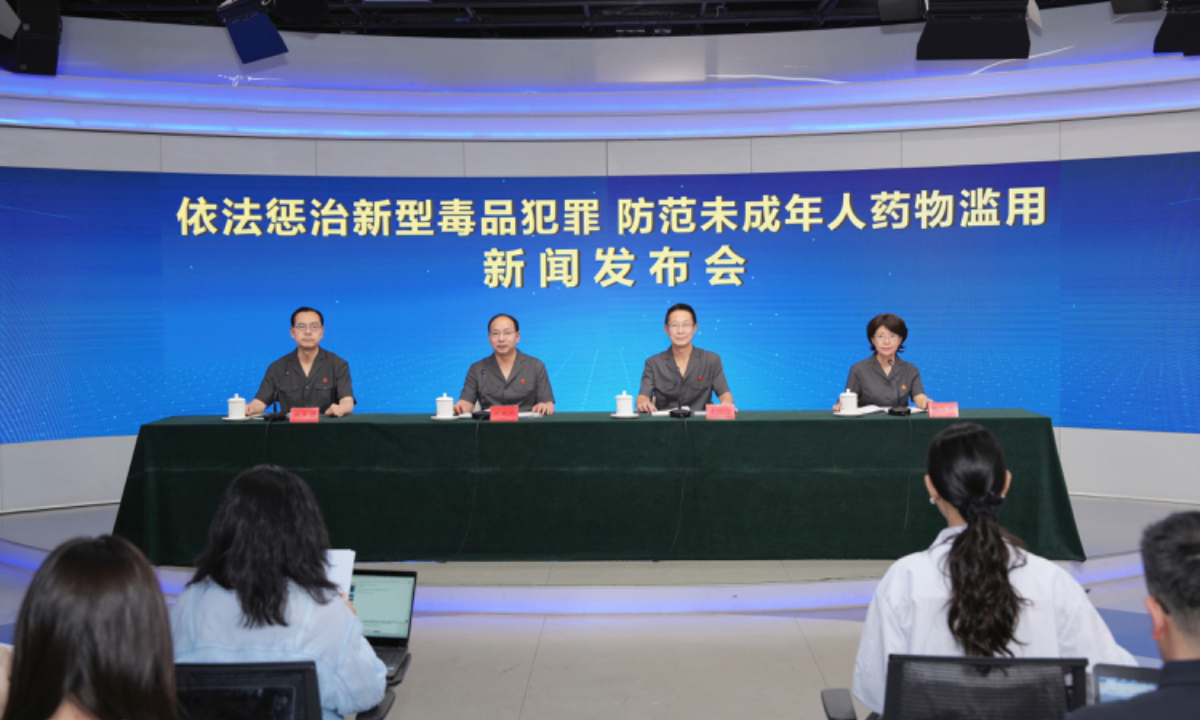
Picture of a press conference held by China's Supreme People's Court on June 25, 2026. Photo: Courtesy of China's Supreme People's Court
Ahead of the International Day against Drug Abuse and Illicit Trafficking, China's Supreme People's Court (SPC) and Supreme People's Procuratorate (SPP) said on Thursday that the country's drug-related crime situation has continued to improve in recent years, with adolescents emerging as the primary group for prevention and vigilance against new drugs and non-scheduled addictive substances.
Liu Weibo, an official from SPC, said the country's anti-drug efforts have continued to yield positive results in recent years, although the drug crime situation is undergoing profound and complex changes, according to a press release sent to the Global Times by the SPC. Liu made the remarks on Thursday ahead of the 39th International Day against Drug Abuse and Illicit Trafficking, which falls on June 26.
Liu said that research shows that etomidate has surpassed heroin to become the second most widely abused drug in China.
Meanwhile, the abuse of non-scheduled addictive substances such as nitrous oxide, commonly known as "laughing gas," has become increasingly prominent, with some provinces seeing such cases outnumber traditional drug-related offenses.
Liu said adolescents have become the primary group for prevention and vigilance against new types of drugs and non-scheduled addictive substances.
Both the number of juvenile defendants and cases dropped by 32 percent year on year in 2025, with the downward trend continuing in the first five months this year, suggesting that efforts to curb drug abuse among minors have achieved initial results. However, compared with 2023, both figures in 2025 were still about 1.8 times higher, while the abuse of non-scheduled addictive substances has become increasingly obvious, said Liu.
Liu said minors have been exposed to a growing variety of substances, including narcotic and psychotropic drugs diverted from hospitals and pharmacies or smuggled from overseas. Many of these substances are disguised as everyday products, such as milk tea, chocolate and e-cigarettes, or marketed as products for weight loss, boosting energy or enhancing sexual performance, with some even promoted for the use in drug-facilitated sexual assault.
Besides, court data show that e-cigarettes laced with psychoactive chemicals have become a most common way minors consume illicit substances, with etomidate most frequently mixed into the vape liquid, said Liu.
Among prescription-controlled drugs, dextromethorphan, a common cough suppressant, is the substance most often abused. For non-controlled addictive substances, nitrous oxide, or "laughing gas," and Yumei tablets are the most widely misused.
Authorities continue stepping up punishment for drug offenses involving minors, including crimes in which minors are used or coerced to commit drug offenses, as well as cases targeting minors and students.
Liu cited a case in Central China's Henan Province, where two defendants, surnamed Zeng and Wu, were each sentenced to 15 years in prison for drug trafficking after using minors and selling hundreds of "head-rush e-cigarettes" to minors.
Liu added that courts will also impose harsher penalties, in accordance with the law, on offenders who use narcotic or psychotropic substances and other addictive substances for their sedative or anesthetic effects to commit rape or indecent assault against minors.
Also on Thursday, Miao Shengming, a deputy procurator-general of SPP, said that China's drug situation has remained stable and continued to improve, with fewer drug cases, fewer offenders and a decline in large-scale drug manufacturing and trafficking operations.
Between January 2025 and May 2026, prosecutors nationwide approved the arrest of more than 29,000 people on drug-related charges, down 36 percent year-on-year, and prosecuted more than 46,000 suspects, a 30 percent decrease year on year.
Echoing Liu, Miao said new forms of drug crime have become increasingly prominent due to factors including the infiltration of drugs from overseas. Cases involving synthetic drugs and the abuse of addictive substances that are not yet under state control have emerged as key challenges requiring continued enforcement efforts.
He cited a case in Jiangsu Province in which a pharmacy operator, surnamed Chen, exploited her business to illegally sell more than 30 batches of the controlled psychotropic drug compound tramadol oral preparations. She was sentenced to seven years in prison for drug trafficking.
RELATED ARTICLES