ARTS / BOOKS
How books influenced woodcarver master Ye Xiaopeng's view of tradition
Carved by hand, shaped through reading
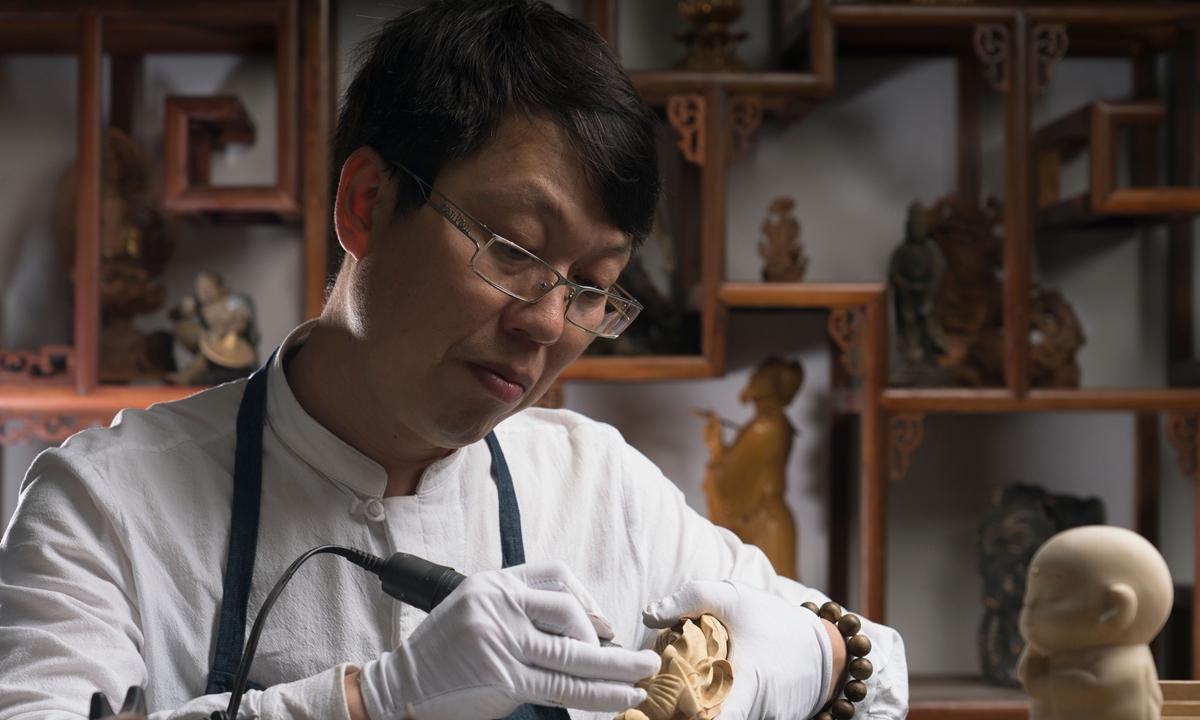
Woodcarver Ye Xiaopeng Photo: Courtesy of Ye Xiaopeng
Editor's Note:
In an age of information overload, reading remains a necessary channel to invigorate the mind, provide inspiration and cultivate virtue. Whether it is childhood enlightenment or the pursuits of adulthood, everyone's reading journey carries unique emotions and life experiences. The Global Times has specially launched the "100 Avid Readers" series, inviting guests from various fields to share their connections with books, stories of growth and sparks of thought.
In this installment, we meet Chinese woodcarver Ye Xiaopeng, for whom reading serves as both inspiration and compass in shaping his artistic vision.
At a workshop in Yongjia, East China's Zhejiang Province, a piece of boxwood rests quietly on the workbench. Before making the first cut, 53-year-old woodcarver Ye Xiaopeng often spends time working out the overall composition, and the expressions of his figures he wants to convey. In his view, woodcarving is not simply about carving what you see; a craftsman has to think through what he wants to express before putting knife to wood.
A master of Chinese arts and crafts and the sixth-generation inheritor of the Ye family's boxwood-carving tradition, Ye, is known for his use of openwork carving techniques and for incorporating modern design elements and painting methods into his creations. Over the years, he has produced numerous finely crafted woodcarving works.
To outsiders, it may seem only natural that someone born into a family of woodcarvers would follow the same path. But Ye believes that what has truly shaped his artistic vision is not only the craft passed down through generations, but also the influence of reading.
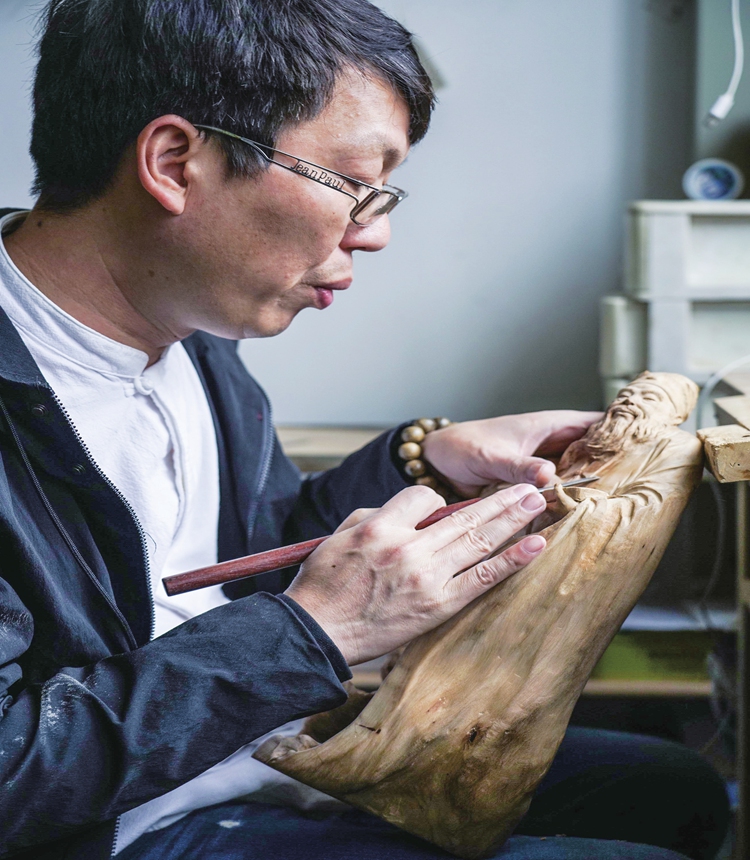
Woodcarver Ye Xiaopeng Photo: Courtesy of Ye Xiaopeng
The hidden grain
Ye's earliest reading memories had little to do with art theory.
Like many teenagers of his generation, Ye was drawn to martial-arts novels. He was fond of the Chinese classics Journey to the West and Romance of the Three Kingdoms. At the time, however, he was mainly captivated by the stories themselves and paid little attention to their deeper historical and philosophical meanings.
What left the deepest impression on him, however, was a copy of The Roots of Wisdom (Cai Gen Tan), a renowned collection of aphorisms compiled during the Ming Dynasty (1368-1644). Rooted in Confucian ideas of self-cultivation while drawing on Buddhist and Daoist thoughts, the book came into his hands by chance when he was in his teens.
"I didn't necessarily understand everything in The Roots of Wisdom at the time, but it was the first book that made me realize how reading could shape the way a person thinks," said Ye.
Looking back, he believes the book's influence lay not in any particular knowledge it provided, but in the way it encouraged him to observe the world and reflect on it.
"The influence wasn't obvious," he said. "It was more like the grain hidden inside a piece of wood, forming for decades, shaping both my work and my life."
After entering the arts-and-crafts world, reading gradually evolved from a personal interest to a professional necessity. From learning carving techniques and copying traditional designs to studying sculptural references, art catalogs, and materials on the history of sculpture, books remained a constant companion throughout his professional development.
"I used to think artistic creation depended mainly on technical skill," he said. "But over time I realized that wasn't enough. As my experience grew, I became increasingly aware that a successful work requires not only craftsmanship, but also cultural understanding and a stronger intellectual foundation."
As a result, he consciously expanded the scope of his reading. Beyond professional materials, he began exploring history, aesthetics, and a wide range of cultural subjects.
For Ye, the value of reading lies not in how many facts one remembers, but in the broader perspective it gradually cultivates over time.
Inspiration between pages
Over time, Ye came to realize that artistic traditions do not emerge or evolve in isolation.
"China's 5,000-year civilization is incredibly rich," he said. "Every artistic style that emerged in a particular era was shaped by specific historical events, social conditions, and cultural developments."
Through reading books on history and art, Ye gradually became aware that the characteristics of an era's art is often closely tied to the society in which it was created.
He points to the opening of the Silk Road during the Han Dynasty (206 BC-AD 220) as an example. The route facilitated cultural exchanges between China and the outside world and helped introduce Buddhist art into China.
In different periods, changing aesthetic preferences, social values, and ways of life continued to shape the forms that artistic expression would take.
These insights gradually found their way into his own woodcarving practice.
In Ye's view, a sculptor can observe a figure's expression, posture, or flowing robes from everyday life, but the cultural meanings and spiritual qualities behind the artwork must be built through reading.
"Life provides vivid images; reading provides cultural depth," he said.
For that reason, he has become increasingly convinced that the inheritance of traditional craftsmanship is not merely the transmission of techniques, but also the transmission of cultural understanding.
"Tradition is not about mechanically repeating forms from the past," he said. "It is about understanding why earlier generations created it in a certain way, and then how to find new ways to express those ideas today."
Alongside his creative work, Ye has spent years teaching and promoting the inheritance of intangible cultural heritage. In conversations with younger generations, he frequently encourages them to read. In his view, aesthetic judgment comes not only from training, but also from understanding.
Young people interested in traditional culture, he suggests, do not need to begin with dense theoretical texts. Instead, they can start with historical novels, art collections, or literary works that genuinely interest them, and then visit museums and workshops to connect what they read with tangible cultural heritage.
Today, reading remains an integral part of Ye's daily life.
"Reading does not immediately turn into a piece of work, but sooner or later it quietly finds its way into what you create," he said.
According to Ye, a craft survives across generations not simply because artisans preserve its techniques through their handiwork, but because they continue to ask questions about the culture behind it.
Every turned page strengthens a thread that links knowledge and experience, the present and the past, and ultimately, creativity and tradition.
RELATED ARTICLES