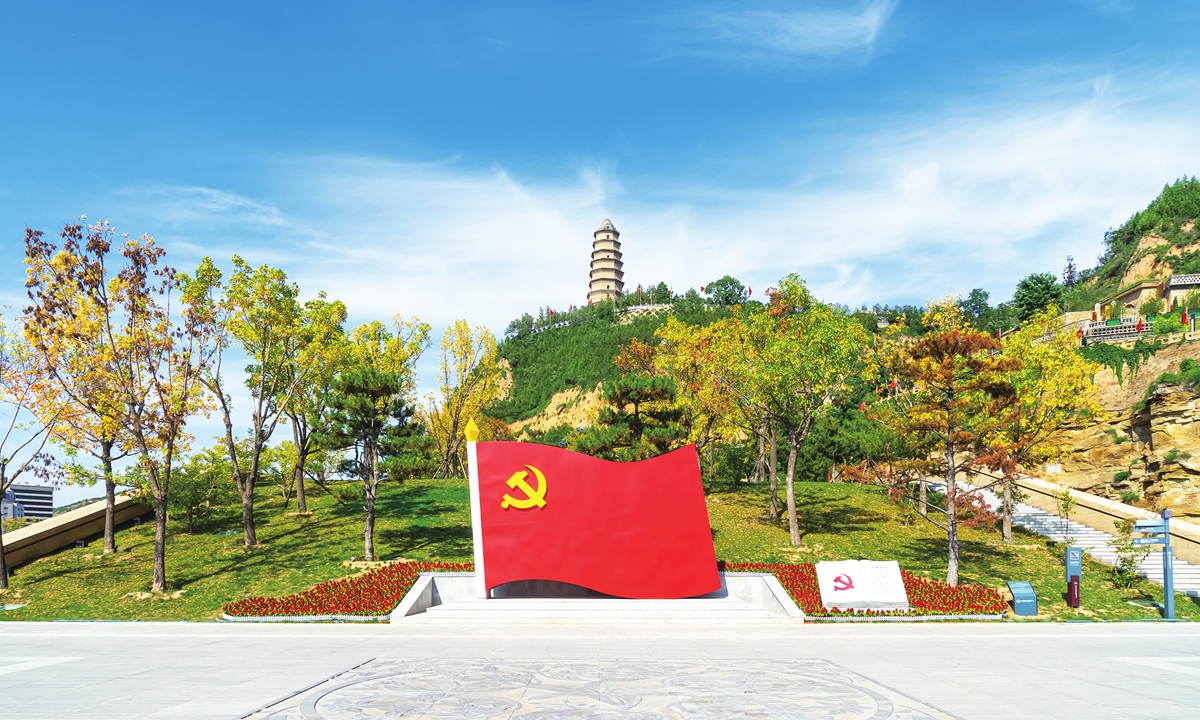
Baota Mountain in Yan'an Photo: VCG
Editor's Note:
2026 marks the 105th anniversary of the founding of the Communist Party of China (CPC). For over a century, the Party has united and led the Chinese people in writing the most magnificent chapter in the millennia long history of the Chinese nation. From the days when Edgar Snow broke through blockades to reach Yan'an, to the present day exploration of Chinese modernization that has charted an entirely new path, a growing number of people around the world are asking: What does China's path mean for the rest of humanity? The Global Times invites Chinese and foreign observers to unpack this question. This is the first installment of the series.
Xin Xiangyang, director of the Academy of Marxism at the Chinese Academy of Social Sciences
In 1936, American journalist Edgar Snow slipped through layers of blockade to reach Yan'an, the sacred land of the Chinese revolution, and for the first time introduced the world the true face of the CPC. Although at that time the Party had only around 40,000 members, Snow's coverage showed the world a party of immense vitality and bright prospects, driven by the unwavering faith and dedication of every member. Ninety years later, the question still being asked about the world's largest party, with over 100 million members, is: Why can the CPC win?
The CPC's success hinges on scientific faith. The CPC is a great political party united by scientific faith. Unlike other political organizations, a Marxist party is not a party formed for the sake of interests, but a party organized around common ideals and convictions. Organized with common ideals and beliefs, the Party's power is immense, capable of penetrating the fog of history and always staying at the forefront of the times. Relying on scientific faith, the CPC has tackled one intractable problem after another in the new era, achieving one historic accomplishment after another.
The CPC's success hinges on the hearts and minds of the people. The 105-year history of the Party is a history of practicing its original aspiration and founding mission, and a history in which the Party and the people share the same future and stay truly connected to each other.
The achievements of socialist revolution and construction were made by the vigorous efforts of the people; the great feat of reform and opening-up was performed by hundreds of millions of people; and the magnificent chapter of rapid economic development and long-term social stability in the new era are jointly written by 1.4 billion Chinese people under the Party's leadership. This 105-year history tells us: This country is its people; the people are the country.
The CPC's success hinges on historical initiatives. The CPC was founded in 1921 in response to the changing historical era. From then on, the Chinese people transformed from a passive to an active role in spirit. After the founding of the People's Republic of China, the CPC led the people to complete the socialist revolution with tremendous initiatives, realizing the most extensive and profound social change in Chinese history. A crucial reason for the Party's historic decision to implement reform and opening-up was its profound insight into the trends of the times. The Party, with its great historical initiatives, broke through the severe constraints of outdated ideas, overcame rigid barriers of vested interests, and eliminated various institutional and systemic drawbacks. Many areas have achieved historic changes, systemic reshaping and overall reconstruction, ushering in a stage of comprehensive deepening of reform.
The CPC's success hinges on strict discipline. Strict discipline is a useful tool for the Party's continuous victories. It is both a glorious tradition and a unique advantage of the Party. Strict discipline not only guarantees unity of action but also enables the Party to carry out continuous self-reform and maintain its vitality.
The CPC's success hinges on a global vision. The report to the 20th National Congress of the CPC states: "The Communist Party of China is dedicated to pursuing happiness for the Chinese people and rejuvenation for the Chinese nation. It is also dedicated to human progress and world harmony."
To that end, the CPC actively responds to the common concerns of people around the world, contributes to solving the common problems facing humanity and proposes building a community with a shared future for humanity. The CPC continuously expands its global vision, deeply understands the trend of human development and progress, and proposes to promote the common values of humanity.
John Milligan-Whyte, chairman of the America China Partnership Foundation
The year 2026 marks the 105th anniversary of the founding of the CPC, which, with 100 million members, is the world's largest political party and has profoundly shaped modern China and global political and economic dynamics. The CPC has overseen China's transformation from a largely agrarian society into the world's second largest economy.
American journalist Edgar Snow, best known for his book Red Star Over China, offered Western audiences one of the earliest detailed portrayals of the CPC's goals and its leadership. Writing in the 1930s, Snow sought to explain the appeal and resilience of the Communist movement in China. He highlighted grassroots mobilization, ideological commitment and the ability of the CPC to adapt to China's unique conditions. Snow's legacy is his focus which revealed the CPC's goals aligning with the need of 1 billion Chinese poor for effective leadership.
The CPC has provided the leadership, vision and pragmatism that has been able to, when necessary, change the CPC's and Chinese people's mindsets by seeking truth from facts, and implementing domestic and international policies that have created China's astonishing economic, social success and political stability that are seen worldwide now.
Snow's open-minded perspective is what Westerners need today. China is evolving extremely rapidly and changing the world at a speed, scale and global impact unequaled in history.
For Westerners that want or need to deal with China's success, Snow is a leading example of a Western journalist seeking to see and understand China from China's perspective instead of criticizing China because it did not follow the Western modernization model.
The success of the CPC and China is a wake-up call for Westerners. Rather than assuming there is only a single Western modernization model, they must deepen their understanding of China and developing nations across cultural and ideological divides.
Fortunately, in recent years, very influential Western elite opinion leaders have been recognizing and admitting publicly that China's system of government led by the CPC is extremely successful.
This is important progress because it will enable the new generation of younger Western political leaders to understand and accept the CPC and China's success as a reality to be adjusted to rather than a threat.
The CPC and China's achievements are examined by Westerners through a prism of competition rather than neutral inquiry, obscuring the path to understanding why and how China and the West can mutually and peacefully coexist.
China has become a major player in trade, technology and international governance. These swift achievements challenge established Western global hierarchies. For many in the West, understanding why the CPC is successful with an open mind is essential to adjusting to profound shifts in global power and influence.
Snow's pioneering inquiry seeking to understand the CPC and China continues to resonate and should remind Westerners that understanding other political systems requires more than comparison. It requires that Western people and governments be realistic and open and willing to reconsider Western assumptions about the CPC and China.
Snow's focus on understanding the CPC from a Chinese perspective reflects enlightening curiosity. It suggests that Westerners need to change the frameworks through which the CPC and China's success is interpreted. Westerners often seek universal explanations, while China's experience may be more context-specific.
Comparative analysis is a fundamental part of political science and international relations. Snow's pioneering work in understanding the CPC and China invites Western policymakers, elites and media to look beyond surface-level judgments and understand the underlying factors that drive political legitimacy and effectiveness in the different Chinese and Western contexts.
RELATED ARTICLES