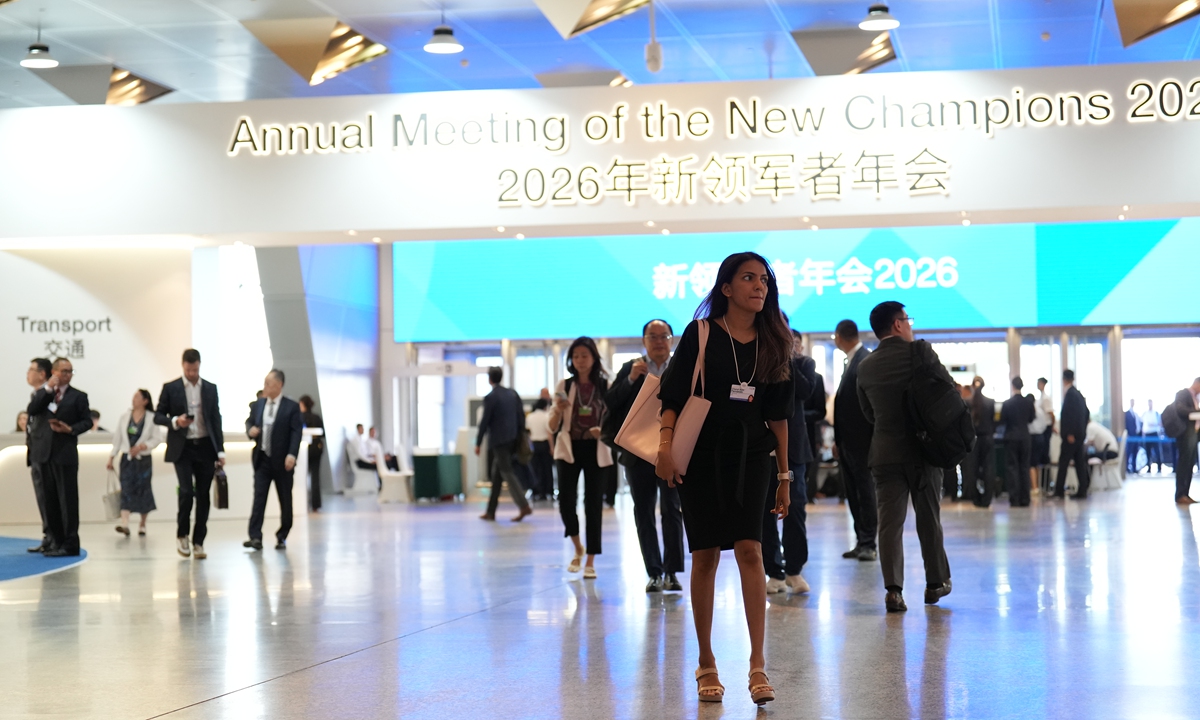
Participants walk inside the venue of the World Economic Forum's 17th Annual Meeting of the New Champions, also known as the Summer Davos forum, in Dalian, Northeast China's Liaoning Province, on June 23, 2026. Photo: VCG
At the 17th Summer Davos, "China opportunity 2.0" emerged as a globally trending phrase. China's innovative model - forged through relentless and painstaking efforts, tempered through extensive applications across industries as well as nurtured in an enabling environment - has become a key window through which the international community observes Chinese modernization. In the past, the "China opportunity" was primarily reflected in the development dividends of a large market and low factor costs. "China opportunity 2.0," however, signifies comprehensive empowerment of innovation and high-return investment opportunities. Against the backdrop of a sluggish global economic recovery, rising protectionism, and growing technological anxiety, this assessment holds particular practical significance.
Why has "China opportunity 2.0" continued to gain traction in international public discourse? Primarily because it is tangible and benefits the entire world. During the 14th Five-Year Plan period, China's contribution to global manufacturing growth exceeded 30 percent. Amid the tide of deglobalization, it has helped stabilize and safeguard global industrial and supply chains through its comprehensive industrial system.
As the world's largest goods trading nation and second-largest consumer market, China has become a major trading partner for more than 160 countries and regions. China's green production capacity, represented by the "new trio" of electric vehicles, lithium-ion batteries and photovoltaic products, has bridged the global supply-demand gap in green development and promoted the world's energy transition and low-carbon development. China's high-tech products, represented by the new "new trio" of artificial intelligence (AI), robotics, and innovative pharmaceuticals, have broken down barriers and monopolies in high-end technology, making emerging technologies accessible and affordable to people in more countries.
At the same time, China continues to expand high-level opening-up. The successive hosting of the China International Supply Chain Expo, the China International Import Expo, the Canton Fair, and regional expos demonstrates that, even amid a tightening external environment, China remains committed to expanding opening-up and continues to provide cooperation platforms for global enterprises.
In 2025, 14,000 new foreign-invested enterprises were established in China's scientific research and technical services sector, representing a year-on-year increase of 27.2 percent. For many multinational corporations, the nature of "opportunity" has expanded from "selling to China" to "creating with China." China has evolved from being a "global consumer market" and a "global manufacturing hub" into a platform for transforming, testing, and amplifying global innovation.
At a time of rising uncertainty in the global economy, openness itself is scarce. Those who can maintain open markets, industrial stability, policy continuity, and extensive business scenarios will become key pillars for the long-term strategic positioning of global capital, technology, and enterprises. A China that continuously expands its opening-up and upholds the public good nature of industrial and supply chains is, in itself, a vital stabilizer for the global economy.
"China opportunity 2.0" is further reflected in the reshaping of values regarding globalization rules and global governance. At a time when certain countries are aggressively pursuing protectionism and hegemony, China is taking the lead in practicing true multilateralism, firmly safeguarding the stable and smooth operation of global industrial and supply chains, and upholding the principles of free trade and fair competition. We reject the jungle law of "the survival of the fittest" and break away from the outdated "core-periphery" system of global division of labor. Building on the Belt and Road Initiative and the Global Development Initiative, we empower numerous developing countries to integrate into economic globalization and achieve industrialization, thereby offering Chinese solutions and wisdom to overcome global growth challenges and resolve development imbalances.
If the "China opportunity 1.0" of the past was primarily characterized by China providing the world with "market dividends" through its massive domestic market and low-cost factors of production, the "China opportunity 2.0" today not only offers even greater "market dividends," but also provides the world with an ever-increasing "innovation dividend" through technological progress and industrial upgrading. The convergence and synergy of these dividends bring the world more development opportunities and greater room for growth, while earnestly advancing a more inclusive and equitable economic globalization.
Some in the West portray the entry of Chinese products, such as new-energy products, AI, and telecommunications equipment, into international markets as a "shock," constantly hyping the fallacious notion of a "China shock 2.0." The rise of "China opportunity 2.0" also signifies the collapse of the "shock" narrative. The real problem lies not in the rapid diffusion of new technologies, but in the unwillingness of some countries to accept the redistribution of benefits brought about by industrial competition and the widespread dissemination of technology.
The so-called "China shock" is, in essence, a defensive narrative adopted by those with vested interests in the face of a global rebalancing of productive forces. Their greater concern is that the premium competitive advantages once held by a handful of countries and companies will become development conditions that are accessible and affordable to more countries and consumers, thereby causing them to lose their monopolistic advantages. What truly harms the world is not highly efficient production capacity, but the artificial erection of walls and barriers, the fragmentation of supply chains, and the politicization of technological cooperation.
The current global growth dilemma stems not from an oversupply of technology, but from insufficient cooperation mechanisms, a deteriorating environment for opening-up, and lagging governance capabilities. Faced with a turbulent external environment, global development requires more countries to acquire industrial and technological capabilities, as well as the capacity to participate in governance. The profound significance of "China opportunity 2.0" lies precisely in transforming China's own development into the conditions for shared global development. It means that by viewing China as an opportunity, one can see broader prospects for cooperation, and by viewing China as a partner, one can turn an era of uncertainty into a jointly created future.