ARTS / CULTURE & LEISURE
‘Avant-garde’ should never be an excuse for sloppy preparation in theater
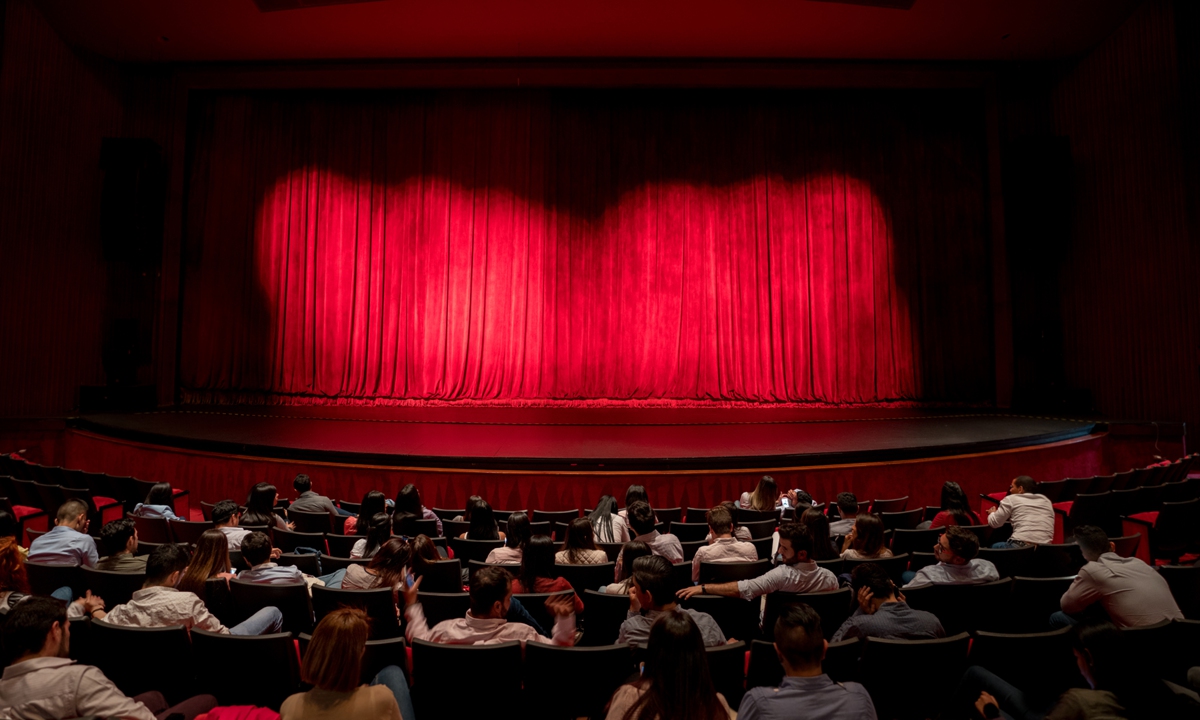
Photo: VCG
In the demanding arena of live theater, where every breath, gesture, and line faces immediate judgment from an audience that has paid for authenticity, a recent controversy involving a Chinese actress has ignited fierce debate.During the premiere of an ambitious avant-garde play, the star was widely criticized for spending much of the performance glued to a teleprompter. In later sections, she reportedly resorted to holding physical scripts or even a phone to read lines aloud. When backlash mounted, her defense was straightforward: The director had instructed her that memorizing lines was unnecessary and that she could improvise freely on stage.
This explanation collapses under scrutiny. "Free improvisation" and "avant-garde experimentation" are not synonyms for inadequate preparation. True innovation in theater has always rested on a bedrock of rigorous mastery, not the absence of it.
Consider the foundations of modern experimental drama. Samuel Beckett's absurdist masterpieces, such as Waiting for Godot, derive their power from actors who internalize the repetitive, rhythmically precise language to convey the existential void. Jerzy Grotowski's "poor theater" emphasized the actor's raw physical and vocal presence, stripped of technological crutches, demanding total commitment to the text and the body. In China, pioneering director Meng Jinghui's early works thrilled audiences because they blended sharp textual understanding with bold conceptual leaps. These artists did not treat the script as optional; they devoured it, then rebuilt.
The "avant-garde" label describes deliberate deconstruction after deep engagement, not casual delivery of half-memorized lines. Relying heavily on prompts transforms the stage into something closer to a rehearsed reading or corporate presentation.
Audiences do not purchase tickets to witness a celebrity reciting from a device; they seek the electric tension of live performance - the risk, the vulnerability, and the triumph of human craft under pressure.
This incident highlights a deeper tension in contemporary performing arts. In the film and television industry, technology has become a crutch: dubbing, CGI, body doubles, and digital corrections routinely mask imperfections. A scene can be shot dozens of times and stitched together in post-production. Theater, by contrast, remains one of the last bastions of unfiltered reality. There are no retakes, no edits, no safety nets. An actor stands exposed before hundreds of eyes, armed only with voice, body, and preparation.
This irreplaceability is exactly why theater still commands cultural respect even as screen entertainment dominates. When that contract of authenticity is broken, the audience feels not intellectual provocation but simple disrespect.
Defenders might argue that rigid adherence to text stifles creativity. Yet this misunderstands the relationship between discipline and freedom. Jazz musicians master scales and chord progressions before they improvise meaningfully. Dancers train their bodies to precision before they explore new forms. In theater, the same principle applies: Only when lines are internalized can an actor truly "play" the part, responding spontaneously to scene partners, the audience's energy, or unexpected moments without the text becoming a barrier. Clinging to a teleprompter or script signals not liberation but constraint. The mind is occupied with reading rather than embodying, listening, or discovering.
Chinese theater audiences, while perhaps unfamiliar with every Western theorist, possess an instinctive understanding of "sheng, tai, xing, biao," voice, posture, movement, and expression, as the foundational skills of the actor's art. They recognize when ambition outstrips execution.
This episode is not an isolated misstep but reflects broader challenges as more film and television stars venture into theater, drawn by its prestige. Cross-over appeal can invigorate the form, injecting fresh energy and drawing new crowds. Yet it also risks diluting standards if stars treat the stage as a vanity project or marketing exercise rather than a craft demanding humility and sweat.
As China's theater scene continues to evolve, blending tradition with bold experimentation, it must uphold core professional ethics. Audiences deserve better than stars treating the stage like a soundstage with invisible prompters. They deserve the real thing: actors fully present, fully prepared, and fully alive in the moment. The stage still insists on truth. Those who step onto it should honor that insistence, or step aside.
The author is a reporter with the Global Times. life@globaltimes.com.cn
RELATED ARTICLES