US military maintaining high-intensity South China Sea operations raises risks; provocations by Japan, Philippines warrant attention: think tank
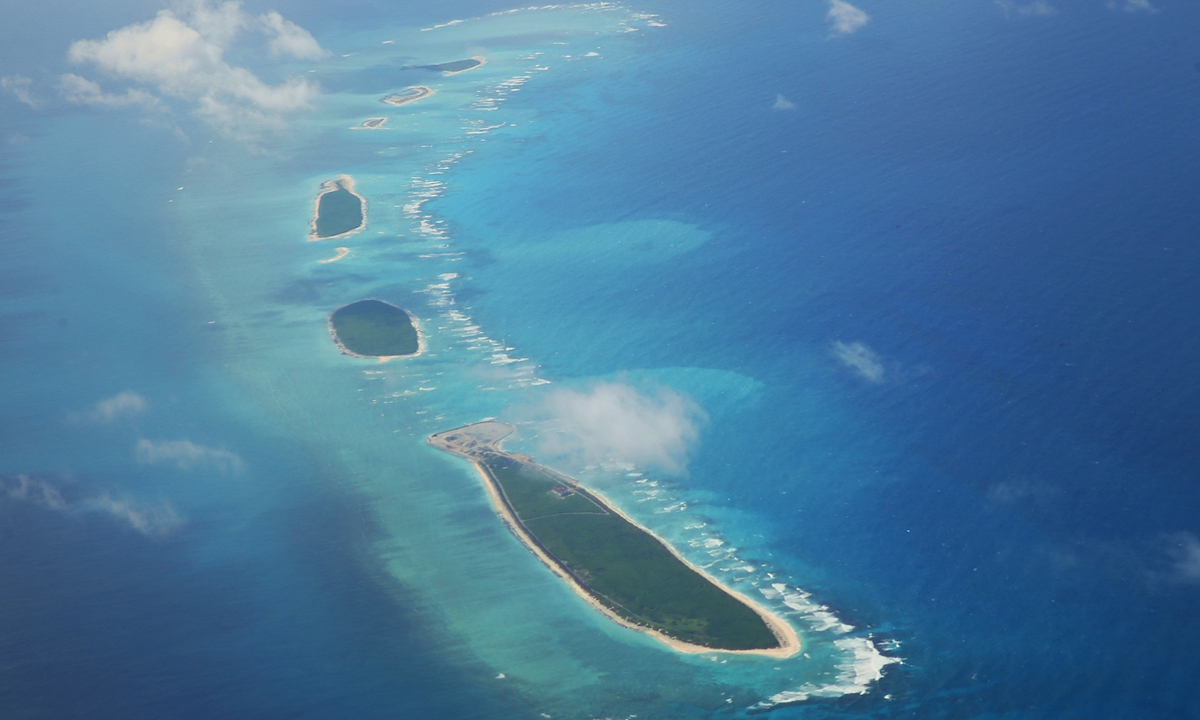
South China Sea Photo: VCG
The US military has maintained a high-intensity military presence in the South China Sea and its periphery in 2025, with close-in reconnaissance, drills and exercises, and joint operations with its allies continuing to expand, according to a report released Thursday by the South China Sea Strategic Situation Probing Initiative (SCSPI).
While the report found that some key US strategic platforms showed signs of slowing operational growth because of resource constraints, a Chinese expert warned that increasingly aggressive frontline operations, greater use of unmanned platforms and rising provocations by US allies, particularly Japan and the Philippines, could become more destabilizing factors in the region.
The report, titled "An Incomplete Report on US Military Activities in the South China Sea in 2025", found that the US military continued to strengthen its military deterrence against China.
According to the report, large reconnaissance aircraft conducted about 1,200 missions over the South China Sea in 2025, while ocean surveillance and oceanographic survey vessels accumulated 197 ship-days of activity.
US carrier strike groups (CSGs) have entered the South China Sea nine times, up slightly from eight deployments in 2024, while at least 11 nuclear-powered submarines operated in the region over the course of the year.
Furthermore, US bombers also conducted 13 sorties across seven deployments into the South China Sea and its surrounding areas, frequently rehearsing "north-south converging maneuvers" and "distributed operations".
Overall, the report said it sees sluggish growth of strategic platform activities from the US military. Although US CSG deployments increased modestly, the report noted that the actual intensity of carrier operations in the South China Sea declined compared with previous years. It attributed the slowdown largely to extended deployments in the Middle East, maintenance challenges and operational accidents involving CSGs such as the USS George Washington, USS Carl Vinson and USS Nimitz.
Reconnaissance activities, however, continued to expand. The report said US reconnaissance aircraft conducted approximately 1,200 sorties in the South China Sea in 2025, representing a moderate increase from 2024. The growth was driven primarily by unmanned aerial systems and expanded access to air bases in the Philippines.
"We have seen closer and more dangerous military approaches by US forces, reflecting what can be described as an 'autopilot' mode among frontline US military units in the region," said Hu Bo, director of SCSPI.
The report warned that despite constraints on major strategic assets, the broader Asia-Pacific, particularly the South China Sea, will remain the US military's most important strategic theater.
Facing growing resource constraints, the US military has increasingly relied on allied cooperation to sustain its regional presence. According to the report, the US military conducted 122 large-scale exercises in the South China Sea and surrounding areas in 2025.
Japan participated in 71 exercises, the highest number among US allies and partners, followed by the Philippines with 32.
Hu said that although the US has adopted a more assertive tactical posture, its overall military activities have moderated somewhat as resources are diverted to other hotspots. "The biggest security risk in the South China Sea today is no longer the US itself, but the increasingly provocative actions of Japan and the Philippines," he said.
Unlike the US, the two countries are less willing to acknowledge China's growing strength and are therefore more prone to miscalculation. "Many of the recent provocations highlighted in the report were initiated by Japan and the Philippines, making their actions an increasingly important source of regional instability," Hu said.
RELATED ARTICLES