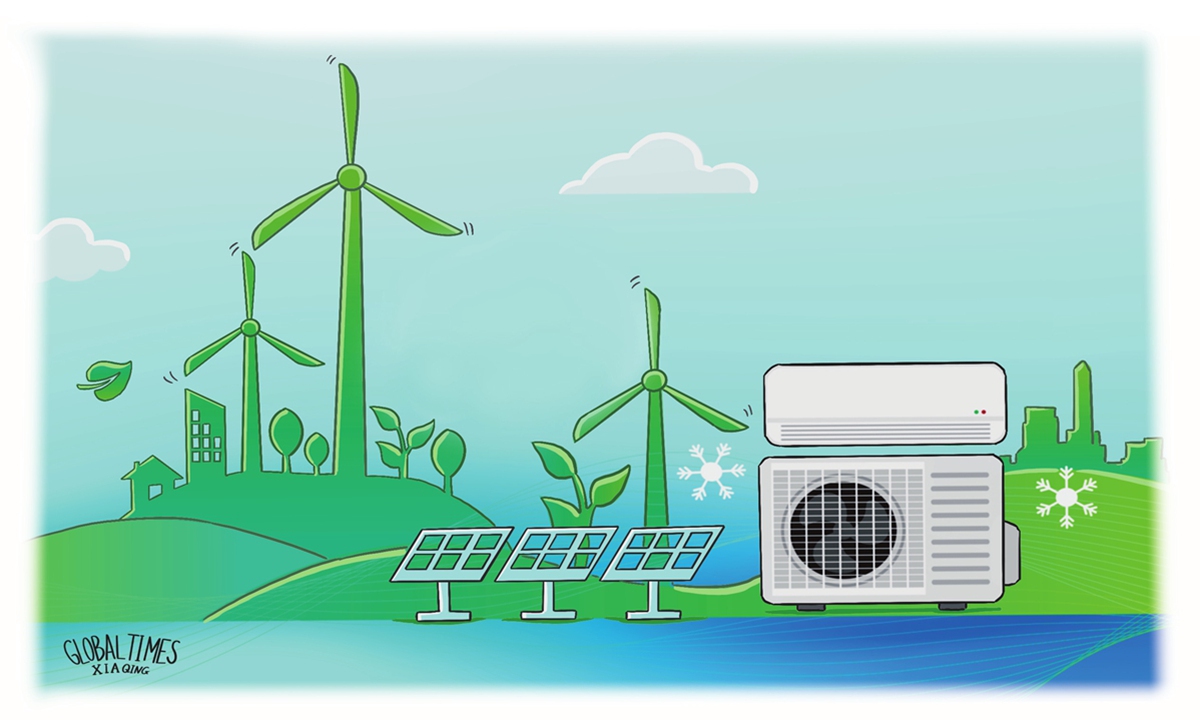
Illustration: Xia Qing/GT
A "deadly" heatwave is sweeping across the European continent. It is estimated to have caused around 15,000 deaths, many of them older people living in apartments and care homes without air conditioning. Amid the heatwave, air conditioners made in China have been almost snapped up across major shopping malls in Europe. On social media, many European users have remarked that "Chinese air conditioners are affordable" and that "Europe should import more." Scenes like this deserve careful reflection from EU policymakers.
Since 2020, extreme heat events have become significantly more frequent in Europe. Take 2025 as an example: temperatures in parts of Western Europe exceeded 46 C in June, while areas near the Arctic Circle experienced the longest heatwave on record, lasting three consecutive weeks in July. Another telling figure is that during the 2025 cooling year (a term used in the air-conditioning industry, referring to August 2024 to July 2025), Europe's imports of Chinese air conditioners surged by about 40 percent, making it the primary driver of global growth in China's AC exports. Beyond air conditioners, a wide range of Chinese-made cooling products - from fan-equipped sun hats to handheld fans and cooling blankets - have also gained popularity across Europe.
This forms the real backdrop to the recent hype among some European politicians over the so-called "trade deficit with China." For many European households, the requirements are straightforward: reasonable prices, easy installation, energy efficiency, and minimal disruption to older housing structures. In response to these practical and pressing needs, Chinese companies such as Midea Group, Haier, and Gree have introduced well-adapted products that are well received. These are affordable solutions chosen by European consumers under the real constraints of extreme heat, aging housing, and limited budgets.
Some European consumers have even shared stories online of traveling long distances to secure a Chinese air conditioner. One user said they spent two days searching across the EU, eventually driving 200 kilometers to purchase the last available unit - at a price that had already increased by 100 euro. Another commented bluntly: "If there were French air conditioners, I would buy French. But first, there has to be air conditioning. If France allows Chinese products, I'll buy Chinese." Such remarks capture the real, lived dimension behind Europe's trade deficit with China.
The rush among European consumers to buy Chinese air conditioners represents just a small piece of the broader mosaic of China-Europe economic and trade relations, but reflects a much larger picture. There is no coercion, no so-called "industrial domination" and no "shock." The logic is simple: demand generates orders, shortages drive imports, and competitive pricing sustains consumption. Real demand from society is the fundamental basis of China-Europe trade. Many Chinese exports to Europe serve diverse needs - some are intermediate goods required for industrial production, others are consumer products for daily life, and still others support Europe's green transition. At its core, China-Europe economic and trade cooperation is about mutual benefit and win-win outcomes.
Europe's air conditioner shortage is a reminder that the problem is not that China manufactures too well, but that some countries have been insufficiently prepared in terms of industrial capacity and public policy. For decades, Europe's architecture design, energy strategy, and industrial layout have been built on the assumption of a relatively mild climate, underestimating the prospect of extreme heat becoming the norm. Today, domestic manufacturing capacity, installation services, retrofitting of aging buildings, and the affordability of energy are all under growing strain in the face of changing climate conditions. Faced with these structural shortcomings, trade barriers cannot lower indoor temperatures, and political finger-pointing cannot increase supply. The only effective solution is to respect market dynamics and close capability gaps through mutually beneficial cooperation. Looking at China-Europe relations through the lens of a single air conditioner, the conclusion is straightforward: European consumers get better products, Chinese companies gain broader markets, and both sides find more practical pathways toward a green transition.
In fact, the EU has previously imposed tariff barriers on Chinese air conditioners on environmental grounds. However, these measures neither enhanced the competitiveness of European manufacturers nor meaningfully improved people's quality of life. Driven by the long-standing competitive market environment and a well-established industrial chain, Chinese air conditioner manufacturers quickly transitioned to next-generation refrigerants. Put simply, while Europe was still debating whether air conditioning was necessary, Chinese companies had already built better products. This example demonstrates that trade barriers cannot alter the broader trajectory of China-Europe economic ties; instead, they have imposed greater costs on European society itself.
Europe's scorching heat should have been enough to wake some people up. If European policymakers truly care about public opinion, they should take to the streets and ask ordinary citizens a simple question: would they support higher tariffs on Chinese-made air conditioners or import quotas that restrict their availability? European politicians, who have long portrayed themselves as champions of democracy, should not choose to ignore the most genuine public opinion. It is time for Europe's political elite to stop sleeping through the heat.