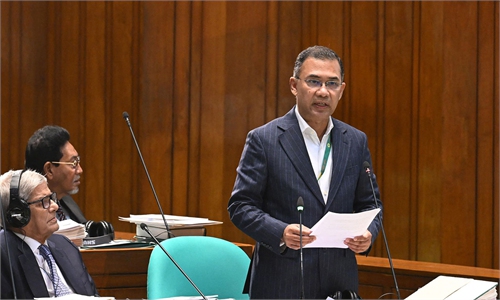
PM Rahman’s China visit has far-reaching implications
By Published: Jun 28, 2026 09:51 PM


Illustration: Xia Qing/GT
In an era marked by shifting global geopolitics, overlapping economic and security challenges, and growing uncertainty in international relations, neighborhood diplomacy and Global South cooperation have become pivotal variables reshaping the international landscape. The recent successive visits to China by leaders of Bangladesh and Cambodia reflect a collective choice of developing countries worldwide to pursue steady cooperation and deepen structural development partnerships, drawing regional and global attention to the value of neighborhood diplomacy, South-South solidarity, and partnership frameworks centered on mutual growth and sustainable development.
This wave of high-level exchanges reflects more than just improving bilateral friendship. It demonstrates a broader strategic readjustment taking place across South and Southeast Asia, where countries are increasingly prioritizing independent foreign policy choices, diversified development cooperation, and long-term economic certainty amid global volatility. Among these diplomatic engagements, Bangladeshi Prime Minister Tarique Rahman's official visit to China stands out as a landmark moment with far-reaching bilateral and regional implications.
During the historic visit, Bangladesh and China reached extensive consensus on trade, investment, industrial collaboration, and regional connectivity. The two sides formally agreed to build a China-Bangladesh community with a shared future in the new era, elevating bilateral relations to a higher level. Notably, Bangladesh voiced full support for China's four global initiatives which are important to maintaining world peace, development and international fairness and justice. This comprehensive endorsement reflects a deeper national-level understanding of inclusive global governance, modern development pathways, and win-win international cooperation, signaling growing political trust, strategic consistency, and mutual confidence between Dhaka and Beijing.
I particularly noticed that Prime Minister Rahman said that Chinese modernization is an example for Bangladesh to learn from. He noted that Bangladesh hopes to strengthen bilateral exchanges between political parties, advance Belt and Road cooperation, and enhance cooperation and exchanges in economy and trade, connectivity, agriculture, technology, green energy, education and health to help Bangladesh achieve modernization. I also deeply felt such expectations from my two contacts with the Bangladeshi delegation visiting China prior to the prime minister's visit.
I had the chance to interact with two Bangladeshi delegations visiting multiple Chinese cities, including Beijing and Shanghai recently. The two groups — consisting of youth and women representatives, as well as political party officials and local development stakeholders — offered genuine insight into how contemporary Bangladeshi society perceives China and future bilateral cooperation.
Though talks with them, I sensed that an increasing number of Bangladeshi young people, professionals, and local policymakers now regard China as a reliable, long-term cooperation partner capable of supporting Bangladesh's modernization agenda. During visits to industrial parks, innovation hubs, universities, and public governance institutions across China, Bangladeshi delegates were deeply impressed not only by China's rapid economic progress but also by its systematic governance, institutional order, policy continuity, and structured approach toward national development.
While traditional cooperation has long focused on infrastructure development, trade expansion, and basic investment projects, Bangladesh's new generation of stakeholders is increasingly eager to explore cooperation in emerging and future-oriented sectors. These include green development, renewable energy transition, digital economy, modern industrial upgrading, and public governance capacity building. This indicates that Bangladesh-China ties are moving beyond project-based toward comprehensive, multi-layered, and future-focused strategic collaboration.
It is important to recognize that Bangladesh pursues this strengthened partnership while maintaining its balanced and independent foreign policy. Like many South Asian nations, Bangladesh operates within a complex regional geopolitical environment and often faces external pressures. Against this backdrop, the recent China visit serves as a clear assertion of Bangladesh's diplomatic autonomy. It represents the country's deliberate choice to diversify its international partnerships, secure stable development resources, and create more space for its domestic modernization drive.
It must be clarified that deepening China-Bangladesh cooperation targets no third party and does not exclude other bilateral or multilateral cooperation mechanisms within the region. Upholding open regionalism, China welcomes Bangladesh to improve ties with all neighboring states, and South Asia is fully capable of fostering a win-win multilateral cooperation ecosystem. A handful of Western and Indian media outlets deliberately hype narratives of geopolitical confrontation, framing China-Bangladesh friendship as a game of blocs. Such rhetoric is rooted in outdated Cold War zero-sum mindsets and ignores the shared development aspirations of people in both countries.
From a broader lens, Rahman's China visit is not an isolated bilateral diplomatic event, but a microcosm of a prevailing trend among China's neighbors and Global South nations. Amid sluggish global economic recovery and turbulent industrial supply chains, developing nations are seeking predictable partnerships, cross-border connectivity, and inclusive growth mechanisms. Through sustained opening-up, stable industrial chains, and mature cooperative frameworks, China has become a key source of stability for regional economic integration.
In particular, the progress of the China-Myanmar-Bangladesh Economic Corridor has opened new prospects for cross-border connectivity, regional trade integration, and access to the Bay of Bengal. Although the corridor still faces practical challenges related to regional security, refugee issues, and local social conditions, Bangladesh and China share a common willingness to resolve obstacles through multilateral dialogue and sustained cooperation.
In an era of global shifts, development represents the greatest common ground for all nations. Prime Minister Rahman's historic China visit has elevated China-Bangladesh relations to a brand-new starting point, setting an exemplary model for countries pursuing independent development. As the China-Bangladesh community with a shared future takes root and the China-Myanmar-Bangladesh Economic Corridor moves forward steadily, China and Bangladesh will jointly boost regional integration in South Asia, inject certainty and development momentum into a volatile world, and deliver a clear and viable practical path for unity and self-improvement across the Global South.
The author is deputy director of the News Desk of the Global Times. The article was originally published in the Times of Bangladesh. chenqingqing@globaltimes.com.cn
RELATED ARTICLES