China launches 3 world-class carbon fiber production lines in major advanced materials push
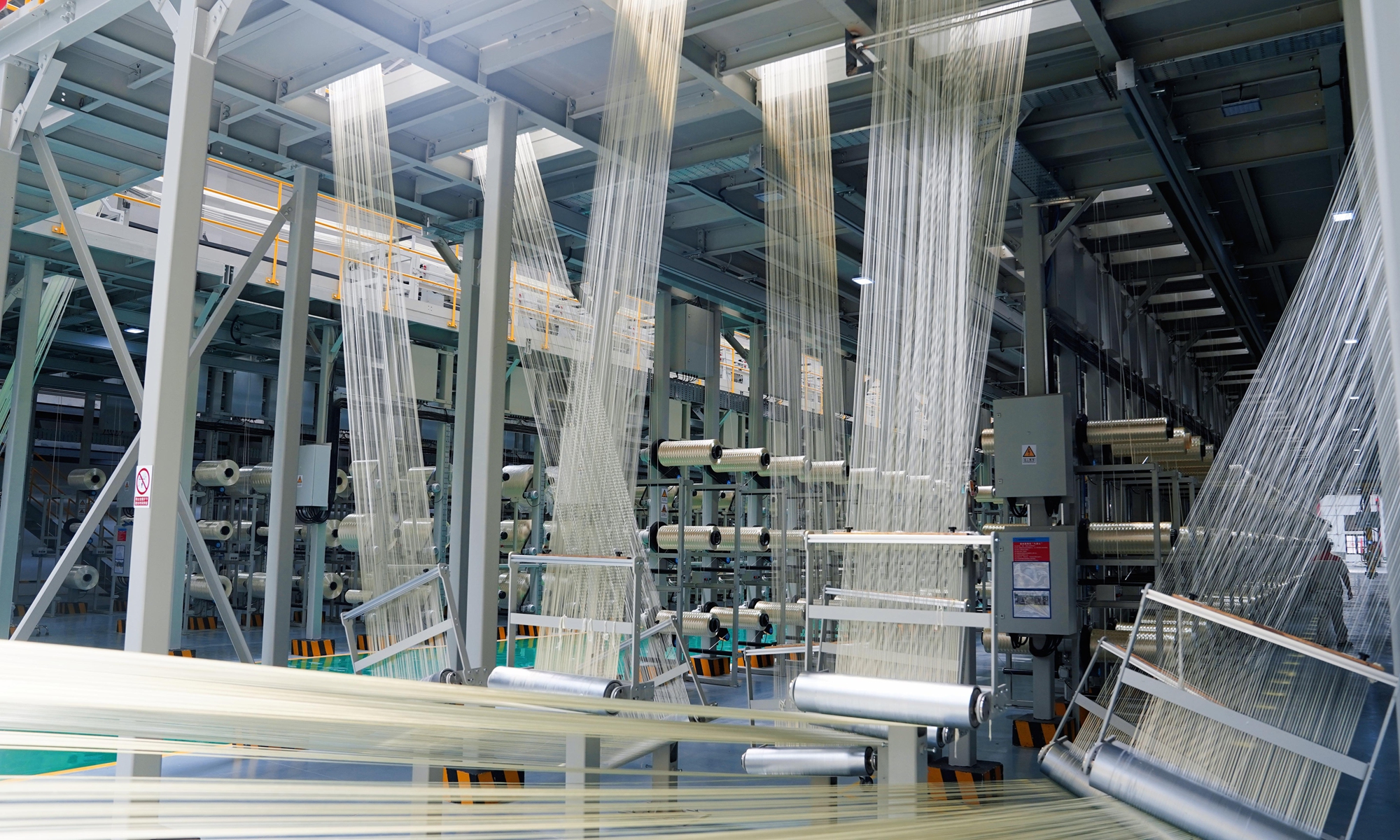
Screenshot of report by Sceince and Technology Daily
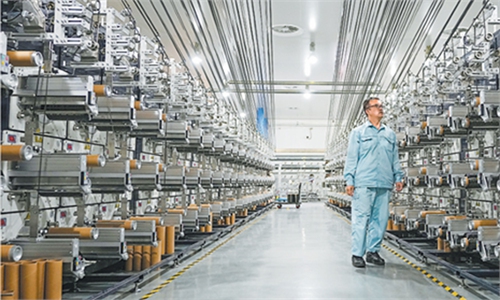
China National Building Material Group Co has put three world-class high-performance carbon fiber production lines into operation, marking a fresh milestone in China's push to strengthen its advanced materials sector and expand domestic supply of strategic materials for high-end manufacturing.
The new lines, which cover general-purpose, high-strength and high-modulus carbon fiber, will support applications ranging from aerospace and new energy to high-end sports equipment and consumer electronics, Science and Technology Daily reported on Sunday, citing the company.
The company announced on Sunday that the production lines have started operation at the Lianyungang base of Zhongfu Shenying Carbon Fiber Co, a CNBM subsidiary, in East China's Jiangsu Province. The newly commissioned lines have achieved a localization rate of more than 95 percent in core equipment, underscoring China's growing capacity to produce not only high-end carbon fiber products, but also the key manufacturing systems needed to make them at scale.
Carbon fiber, often called "black gold" in the field of new materials, is valued for its high strength, light weight, corrosion resistance and heat resistance. These properties make it a strategic material for industries such as aerospace, renewable energy, high-end sports equipment and consumer electronics.
All three lines are the largest of their kind globally in their respective product categories, according to the announcement.
One of the lines is a 1,000-ton-per-year SYT70, or T1100-grade, high-strength carbon fiber production line. Designed to meet cutting-edge demand for lightweight structures and high load-bearing performance in aerospace applications, the line represents the world's large-scale production of T1100-grade carbon fiber products on a 4-meter-wide production line.
Another is a 5,000-ton-per-year SYT45S-48K carbon fiber production line, which uses Zhongfu Shenying's proprietary dry-jet wet-spinning polyacrylonitrile large-tow preparation technology. Its products can be widely used in sectors such as wind power and new energy vehicles.
The third line, with an annual capacity of 600 tons, will produce SYM40-grade and above high-modulus carbon fiber. The products will provide high-rigidity and high-precision material options for deep-sea, deep-earth and deep-space applications, as well as competitive sports equipment and 3C electronics.
Zhongfu Shenying is one of China's key players in the industrialization of high-performance carbon fiber. CNBM information shows that the company's carbon fiber products are used in aerospace, pressure vessels, wind turbine blades, transportation, construction, and sports and leisure sectors.
The latest achievement comes as China's carbon fiber industry is moving beyond capacity expansion toward higher performance, broader product coverage and stronger domestic supply-chain resilience.
In March, China National Building Material Group released SYT80, a T1200-grade ultra-high-strength carbon fiber independently developed by Zhongfu Shenying Carbon Fiber. The material has an engineering tensile strength of more than 8,000 megapascals, and was the world's first T1200-grade carbon fiber product to achieve mass production, Science and Technology Daily reported.
In another development, a research institute under China Sinopec achieved a key technological breakthrough in wet-process T1000-grade high-performance carbon fiber and realized mass production in early June, marking another step in China's push to strengthen the domestic supply of strategic materials for high-end manufacturing and industries of the future.
"China now has a clearer, more forward-looking and better-supported road map for scientific and technological development. High-quality innovation in advanced materials will serve as a key foundation for future industries, helping sectors such as aerospace, the low-altitude economy and embodied intelligence to develop new products, upgrade technologies and build stronger global competitiveness," Wu Chenhui, an industry analyst, told the Global Times.
China's progress in high-performance carbon fiber reflects a broader shift in its advanced materials sector from relying on imports of key materials toward building a more complete industrial ecosystem. The expert said that strengthening capabilities in strategic materials will provide greater support for emerging industries and enhance the competitiveness of China's manufacturing sector in global markets.
Global Times
RELATED ARTICLES