Severe heatwave continues to grip much of Europe, sparking discussion among netizens of China's innovative products and governance capabilities
Severe heatwave continues to grip much of Europe, triggering debate on cooling gap
By Published: Jun 28, 2026 11:37 PM

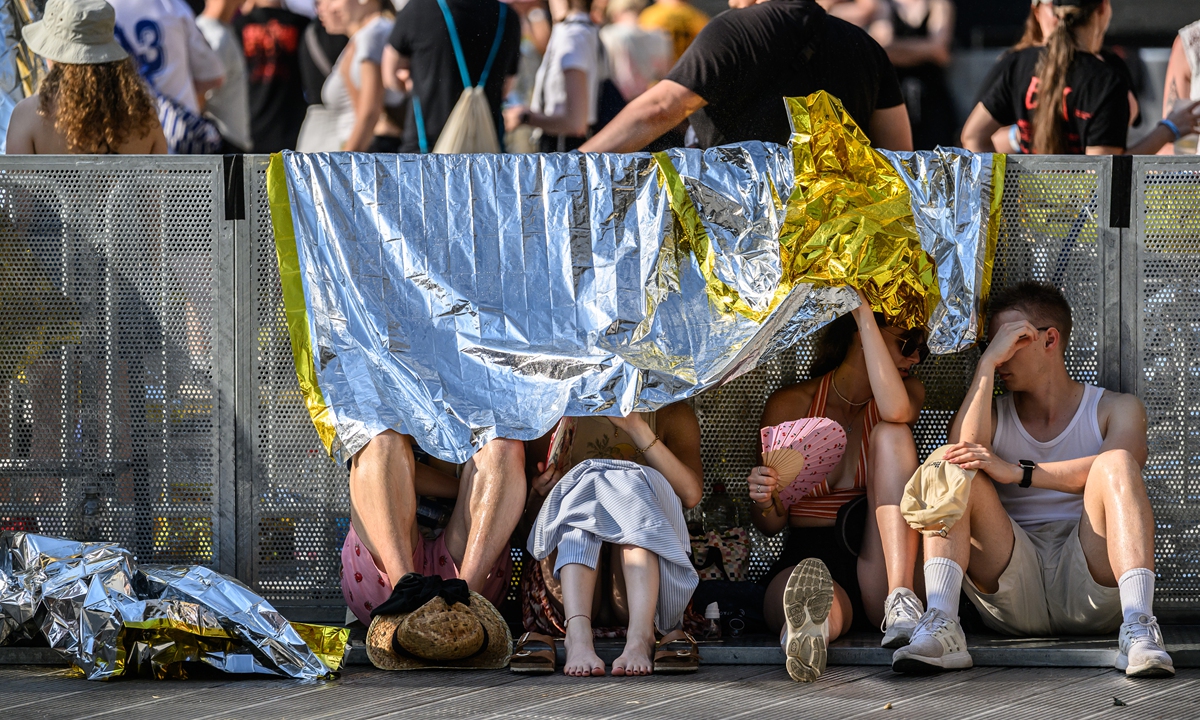
Fans of the band Kraftklub shelter from the sun under emergency tarps before the start of the concert as part of the 2026 "Sterben in Karl-Marx-Stadt" Open Air festival at Rudolf-Harbig Stadium in Germany on June 27, 2026. Photo: VCG
As a severe heatwave continues to grip much of Europe, extreme temperatures are disrupting daily life across major countries, with transport infrastructure strained, cultural landmarks adjusting operating hours, and urban spaces increasingly turning into heat shelters under record-high temperatures.
The controversy escalated after media reports said that in the European Commission's Brussels headquarters, air-conditioning was reduced on lower floors while senior offices remained cooled, prompting internal criticism and accusations of a "feudal" arrangement.
The incident has become a symbolic flashpoint in a broader argument over inequality, climate policy, and Europe's preparedness for increasingly frequent extreme heat events, which triggered heated discussions on international social media platforms, with some netizens beginning to draw comparisons between China and Europe and hailing the country's achievements in infrastructure construction and governance capabilities.
While a French expert said the heatwave illustrates the importance of long-term industrial planning and pragmatic cooperation with China, a Chinese expert said it also highlights China's governance philosophy of "putting the people at the center," noting that what Europe needs now is not just an air conditioner, but also the country's accumulated experience in urban infrastructure development.
Heated stress
In Germany, sections of its famous A2 motorway were forced to close after concrete road surfaces buckled under extreme heat, according to German daily Bild. France also reportedly forced the early closure of the Eiffel Tower and the Louvre Museum, two of Paris's most visited tourist attractions, as authorities grappled with soaring temperatures that have disrupted daily life across the country. In Italy, tourists visiting Rome's Colosseum were seen enduring prolonged exposure to intense heat with limited shade relief in surrounding public areas.
BBC also Wednesday reported that an event due to be held in central London about how the world can adapt to extreme heat has been cancelled due to soaring temperatures. The soaring temperatures have led to hundreds of school closures, or partial closures, across London and southern England.
On Chinese social media platform Xiaohongshu, trendy videos show residents demonstrating extreme heat effects at home in France, including attempts to cook food such as bacon and eggs using rooftop or balcony surfaces under direct sunlight.
Footage on social media shows shoppers in a French store elbowing their way through the crowd and clambering over one another to snatch portable air conditioners and fans from the shelves. Within seconds, the display had been stripped nearly bare, per the New York Post.
Leading Chinese air conditioner manufacturers are working around the clock to keep up with soaring demand for portable split air conditioners in Europe.
Chinese air conditioner manufacturer Midea told the Global Times on Saturday that the company's air conditioner plant in Shunde, South China's Guangdong Province, is currently working around the clock to ramp up production of its PortaSplit models.
The units are being rushed to Europe via China-Europe freight trains in a bid to catch what remains of the peak summer season, the company said in a statement.
In addition to Midea, major Chinese home appliance brands including Gree and TCL have also ramped up production of similar portable air conditioners, according to media reports.
Gree told the Global Times in a Sunday statement that this year, the company's actual air-conditioning sales from January to June increased by more than 40 percent year-on-year in these markets. Portable air conditioners, which are easy to install, have been in extremely high demand, and distributors across Europe have already nearly run out of stock of portable units.
Using Chinese cooling appliance to help address the local heat stress, Geoffroy Boulard, mayor of Paris' 17th arrondissement released a video on X on Wednesday, showing that he has begun deploying China-made air conditioners to public schools as France faces an intense heatwave that has pushed classroom temperatures to as high as 44 C.
The mayor said in the video that there would be 50 air conditioners to by deployed in schools. The video showed that the air conditioners were productions of Chinese company Haier.
"The growing demand for Chinese air conditioners in Europe reflects real consumer needs rather than political ideology. People choose products that are affordable, innovative and available," Pierre Picquart, an expert in geopolitics and human geography from the University of Paris-VIII, told the Global Times on Sunday. "This is not only about air conditioners. It illustrates the importance of long-term industrial planning, innovation and the ability to anticipate future demand."
Time magazine, in an article titled "Why Is Europe so ill-equipped to handle heatwaves?" pointed out that "Europe is warming twice as fast as the rest of the world - it's the fastest warming continent in the world and the second fastest region after the Arctic." However, "old buildings were not designed to include cooling, and the region's once-mild climate meant there was no need for air conditioners (AC)."
Bao Yuanyuan, a chief forecaster at China's National Meteorological Center, told the Global Times that the reason Europe's heatwaves have generated stronger social attention and impact lies primarily in the region's poor infrastructure resilience.
Most residential buildings, offices and even metro systems in central and western Europe were originally designed for cold protection rather than heat adaptation, and air-conditioning penetration remains low. As a result, when temperatures exceed 40 C, indoor environments in many European buildings can easily develop a "heat-trapping greenhouse" effect, Bao said.
The gap between the more frequent extreme heat and lack of AC or cooling systems escalated sharply inside EU institutions during the peak of the heatwave.
According to POLITICO Europe, on Saturday, the European Commission shut down air-conditioning in the lower floors of its Brussels headquarters while upper floors - including offices used by senior officials - remained cooled.
The report cited internal staff frustration, with one employee describing the arrangement as "feudalism," highlighting perceived inequality in access to basic comfort during extreme heat.
In France, the air-conditioning issue has become a political fault line. According to the NYT, in France, far-right politicians who have advocated cutting net zero initiatives hope to gain from the heatwave, using it to accuse the government of failing to make the country more resilient, but also as a cultural issue against the hard left, which has often opposed the use of air-conditioning on environmental grounds.
The French government, however, has repeatedly pushed back against the notion that widespread air-conditioning is a good solution, as it could further increase outdoor temperatures by releasing heat into the streets, POLITICO Europe reported on Thursday.
Jiang Feng, a senior researcher at Shanghai International Studies University and president of the Shanghai Regional Studies Association, told the Global Times that European left- and right-wing politicians are locked in disputes. Each side deliberately steers the issue in a direction that benefits itself, making the rapid resolution of real problems increasingly complex. It is very difficult for the governments to quickly make decisions and implement them on the ground — the idea of "just getting it done" has become extremely challenging. This has become a highly prominent political phenomenon in Europe today.
The scorching summer heat only makes people physically uncomfortable, but the white-hot political situation fills people with indignation. This basically sums up Europe's current dilemma of "double heat," Jiang noted.
China's cool in comparison
Against the backdrop of scotching heat in Europe while limited access to the air-conditioning appliance, the heatwave has triggered widespread online discussion on international social media platforms, where comparisons between Europe and China have become increasingly visible.
On social media platforms such as X, users have highlighted differences in everyday heat resilience. Many posts point out that in China, air conditioning is widely available in residential buildings, offices, public transport and commercial infrastructure, allowing cities to maintain relatively stable indoor temperatures during extreme heat events.
While such commentary is informal and varied, a recurring narrative is that China's rapid urbanization has produced a more scalable cooling infrastructure in major cities, particularly in megacities facing increasingly frequent heatwaves.
X user Aubin DIDON wrote in her post on Sunday that "China has equipped its residential complexes with misting systems. Activated during heatwaves, they lower the air temperature in outdoor spaces by 3 to 6 degrees Celsius. In the West, you're told that you must learn to live with the heatwave and that air conditioning is bad."
"China has an ingenious way of keeping the temperature down outdoor evaporative mist cooling systems spray ultra-fine water droplets into the air that evaporate quickly, absorbing heat," Mario Nawfal wrote on X.
X-user Ketul Parmar wrote in the post that "Europeans can't afford Air Conditioners, so they have to sleep in public places. What kind of developed states is there? China which according to Europeans a developing country is much better."
Even more to the point, X user Christineza said that "Europeans don't want a trade war with China, they want ACs made by a Chinese company, desperately."
Chen Hong, Director of Country and Region Studies Institute, School of Foreign Languages, East China Normal University, who just returned to China after a trip to Sweden, shared with the Global Times on Sunday that "although I didn't experience extreme heat, temperatures still reached 30 C. What struck me deeply was that many hotels had clearly inadequate air conditioning - some didn't even have proper air conditioning at all. This forms a sharp contrast with many cities in China."
In China, large-scale cooling facilities have become a standard part of modern urban infrastructure — whether in hotels, shopping malls, high-speed rail, subways, schools, or hospitals. People take it for granted and rarely pay special attention to it. But in Europe, one realizes that this is actually a very important public service capability, he explained.
"Europe should look beyond ideological debates and strengthen its own long-term competitiveness while developing pragmatic cooperation with China," Pierre Picquart noted.
"What Europe needs is not just an air conditioner, but also China's accumulated experience in urban infrastructure development. This includes power grid construction, energy-efficient building renovations, cooling systems for public transportation, and urban governance capabilities for dealing with extreme weather," Chen said.
RELATED ARTICLES