China, Russia conduct 11th joint strategic air patrol; expert says drill shows systematic deployment and high combat readiness
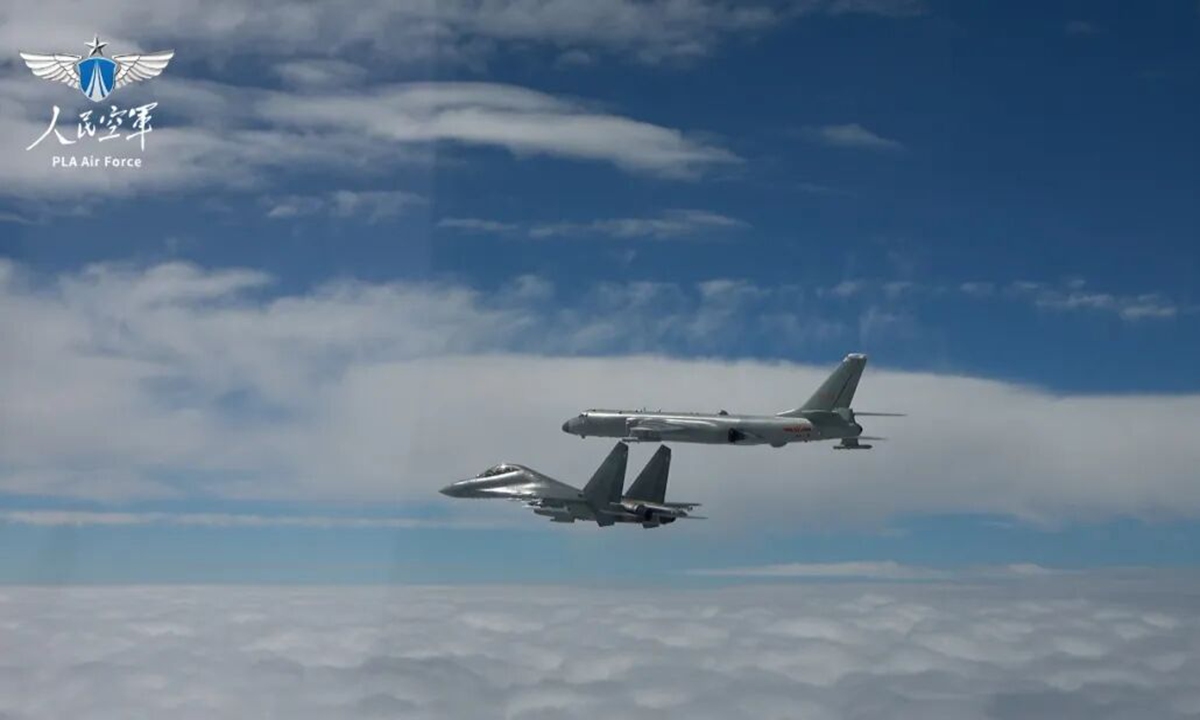
Two aircraft are seen in a photo released by the PLA Air Force on June 27, 2026, during the 11th China-Russia joint strategic air patrol over the Sea of Japan. Photo: PLA Air Force's official WeChat account
Regarding the 11th China-Russia joint strategic air patrol announced by China's Ministry of National Defense (MND) on Saturday, a Chinese military expert told the Global Times that this year's joint patrol was marked by two key features — systematic deployment integrating bombers, fighter escorts, electronic warfare aircraft and aerial refueling, and high combat readiness.The air forces of China and Russia conducted the 11th joint strategic air patrol over the Sea of Japan, the East China Sea and the Western Pacific on Saturday, demonstrating their resolve and capability to jointly safeguard regional peace and stability, MND said Saturday.
Also, the Russian Defense Ministry said that the Russian Aerospace Forces and the Chinese People's Liberation Army (PLA) Air Force have conducted a joint six-hour patrol in the Asia-Pacific region, reported Russian News Agency Tass on Saturday.
According to Tass, during the mission, aircraft from both countries operated strictly in accordance with international law, the ministry emphasized. "No violations of foreign airspace were committed," it added.
Video released by CCTV's military channel showed that the Chinese side deployed H-6K bombers and J-16, J-10C and J-11B fighter jets during the joint patrol. According to Japan's Defense Ministry, Russia sent Tu-95 bombers and Tu-142 patrol aircraft to form a joint formation with the Chinese aircraft.
Chinese military affairs expert Zhang Xuefeng told the Global Times on Sunday that in recent years, China has deployed an increasingly diverse range of aircraft with improved performance and greater system integration for the joint strategic patrols.
This year's patrol highlighted two key features. The first is a system-of-systems approach: in addition to the H-6K bombers and multiple escort fighters, China also deployed new large electronic warfare and reconnaissance aircraft to provide intelligence support, with the KJ-500A early warning aircraft serving as an airborne command platform and the YU-20 providing aerial refueling to extend the range of the fighter escorts, said Zhang.
The second is the high level of combat readiness: the escort fighters, including the J-16, were armed with live munitions, and their electronic reconnaissance and jamming systems are capable of intercepting foreign radar signals for analysis and positioning, and, if necessary, jamming them to enhance self-protection, Zhang said.
Japan, however, has overreacted to what is a routine patrol. Japan's Defense Ministry claimed late Saturday night that Chinese and Russian bombers flew long distances over the Sea of Japan, the East China Sea, and the Pacific, prompting the Air Self-Defense Force to scramble fighter jets.
The Asahi Shimbun claimed on Sunday that this marks the first confirmed joint patrol of Chinese and Russian aircraft near Japan since December in 2025. The Defense Ministry also voiced so-called "serious concerns" over the patrol through diplomatic channels.
Notably, while expressing "concerns," Japan has also been conducting its own provocations, including tracking, monitoring and photographing Chinese naval formations operating in the Western Pacific.
On June 22, the PLA Navy's Liaoning carrier group successfully completed far-sea combat-oriented training and returned safely to its home port in Qingdao, East China's Shandong Province, according to the PLA Navy Wechat account.
During the exercise, Japanese vessels and aircraft repeatedly conducted close-range tracking, surveillance and provocative harassment against the Chinese formation. The Liaoning group maintained a high state of alert throughout, continuously launching carrier-based fighter jets for combat sorties, flexibly adjusting its combat formation, and responding professionally and steadily to Japan's dangerous actions, said the PLA Navy.
Zhang Junshe, a Chinese military affairs expert, said on Sunday that Japan's harassment of the Chinese carrier group is an attempt to create tension and, in doing so, find excuses for its own military expansion and constitutional revision, as part of its bid to re-establish itself as a major military power. Both the international community and Asian neighbors should stay highly vigilant against such moves.
RELATED ARTICLES