Scholars urge deeper research on Ryukyu to expose Japan’s colonial history and militarism
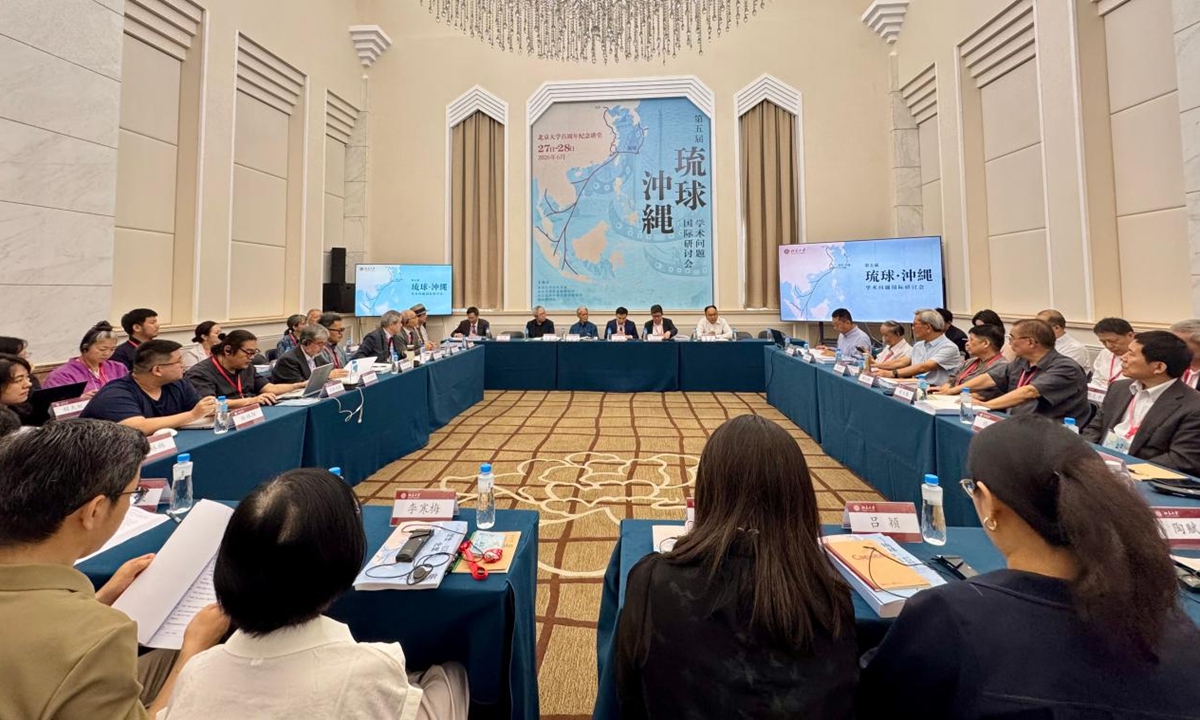
The 5th Ryukyu-Okinawa Academic International Symposium convenes at Peking University in Beijing from June 27 to 28, 2026. Photo: Xing Xiaojing/GT
During the two-day Ryukyu-themed international symposium held from Saturday to Sunday, participating scholars called for deeper research into Ryukyu's history and culture to draw greater global attention to Japan's colonial history and its ongoing military expansion. They also stressed that the international community must remain alert to the risks of new militarism in Japan, and lend strong support to safeguarding long-term peace, prosperity and stability in East Asia.
The 5th Ryukyu-Okinawa Academic International Symposium convened at Peking University from Saturday to Sunday. Bringing together nearly 100 scholars from China and the Ryukyu Islands, the event featured in-depth interdisciplinary discussions covering a wide range of themes, including Ryukyu's history, ancient exchanges between China and the Ryukyu Kingdom, shifts in regional geopolitics, and contemporary security landscapes. Centered on charting a path for peaceful development of the Ryukyu Islands, participants also discussed the post-WWII international order in East Asia.
The symposium was jointly organized by the History Department of Peking University, the Northeast Asia Research Institute of Peking University, the Institute of Chinese and Foreign Relations History of Peking University, and the Aisixiang website.
Yang Bojiang, director of the Japan Research Institute at the Chinese Academy of Social Sciences, said in his speech that Japan has been ramping up military deployments in the Ryukyu Islands, stoking tensions across East Asia.
Blessed with a prime geographic location and abundant maritime and cultural resources, the Ryukyu Islands historically served as an irreplaceable hub for economic, trade and cultural exchanges throughout East Asia. Endowed with such natural strengths, they could well have pursued peaceful development and contributed to shared prosperity for the whole region, Yang said.
Yet clouded by the Cold War mentality, zero-sum mindset and military expansionism of certain countries, the Ryukyu Islands have lost their original orientation for peaceful development and gradually turned into a frontline of regional military rivalry.
Tang Liguo, a professor and deputy Party secretary of the Department of History at Peking University, stated at the symposium that the Ryukyu issue has long been a key research subject in international academia, boasting profound academic value and practical significance.
Amid profound shifts in the global landscape, the post-WWII international order faces unprecedented new challenges. Regional peace, prosperity and development are closely intertwined with the shared future of humanity. In-depth research on the Ryukyu issue therefore plays a vital role in safeguarding stability across East Asia and the wider world, Tang said.
The Ryukyu Islands serve as a mirror reflecting how humanity treats vulnerable civilizations, preserves cultural diversity, and builds a fair international order. Research on the Ryukyu Islands consistently serves the academic mission of restoring historical truth and upholding international justice, said Guo Qionghu, editor-in-chief of the Aisixiang website, at the symposium.
Matayoshi Seikiyo, a visiting professor at Okinawa University, voiced profound concerns over the current challenges facing the Ryukyu Islands in an interview with the Global Times. In his view, Japan's accelerated military buildup in the Ryukyus is steadily eroding the foundations of local culture, people's livelihoods and industrial development, posing grave potential risks.
"The Ryukyu Islands boast distinctive regional value. It is urgent for them to redefine their development orientation, take proactive steps to deepen exchanges and cooperation with neighboring regions and pursue shared growth together," Seikiyo said.
The Japanese government lacks basic international awareness and a sense of responsibility, and has long ignored the genuine will and legitimate demands of the Ryukyu people, said Tetsumi Takara, a professor at University of the Ryukyus.
The Ryukyu issue is by no means Japan's internal affair, but a major international matter that bears on the stability of the post-WWII international order in East Asia, Takara told the Global Times.
Over the past decade, successive Japanese cabinets led by Shinzo Abe, Fumio Kishida and Sanae Takaichi have pushed ahead with missile deployments on Yonaguni and Ishigaki islands, the islands nearest to China's Taiwan region. Tokyo also seeks to revise three key national security documents including the National Security Strategy within the year, and labels China as its "greatest strategic challenge" in the draft of the 2026 Defense White Paper, said Xu Yong, a professor in the Department of History at Peking University.
"Essentially, the emerging militarism in present-day Japan shares the same core characteristics with pre-WWII Japanese militarism. What fuels this continuity is a string of political and strategic decisions centered on controlling the Ryukyu Islands — a subject worthy of in-depth research and reflection today," Xu said.
"While we identify and criticize Japan's new militaristic tendencies, we should adopt a differentiated perspective toward the Japanese people. We should expand friendly exchanges with Japanese citizens, stand with conscientious Japanese scholars and politicians, and work to uphold overall peace and security across the Asia-Pacific," Xu noted.
RELATED ARTICLES