China's Qingzhou cargo craft test vehicle unveils in-orbit results related to future space hospital and biological cultivation in space
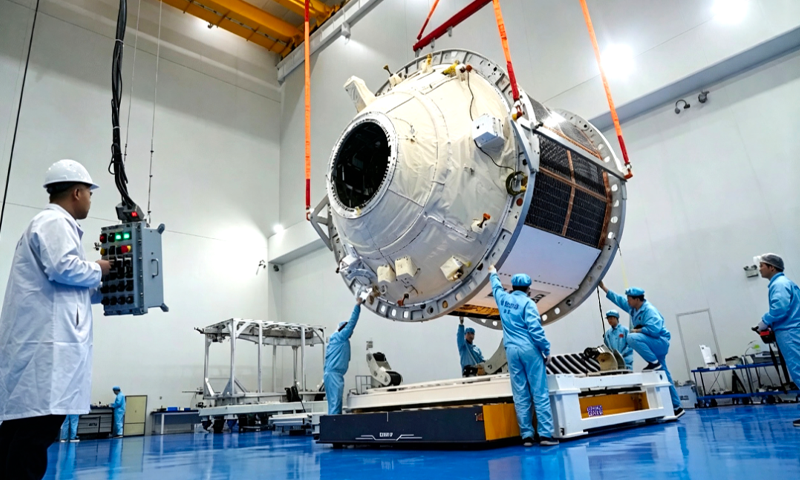
Assembly process of the Qingzhou cargo spacecraft test vehicle Photo: WeChat account of the Innovation Academy for Microsatellites of the Chinese Academy of Sciences
The second batch of in-orbit test results from the Qingzhou cargo spacecraft test vehicle was released on Monday, covering fields including precise measurement in space, cost-saving and efficiency-enhancing technologies for space missions, future space hospital, and biological cultivation in orbit, which provide technical support for the application of new space technologies, according to CCTV News.
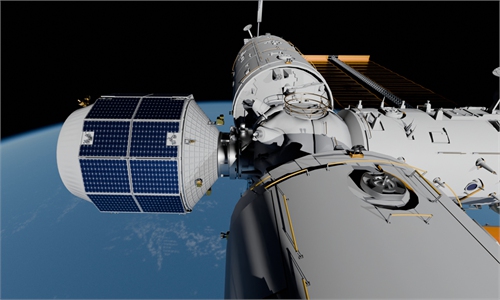
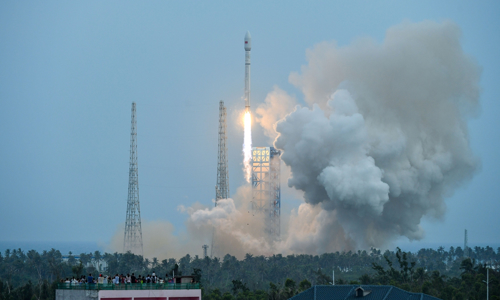
The test vehicle was launched into orbit on March 30 aboard a Lijian-2 Y1 carrier rocket. Developed by the Innovation Academy for Microsatellites of the Chinese Academy of Sciences (IAMCAS), the vehicle has a total mass of 4.2 tons, carries one ton of scientific payloads, and has a three-year in-orbit operational life, according to the Xinhua News Agency in April.
Among the latest in-orbit test results, the cost-saving and efficiency-enhancing technologies for space missions focus on developing support equipment for maintaining spacecraft in orbit and supporting astronauts' daily work and living in the space environment, according to CCTV News on Monday.
The test vehicle carried an upgraded vapor-compression space refrigerator, a key piece of equipment designed to preserve astronauts' food and temperature-sensitive biological samples for future space missions. During the in-orbit tests, the refrigerator overcame the challenge of gas-liquid separation and stable compressor operation in microgravity, providing a cost-effective solution to cold-chain logistics aboard the space station and future extraterrestrial refrigeration applications.
A comprehensive healthcare support system will be indispensable if humans are to live in space for extended periods or eventually establish space bases. This is the central focus of the future space hospital project, the report noted.
According to CCTV News, space biological cultivation has been a key priority for China's life science research conducted on the Tiangong space station over the past two years. A host of in-orbit experiments involving zebrafish, hornwort, and space mice have been completed previously. Multiple technical verifications in relevant fields were carried out during the on-orbit tests aboard the test vehicle this time.
Chinese researchers have also developed an electromyography monitoring device that addresses the limitations of conventional astronaut muscle monitoring, which relies on manual operation and cannot provide continuous measurements. Equipped with a domestically developed neural chip, the device demonstrated for the first time in orbit the feasibility of continuously collecting and transmitting weak muscle electrical signals in real time.
In addition, the handheld blood cell analyzer eliminates dependence on large medical equipment and ground instruction, providing critical technical support for establishing a real-time human health assessment and support system under complex space environments.
Chang Liang, chief designer of the Qingzhou cargo spacecraft, stated that the test flight is intended to conduct comprehensive in-orbit testing for the flight model spacecraft and verify a host of key technologies including sealed cabin and propulsion systems. All these tests have laid a solid technical foundation for the flight model of the Qingzhou cargo spacecraft.
It is expected that the flight model of the Qingzhou cargo spacecraft will be launched in early 2027 and officially dock with the Tiangong space station, Chang said. Moving forward, it will act as an important supplement to Tianzhou cargo spacecraft, undertaking relatively low-cost cargo transportation and other missions for China's space station. At present, the development of the flight model of the Qingzhou cargo spacecraft is steadily advancing, per CCTV.
Global Times
RELATED ARTICLES