Beijing launches space computing innovation center, first in nation
Move a key step in advancing digital infrastructure: expert
By Zhang Yiyi and Published: Jun 29, 2026 10:31 PM

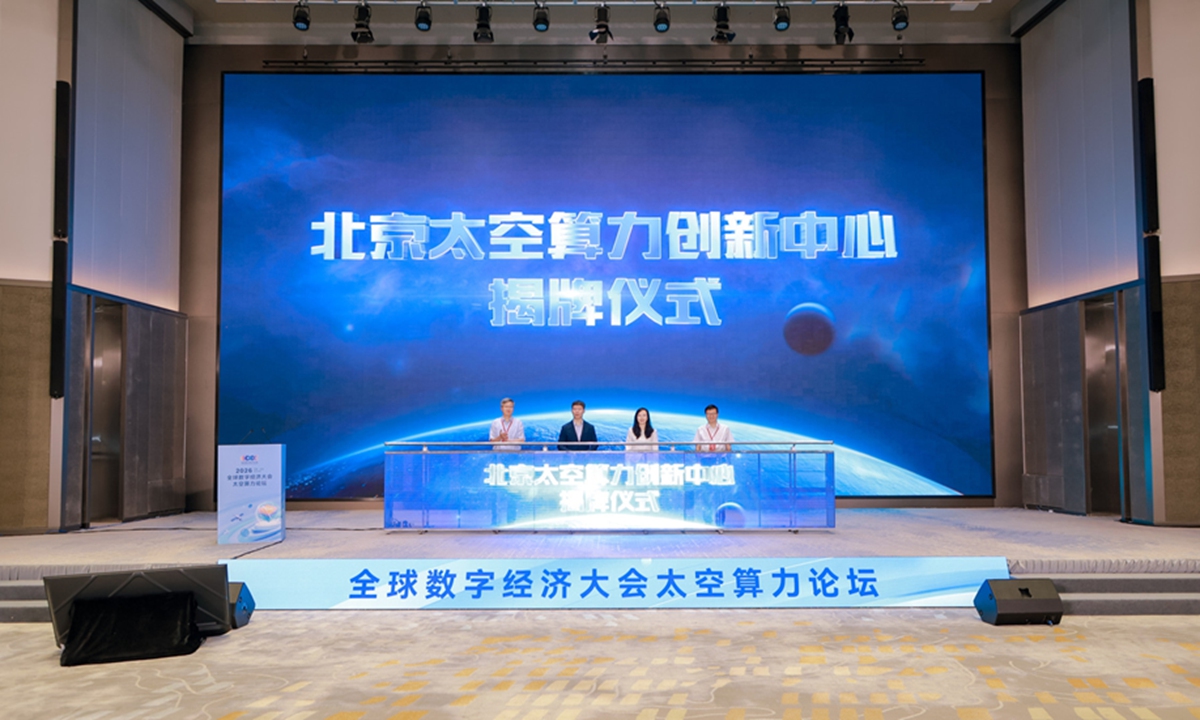
Photo: Courtesy of Zhongguancun Science City
The Beijing Space Computing Innovation Center was officially unveiled on Monday at the Space Computing Forum of the Global Digital Economy Conference held in Zhongguancun, Haidian District, Beijing, where experts said the move marks a key step in advancing space-based computing as a new frontier of digital infrastructure, with strong development potential and broad application prospects.
Approved by the Beijing Municipal Bureau of Economy and Information Technology, the center is positioned as China's first innovation hub dedicated to breaking bottlenecks across the industrial chain and promoting integrated industrial development. It aims to build a full-stack, vertically integrated space-based computing capability covering "chips, hardware, platforms, intelligence, networks, and applications," according to the center's official WeChat account.
The Beijing Space Computing Innovation Center operates under a "company + alliance" dual-engine model, with Beijing Tiansuan Xinglian Technology Co serving as its operating entity.
Space-based computing refers to deploying computing, storage and intelligent analytics capabilities in low Earth orbit, with constellations of computing satellites and space stations being key platforms, to build a new type of integrated space-ground computing network with seamless coordination and global coverage, according to the Xinhua News Agency.
The innovation center will focus on coordinated R&D of core technologies, including onboard AI chips, high-performance computing payloads, intelligent satellite systems, space-based large models and integrated space-ground cloud platforms. It will also build shared public infrastructure such as integrated ground verification facilities and space-ground testing environments covering the full chain from chips to systems and open to upstream and downstream industry players, according to a statement sent by Zhongguancun Science City.
It will also contribute to standard-setting and ecosystem development by participating in national and industry standards formulation and promoting an open, collaborative industrial ecosystem. In parallel, it will advance the commercialization of space computing through applications in urban governance, "space computing-based services," and tokenized AI-driven services, supporting the large-scale rollout of space-based computing applications.
Tang Chao, deputy head of the Zhongguancun Science City Administrative Committee and vice mayor of Haidian District, said in the forum that space-based computing represents a new track for developing new quality productive forces through aerospace integration. She said Haidian is advancing the establishment of the Beijing Space Computing Innovation Center.
Meanwhile, the Beijing Space Computing Innovation Alliance was also launched, with 108 founding member organizations joining as initial prospective participants. The alliance brings together a diverse range of innovation actors, including universities, research institutes, state-owned enterprises and private companies, per the statement.
GalaxySpace is a member of the Space Computing Industry Innovation Center. Zhang Shijie, chief scientist at GalaxySpace, told the Global Times that a breakthrough reduction in satellite costs and the shift toward low-cost, industrialized mass production mark a key step toward building a scalable and operable space computing network.
Zhang said the company's satellite smart factory extensively uses intelligent assembly robots, digital manufacturing systems and automated integrated testing platforms as its "smart brain," significantly enhancing flexible production and digital manufacturing capabilities.
China Mobile, a telecom "national team" participating in the forum, also outlined its plans in space computing, noting that it began developing the field in 2023.
China Mobile will first establish unified space-ground communication and computing standards under the 6G framework, enabling satellites and terrestrial devices to operate within a shared system. It will then build a centralized "computing brain" to integrate and schedule satellite and ground computing resources.
Wang Peng, an associate research fellow at the Beijing Academy of Social Sciences, told the Global Times on Monday that the launch of the Beijing Space Computing Center marks a key step in extending China's computing infrastructure from Earth to space.
He said space computing can process satellite data directly in orbit during emergencies such as wildfires and earthquakes, cutting disaster-response time from hours to minutes by avoiding the transmission of enormous amounts of raw data to the ground. It enables real-time global processing for applications like smart agriculture and ocean monitoring, while supporting navigation and emergency services in remote areas. Powered by solar energy and space cooling conditions, it can also reduce energy use and lower the cost of cloud and AI services.
Experts said that with the rapid development of AI, computing power consumption has increased significantly, making the expansion and upgrading of computing capacity increasingly critical.
Official data shows that during the 15th Five-Year Plan (2026-30) period, electricity consumption by computing power is expected to increase by more than 100 billion kWh annually. By 2030, it is projected to reach around 800 billion kWh, accounting for roughly 6 percent of total electricity consumption.
China's commercial space sector will expand satellite application scenarios and cultivate new business models integrating sensing, communication, computing and applications across space, air and ground. It will also promote the cross-sector integration of space technologies to empower other industries, the head of the China National Space Administration said in April.
In the same period, the Ministry of Industry and Information Technology said it would support forward-looking research on space-based computing technologies and promote the orderly development of the space computing industry.
Wang noted that China has already achieved many global "firsts" in areas such as satellite constellation networking and in-orbit AI inference, and is well positioned in the global first tier. As land, energy and cooling constraints intensify for terrestrial AI computing, he said space computing represents a next-generation infrastructure with significant long-term potential.
RELATED ARTICLES