China, EU launch trade consultation mechanism; devt injects hopes but frictions may persist if Brussels shifts blame: expert
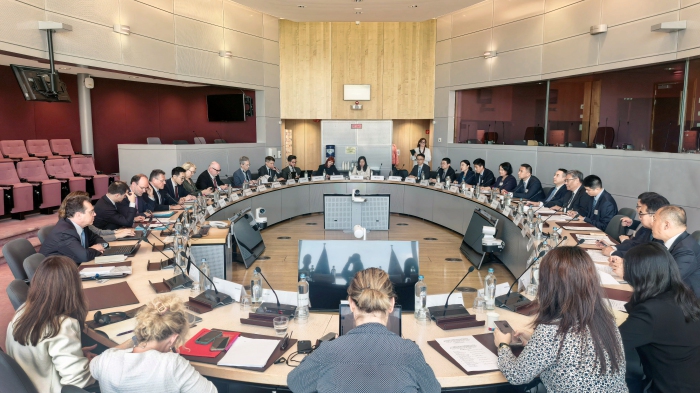
Photo: China's Ministry of Commerce
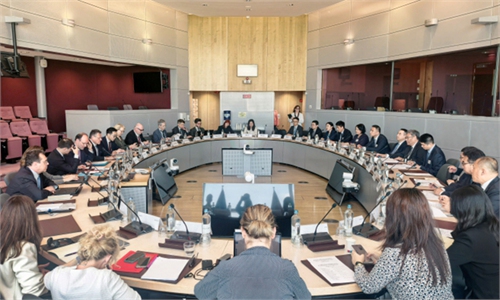
China and the EU have officially established the China-EU trade and investment consultation mechanism, with the two sides holding the inaugural meeting on Monday in Brussels, according to a joint statement released on Tuesday.
During the first meeting, both parties identified four initial workstreams under the mechanism: trade and investment balancing, export controls, intellectual property rights and WTO reform, according to the statement.
China's Minister of Commerce Wang Wentao and European Commissioner for Trade and Economic Security and Interinstitutional Relations and Transparency Maros Šefčovič co-chaired the meeting, engaging in comprehensive, in-depth, and constructive discussions on key economic and trade issues, the Chinese Ministry of Commerce (MOFCOM) said in a statement on Tuesday.
The two sides also agreed to set up a joint monitoring mechanism to exchange relevant data, monitor trade flows and support technical work with a view to improving transparency, enhancing mutual trust and managing trade frictions, said MOFCOM.
The new mechanism will help prevent potential friction through bilateral communication and ease existing issues through consultation, Jian Junbo, director of the Center for China-Europe Relations at Fudan University's Institute of International Studies, told the Global Times on Tuesday.
"The mechanism provides both sides with a platform to prevent and resolve economic and trade disputes, helping to defuse frictions and make bilateral economic and trade ties more stable and predictable, which is a positive development," Jian said.
Both sides agreed that expanding market access would help balance trade relations. They discussed possible tariff and non-tariff measures, exchanged lists of market access issues, and agreed to continue consultations under the trade and investment balancing workstream to achieve progress on specific issues.
Wang and Šefčovič authorized bilateral officials to maintain communication on the four workstreams and agreed to hold another ministerial-level meeting in autumn 2026.
Both sides took note of the positive results of the China-EU export control dialogue regarding rare earth elements and other critical materials and minerals, and intended to strengthen dialogue in this field, according to the joint statement. The two sides recognized the need to strengthen the China-EU export control dialogue and agreed to take further facilitation measures to maintain the stability of global industrial and supply chains.
Jian noted that the main frictions between China and the EU currently center on trade balances, export controls, as well as technology and intellectual property protection - issues of concern to both sides. The working areas established under the mechanism precisely cover these pressing and pertinent frictions and are thus expected to play a more constructive role in addressing the core disputes at hand, he said.
According to Politico, Šefčovič said after meeting Wang that he would visit China in October, hoping to present the "first tangible results."
"Economic and trade frictions between China and the EU will persist in the short term, but the key is that once such a mechanism is in place, there is hope of easing them and keeping frictions in check to a certain degree," Jian said, adding that the mechanism could set a positive tone for future bilateral dialogue.
Look inward, not outward
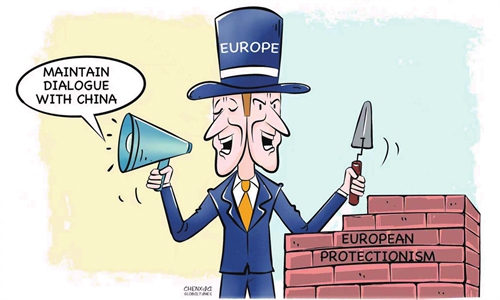
The establishment of the China-EU trade and investment consultation mechanism came as the two sides continued their dialogue, even as Europe quietly piled on new protectionist measures.
A statement published on the European Commission's website showed that starting from July 1, steel exports to the EU exceeding allocated quota limits will be subject to an additional 50 percent duty under the pretext of countering "overcapacity." The document does not explicitly name China, but its target is obvious.
In addition, EU member states will introduce a 3-euro customs duty per item on e-commerce parcels valued below 150 euros, starting in July. Data from the European Commission showed that a total of 4.6 billion items valued under 150 euros were imported into the EU in 2024, and that 91 percent of all e-commerce shipments valued under 150 euros came from China that year, confirming the intended target.
So far, the trade restrictions the EU has adopted against China appear irreversible. Rather than confronting the roots of its own sluggish industrial development, Europe is shifting responsibility onto China, said Jian, noting that if this stance does not change, frictions between China and the EU will persist and may even multiply.
A June 25 article in The Economist, titled Global imbalances have little to do with Europe's industrial woes, noted that European leaders are blaming the imbalanced global economy for their troubles, particularly China's formidable manufacturers, which are outcompeting European producers in many markets. Yet in blaming China, Europe's leaders risk losing sight of their home-grown failings, the article said.
The article said that Europe must recognize that erecting trade barriers with China only increases the need for reforms, because diversifying away from the cheapest supplier raises costs and harms growth. An economy of China's size and stage of development will always have significant manufacturing exports. If Europeans want their industries to thrive, they should focus not on shutting out competitors but fixing their own house, read the article.
Wang Xiaoli, executive dean of the Institute for National Security Studies, Guangdong University of Foreign Studies, told the Global Times that the question of "who benefits" is reframed as "who gets hurt."
"The 'China Shock 2.0' debate systematically ignores one fact: cheaper, better Chinese goods offer a rare 'disinflationary dividend' to the global middle class under inflationary pressure," Wang said.
At a press conference, when asked to comment on remarks by Šefčovič claiming that the trade imbalance between the EU and China was becoming increasingly unsustainable and that maintaining the status quo was not an option, Guo Jiakun, a spokesperson for China's Ministry of Foreign Affairs, noted that China and the EU are partners, not rivals. China-EU economic and trade cooperation is mutually-beneficial and win-win in nature. The root cause of the EU's problems does not lie with China. The key to resolving issues in bilateral trade lies in deepening cooperation and realizing shared development.
China is willing to step up communication and consultation with the EU to properly handle trade differences in a constructive manner based on the principles of equality, respect and mutual benefit, and jointly safeguard the stability of global industrial and supply chains, the spokesperson added.
Noticeably, Chinese enterprises are leveraging their own strengths to actively expand cooperation with European companies and advance their global operations.
Stellantis N.V., the Amsterdam-based multinational automaker, and China's Dongfeng Group announced on May 15 that they had signed a strategic cooperation agreement to jointly produce Peugeot- and Jeep-branded vehicles in China for sale in global markets, according to Stellantis' WeChat account.
In March, German chemical giant BASF inaugurated its new world-scale Verbund site in Zhanjiang, Guangdong Province, marking a continued push by multinationals to invest in China despite global economic headwinds. With a total investment of €8.7 billion ($10.04 billion) so far, it is BASF's largest-ever project and its third-largest site worldwide.
RELATED ARTICLES