Illustration: Chen Xia/GT
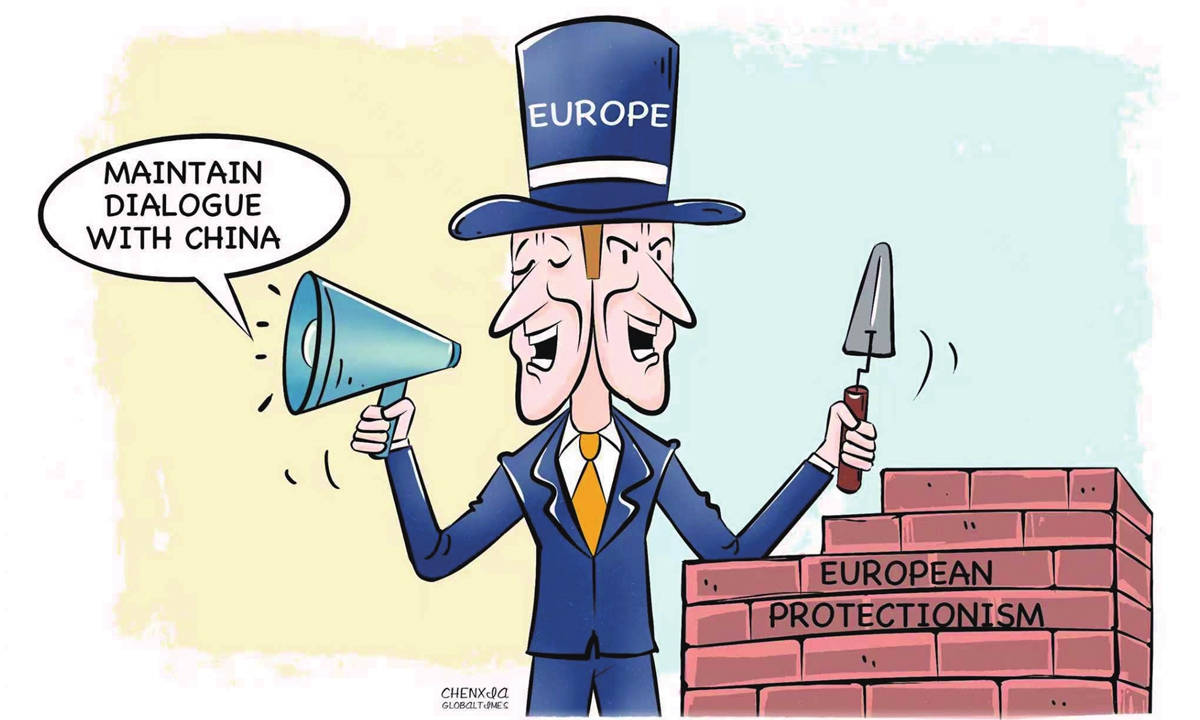
China-EU relations are at a delicate crossroads. On the surface, dialogues continue, but behind the scenes, Europe is piling on new protectionist measures.
Chinese Commerce Minister Wang Wentao is reportedly set to meet with European Trade Commissioner Maros Sefcovic on Monday in Brussels. Yet starting from July 1, steel exports to the EU exceeding the allocated quota limits will be subject to an additional 50 percent duty, along with a 47 percent reduction in tariff-free imports, under the pretext of countering "overcapacity." The file does not explicitly name China, but the target is obvious.
In recent years, under the banner of "de-risking" and "anti-subsidy" measures, the EU has been targeting Chinese industries and investments in Europe. In June alone, EU leaders "directed the European Commission to develop and complement the bloc's toolbox of trade defenses" against China, while also reportedly preparing new tariffs on Chinese plug-in hybrid vehicles. The pace and intensity of these actions have been rare in recent years.
According to Chinese media reports, the two sides held multiple rounds of consultations over the past week. China came to the table in good faith, raising its core concerns, including price commitments in the EV countervailing case and barriers to Chinese imports, such as high-tech export controls and the politicization of economic issues. Yet at the negotiating table, the EU focused almost exclusively on its own demands regarding rare earths, offering little response to China's concerns.
Even more telling, EU officials are already drafting new tools modeled on the US' Section 301 tariffs, aimed at tackling "overcapacity." Some Chinese observers have noted that the bigger issue is that these tools haven't even been officially launched, yet they're already being used as bargaining chips against China.
This reveals Europe's classic "two-track" strategy: Keep the dialogue going in public while quietly ditching hope of solving problems through negotiation. Instead, they're sharpening trade barriers and quietly building a framework for economic confrontation with China. It's a textbook copy of America's playbook - escalate tension first, then use the pressure to force concessions.
The "overcapacity" narrative running through all this has been absurd from the beginning. Some observers have pointed out if we applied that logic consistently, nearly every European industry that once enjoyed trade surpluses - German cars, French wine, Italian fashion - can be counted as "overcapacity." Today, as European goods lose their edge, what Europe really seems to want is special privilege wrapped in the language of free markets.
At its core, what the EU truly fears is not China; it's the realization that its long-held advantages as the traditional center of modern industrial civilization are slipping away fast. The EU's policy toward China has never been solely about "how to deal with China." It is equally, and perhaps more profoundly, about "how Europe sees itself." Europe's mindset is reminiscent of Rose's mother in Titanic - desperately clinging to a fading aristocratic glory while refusing to accept that the world has moved on.
Copying the US' "escalate first, then de-escalate" playbook won't end well. When the US launched its full-spectrum trade war against China in 2025, Beijing demonstrated its response through actions: China does not want to fight trade and tariff wars, but will not flinch when a trade and tariff war comes. China stood firm against the US. Europe, with considerably less leverage and resilience, would do well to think twice before playing the same high-stakes game.
China's position is consistent: It does not initiate friction; more importantly, it values the bigger picture of China-EU cooperation and remains committed to the multilateral trading system. China is also willing to resolve differences through dialogue. However, goodwill is not endless concession, and restraint is not weakness.
Europe knows where its real problems lie. As some sober voices within the EU have pointed out, all EU policies must be geared toward attracting investment, boosting innovation and increasing productivity if we want to put the European economy back on track. What Europe needs to realize is that building tariff walls will not achieve this goal.
After all, the US has already run the experiment: Protectionist measures don't create innovation, they don't solve energy crises, and they won't magically rebuild industries overnight.
RELATED ARTICLES