Chinese-built national stadium witnesses Cape Verde's historic World Cup journey
Facility stands as a landmark of China-Africa friendship, help the continent pursue sports dream
By Published: Jun 30, 2026 08:00 PM

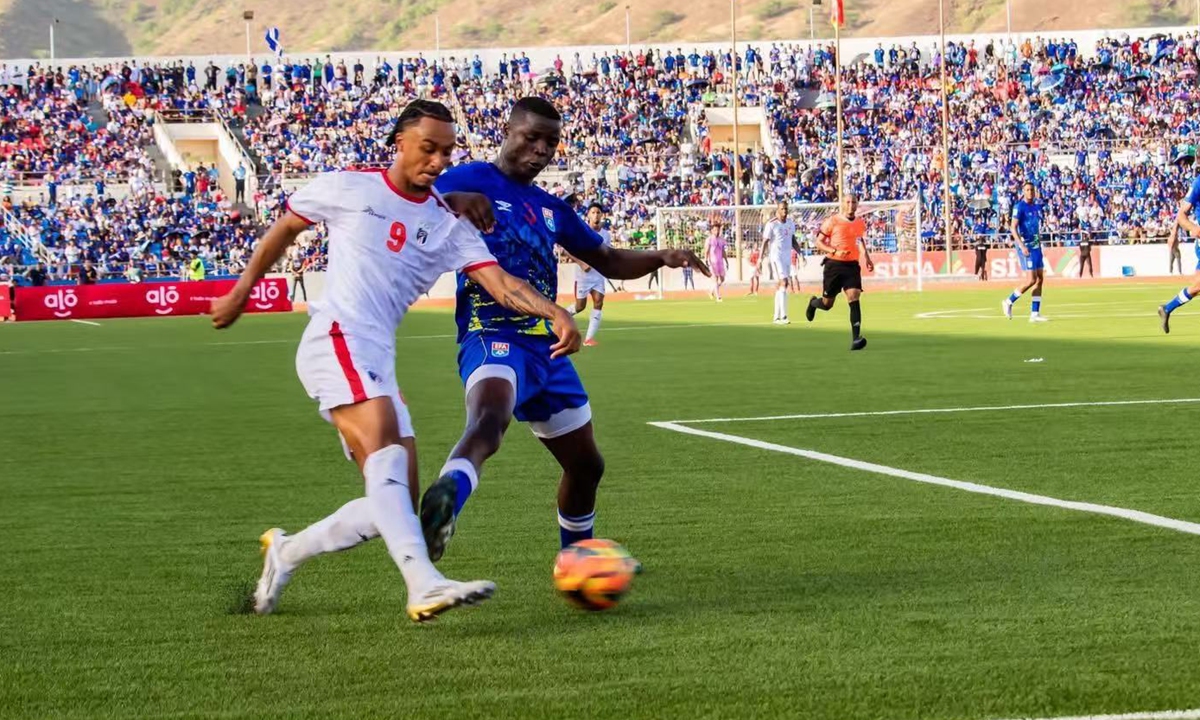
A scene from a match during the World Cup African qualifiers held at the Cape Verde National Stadium earlier this year Photo: Courtesy of Li Junsheng
When the news that Cape Verde, a small African country, made history by reaching the World Cup round of 32 popped up on the phone, Li Junsheng, head of the Shaanxi Construction Engineering Technical Team, or the Chinese technical assistance team to Cape Verde's National Stadium, said he "was thrilled, but not surprised at all."
Li was on site when the World Cup African qualifiers were held at the Chinese-built stadium earlier this year, and he witnessed all the home matches as Cape Verde eventually advanced to the World Cup. The stadium, which started construction in 2009 and was put into operation in 2013, is the only one in the country that is certified by FIFA.
It is also the highest-standard multi-purpose stadium in Cape Verde, featuring not only a FIFA- and IAAF-certified football pitch and a 400-meter running track, but also facilities for long jump, high jump, throwing events and other athletics disciplines, along with advanced amenities such as large LED screens, lighting and sound systems, timing and scoring equipment, and a press media center. It is also the most fully functional and highest-configured standard stadium in West Africa.
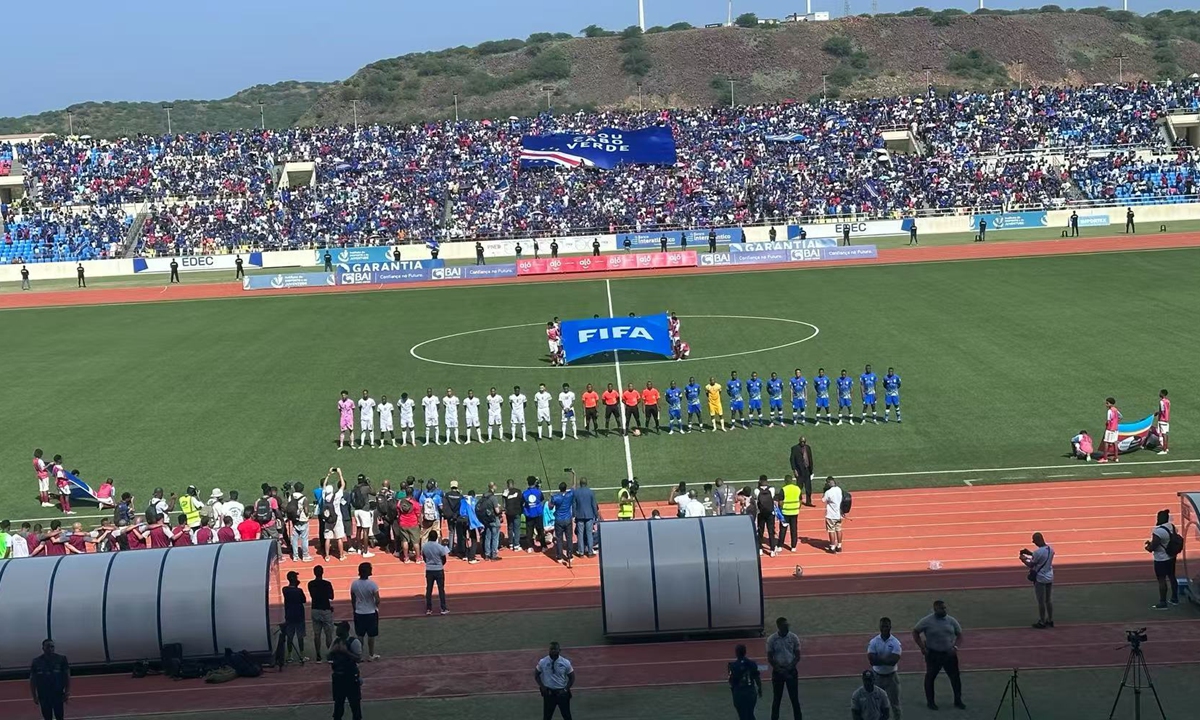
A scene from a match during the World Cup African qualifiers held at the Cape Verde National Stadium earlier this year Photo: Courtesy of Li Junsheng
Li leads a team of 11 Chinese technical experts responsible for key stadium operations, including water supply, power, lighting and intelligent lighting systems, sports facilities, timing, scoring, audio amplification and drainage. Since 2015, after local teams encountered operational challenges, the Chinese team has been stationed in the island country, delivering on-site technical support, maintenance and hands-on training to local personnel, including during the FIFA World Cup African qualifiers.
Li could clearly recall a match during the World Cup qualifier, when Cape Verde played against Eswatini.
"The atmosphere on the match day was incredibly lively. The national stadium has a capacity of 15,000 seats, and was fully occupied. And there were still large crowds of fans gathered outside watching the game on big screens," Li told the Global Times on Tuesday. "After the match, people cheered and danced late into the night."
He noted that some seats were damaged due to trampling, and the team contacted the manufacturer in Hangzhou, East China's Zhejiang Province, that produced the chairs and arranged for a new batch of seats to be shipped to Cape Verde for a major replacement.
Cape Verde has a population of over 520,000 people and football is one of the national sports.
Han Huibin, who was the project manager of the stadium at the time, told the Global Times that Cape Verdeans are deeply passionate about sports, particularly football - from the elderly to adults, children, and teenagers.
"Their love of the game is sincere and deeply rooted. Whenever they find a flat piece of ground, they start playing, and they seize every moment of free time to kick a football. Their passion for football is truly from the heart," Han said.
However, before the stadium was delivered in 2013, Cape Verde only had an old and dilapidated stadium that was in disrepair.
In fact, when the Chinese assistance project was proposed by the African country, Cape Verde already had a strong football tradition. Many of their players were active in professional leagues in Portugal and across Europe, and the country also had a domestic league involving teams from different islands.
"Yet, hosting major international matches at home remained extremely difficult without an international-standard stadium. This is why the Cape Verdeans had long hoped for a modern venue of their own," Han said.
And according to Li, to prepare for the World Cup qualifiers and the Africa Cup of Nations, the national team previously had no choice but to travel overseas to rent venues for training camps.
Now, ahead of major competitions, football players arrive several days in advance in the Chinese-built stadium for closed-door training, and also to adapt to the pitch, lighting and venue rhythm to get accustomed to the home match environment.
In addition to World Cup qualifying matches, the Chinese-built stadium has also hosted multiple major sports events such as the Africa Cup of Nations qualifiers, Portuguese-speaking Nations League, West African regional leagues and domestic club league matches.
Li said that many Cape Verdeans like to greet the Chinese team members by shaking hands or giving a high-five, while a small number of locals proactively say "Ni Hao" in Chinese - which he said are all expressions of the friendship between Chinese and local people. Some locals even call the venue the "Chinese stadium" instead of the national stadium.
During the construction process, Han felt the deep gratitude of the local people.
The Chinese company dispatched over 100 technical staff and hired approximately 300 local workers for the project. "I still remember that when I got off the plane, the Cape Verdeans were polite and particularly warm and welcoming to Chinese people, especially when they knew we had come to construct the stadium," Han said.
Li believes the sports stadium stands as a landmark of China-Africa friendship characterized by equality, mutual assistance, and win-win cooperation, one that has not only witnessed the remarkable football rise of this small island country, but also reflects China's sincere commitment to supporting the development of sports and improving people's livelihoods in other countries without any strings attached.
Across Africa, Chinese companies have been actively engaged in the construction of stadiums over the past decades, which observers believe has provided a huge boost in driving economic development in the African continent and helped them develop national sports teams.
Africa has nine representatives in the round of 32 of the 2026 FIFA World Cup. Among the other African teams that also qualified for the World Cup, Senegal and Ghana have similar "China-built stadiums" - Stade Léopold Sédar Senghor in Dakar, Senegal's largest stadium, and the 15,800-square-meter signature Cape Coast Sports Stadium in Cape Coast, Ghana, according to media reports.
On July 4 (Beijing time), Cape Verde will challenge defending champions Argentina.
"I wish Cape Verde can go as far as it can in the World Cup. This is the moment when the Chinese hard-working spirit resonates with the Cape Verde World Cup dream," Li said.
RELATED ARTICLES