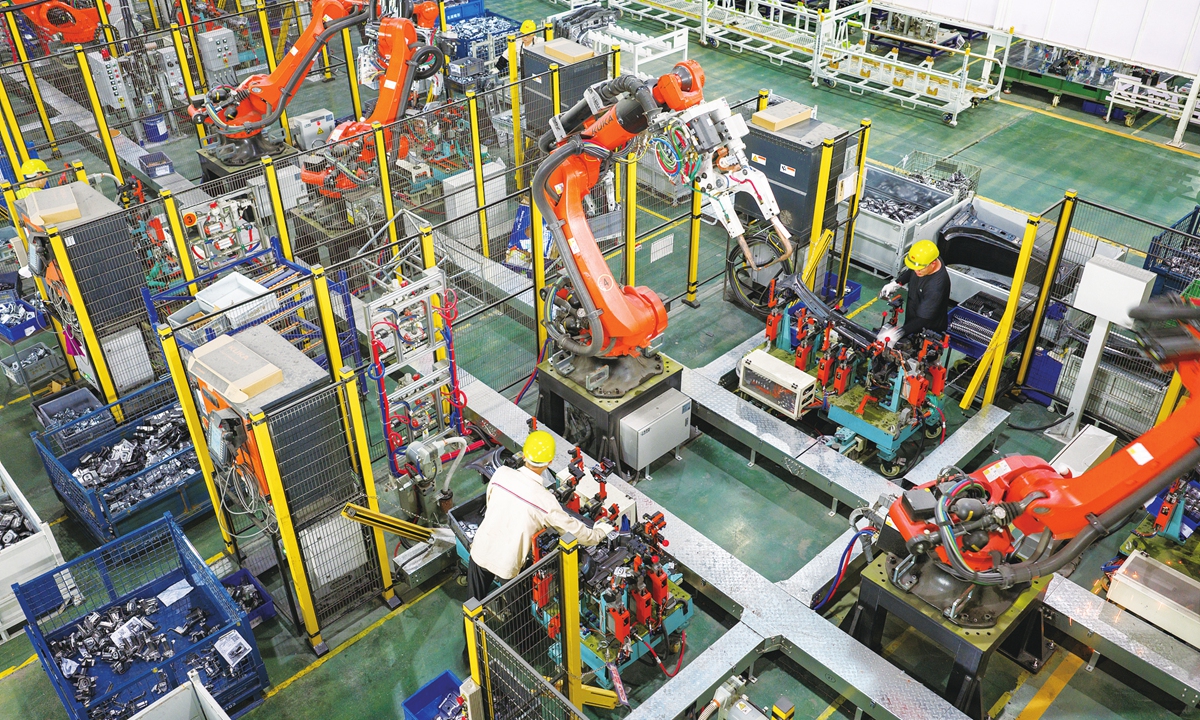
Industrial robot production lines run at full capacity at a new-energy vehicle parts company in Jinhua, East China's Zhejiang Province on June 22, 2026. Photo: VCG
Editor's Note:The year 2026 marks the 105th anniversary of the founding of the Communist Party of China (CPC). For over a century, the CPC has united and led the Chinese people in writing the most magnificent chapter in the millennia-long history of the Chinese nation. From the days when Edgar Snow broke through blockades to reach Yan'an to the present day exploration of Chinese modernization that has charted an entirely new path, a growing number of people around the world are asking: What does China's path mean for the rest of humanity? The Global Times invites Chinese and foreign observers to unpack this question. This is the fourth installment of the series.
Tong Dezhi, a research fellow at the Tianjin Normal University branch of the Tianjin Research Center for the Theoretical System of Socialism with Chinese Characteristics
Over the past century, countless patriots and pioneers have dedicated their lives to the rejuvenation of the Chinese nation through Chinese modernization under the leadership of the Communist Party of China (CPC).
In the new era, the CPC has upheld and developed socialism with Chinese characteristics, promoting coordinated development of material, political, spiritual, social and ecological civilizations. This relentless effort has resulted in two remarkable achievements: rapid economic growth and long-term social stability, giving rise to a new form of human civilization - Chinese modernization.
The process led by the CPC toward Chinese modernization is not merely a historical journey of national rejuvenation; it also bears profound global significance.
The first global significance of Chinese modernization is that it transcends "Western centrism" and offers a new development pathway for other developing countries. Historically, human modernization indeed began in Western capitalist countries, but modernization does not mean Westernization. Currently, the most advanced countries predominantly belong to Western civilization, but modern civilization is not synonymous with Western civilization.
It is in this sense that Chinese modernization dispels the myth that "modernization equals Westernization" and presents an alternative vision of modernization. With undeniable achievements, China's path to modernization proves that there is no single route to modernity - there is more than one way.
The second global significance is that Chinese modernization moves beyond "capital supremacy" and adopts a people-centered approach. Behind the success of Western modernization, the profit-driven nature of capital has come at a high cost to the ecological environment. In contrast, Chinese modernization emphasizes harmonious coexistence between humanity and nature. The most revolutionary change of this new form of human civilization is that it transcends capital logic with people-centered logic, ensuring that the fruits of modernization benefit all people fairly.
The third global significance of Chinese modernization is its rejection of the "clash of civilizations" narrative, advocating instead for exchanges and mutual learning among civilizations. After the Cold War, the "clash of civilizations" rhetoric proposed by Samuel Huntington was once widely influential; yet, it exaggerated differences and conflicts among civilizations.
Against this backdrop, China champions exchanges and mutual learning, transcending the "clash of civilizations" narrative. In the Global Civilization Initiative, China has called for respecting the diversity of civilizations and being open-minded to the values of other civilizations.
As Chinese modernization continues to develop, its global influence grows ever more prominent. And as China moves ever closer to the center of the world stage, the global significance of Chinese modernization will also shine brilliantly.
Xulio Ríos, the founder and emeritus advisor of the China Policy Observatory in Spain
The year 2026 marks the 105th anniversary of the founding of the CPC and the starting year of China's 15th Five-Year Plan (2026-30). Standing at this historic juncture, we should take the opportunity to reflect on the global importance of Chinese modernization, which presents multiple dimensions that transcend national boundaries and make it one of the most relevant phenomena of our time. It is not merely about the economic and social transformation of a country that is home to more than one-sixth of the world's population, but also offers a proven development model that enriches the international debate on possible pathways toward prosperity, stability and progress.
One of the most significant aspects of this process is that China has established its unique path to modernization. In contrast to the idea that there was a single, universal model for achieving development, the Chinese experience has demonstrated the possibility of articulating one's own trajectory, adapted to its historical, cultural and political conditions.
The combination of gradual reform, strategic planning, opening to the outside world and constant experimentation has made it possible to achieve extraordinary results in just a few decades. The eradication of extreme poverty, the construction of a powerful industrial base, the improvement of infrastructure, and the country's growing scientific and technological capacity constitute undeniable milestones.
This uniqueness lies not only in the results obtained but also in the method followed. Chinese modernization has been characterized by an incremental and pragmatic approach, based on trial and error, continuous evaluation of public policies, and permanent adaptation to changing circumstances.
Rather than the rigid application of preconceived formulas, the search for effective solutions to concrete problems has prevailed. This capacity for experimentation has been one of the keys to its success and constitutes one of the most original contributions of the Chinese experience to contemporary thinking on development.
Another fundamental element is the importance of the cultural and civilizational component. Chinese modernization is not presented as a break with its own tradition, but rather as an updating of historical and cultural elements considered valuable for facing the challenges of the 21st century. Concepts such as harmony, the search for balance, the centrality of the common good and the importance of stability have influenced the definition of the country's strategic priorities. This recourse to its own tradition gives the Chinese model a unique profile and reinforces the idea that modernization does not necessarily imply cultural homogenization.
The affirmation of a modernization based on one's own characteristics does not necessarily imply isolation or civilizational confrontation. On the contrary, it can foster a more plural understanding of modernity and enrich international dialogue on the common goals of humanity.
At a time when many societies are questioning the limits of certain development models, the Chinese experience provides additional perspectives on how to face the challenges of growth, inequality and sustainability.
Therefore, Chinese modernization can be interpreted as a contribution of global scope. Its main value does not lie in offering an exportable recipe or a model that can be mechanically reproduced in other contexts. Each country has its own historical, institutional and cultural conditions. However, the Chinese experience demonstrates that alternatives exist and that development can follow diverse trajectories. In that sense, it expands the repertoire of options available to countries seeking effective ways to improve the well-being of their populations.
In other words, it is not only the future of China that is being evaluated, but also the credibility of a non-Western modernization in the heart of the 21st century. China is testing the viability of a modernization alternative for the Global South countries. That is why it constitutes one of the great political, economic and social laboratories of our time. Its future evolution will help define not only China's place in the world but also the true breadth of the paths available for achieving development, prosperity and sustainability in the 21st century.
RELATED ARTICLES