Illustration: Liu Rui/GT
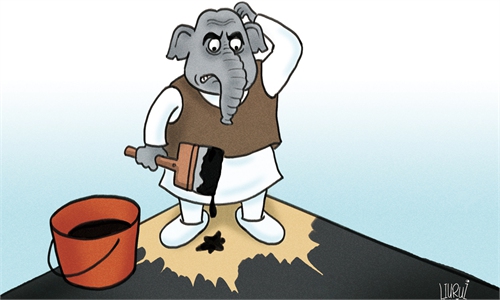
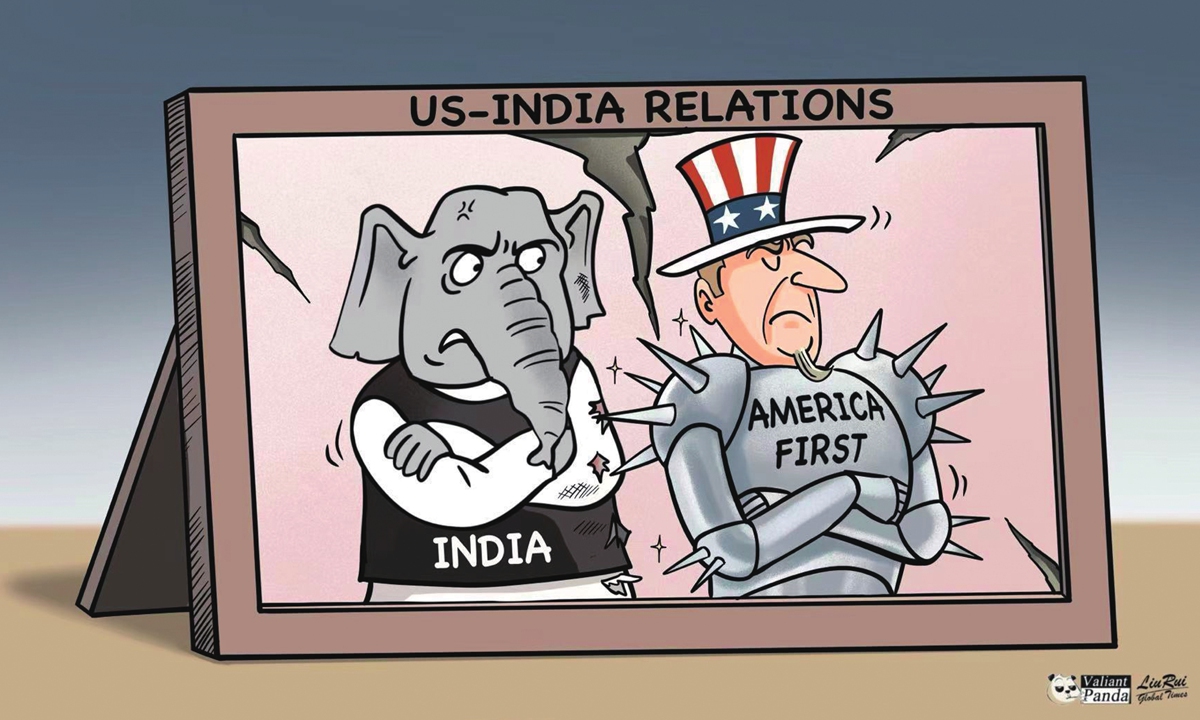
According to media reports, the US is seeking to arrange a visit to India by President Donald Trump early next year as the countries work on a bilateral trade deal. However, beneath the diplomatic momentum, significant fissures remain on key bilateral issues that cannot be glossed over.
On June 16, Indian Prime Minister Narendra Modi met Trump at a sideline meeting at the G7 summit in France. "It was about managing a relationship that has become more complicated," according to Indian media analysis.
The meeting failed to bridge bilateral differences. It was a typical high-level encounter, where diplomatic engagement and strategic pressure went hand in hand from the US: On the very day of the meeting, the US Department of War announced that it would revert the name of the "US Indo-Pacific Command" to the "US Pacific Command," while stressing that the command's area of responsibility and core mission would remain exactly the same.
This decision generated concerns from many analysts in India, because combined with its timing, it suggests that Washington is not particularly concerned about New Delhi's reaction. Rather, Washington appears to view the move as an opportunity to maintain sustained diplomatic pressure on India. Many Indian media are reading the renaming as further evidence of the US moving away from the Quad. Indian politician Shashi Tharoor described the development as the "final nail in the coffin" of the Quad mechanism.
The Modi government had consistently refrained from provoking Washington on geopolitical issues in order to set a constructive tone for the June meeting. For instance, the US-Israel-Iran conflict had posed a major challenge for countries such as India that depend on the Strait of Hormuz for energy supplies. Given its long-standing relationship with Iran, many initially expected India to assume a mediating role.
Yet India opted for strategic silence. The Modi government neither explicitly supported Iran nor openly condemned US-Israeli military actions, nor did it put forward substantive mediation proposals in multilateral forums. This restraint appears designed to stabilize the rapidly deteriorating India-US relationship.
India has good reasons to worry about its relations with the US when it found its prominence in US strategic calculations declined markedly. In December 2025, the US released a new National Security Strategy. While the document continues to emphasize the importance of the "Indo-Pacific region," the section dedicated to it is significantly reduced compared to previous versions. The strategy further reinforces "America First" orientation and designates India merely as one of its "Asian allies and partners." This characterization represents a clear downgrade from the framing used during previous US governments, leaving Indian strategic circles deeply frustrated.
Extreme caution on courting Washington has therefore constrained New Delhi's geopolitical space. Amid the already weakened India-Iran relationship due to the US-Israel-Iran conflict, although Iran had formally invited Modi to attend the funeral of former Supreme Leader Ali Khamenei, India has reportedly decided to send a delegation to Iran, while Modi is unlikely to be part of the delegation, missing the potential opportunity for India to repair ties with Tehran and expand its influence in the Global South.
Overall, India continues to act with restraint and is expected to maintain its long-standing policy of cultivating stable relations with the US. In their recent commentary, Indian scholars Rajeswari Pillai Rajagopalan and Rajesh Rajagopalan argue that the rationale is straightforward: India perceives limited alternatives. Under sustained US diplomatic pressure, India has few viable options because it continues to regard China as its "overriding strategic concern."
This assessment is widely shared within Indian strategic circles. But this rigid perception of viewing China as a "concern" or even a "threat" provides Washington with considerable leverage over New Delhi. Consequently, the pattern of India-US interaction is shifting from India leveraging China-US competition for strategic gains, to the US leveraging India's rigid mind-set about China in order to shape Indian foreign policy.
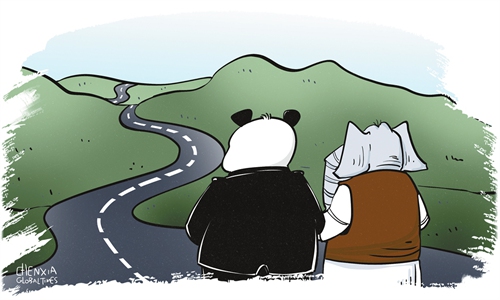
However, China views India not as a threat but as a neighboring country with which coexistence and partnership remain possible. As long as India does not reassess its perception of China as its principal strategic adversary, its diplomacy will remain structurally constrained by the US. Only by genuinely embracing the spirit of China-India friendship and good neighborliness, and by actively advancing Asian solidarity, can India secure a broader diplomatic horizon and a more promising future for development.
The author is an associate professor at the Institute of International Studies, Fudan University. opinion@globaltimes.com.cn
RELATED ARTICLES