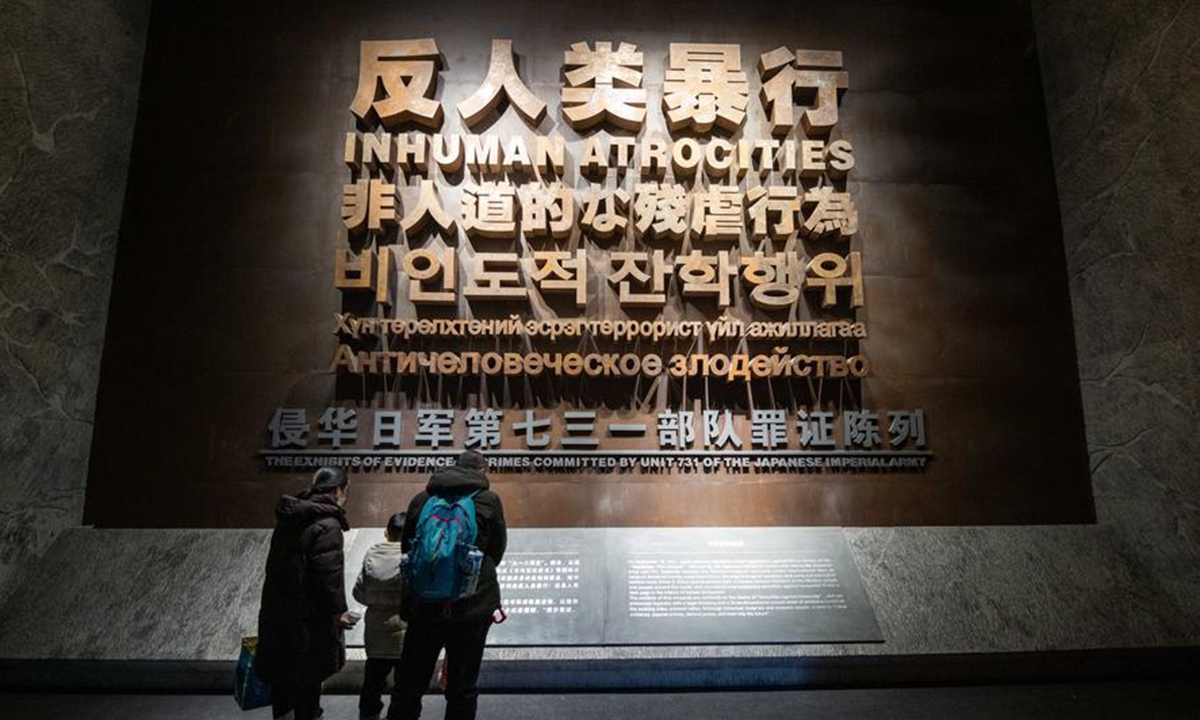
People visit the Exhibition Hall of Evidences of Crime Committed by Unit 731 of the Japanese Imperial Army in Harbin, northeast China's Heilongjiang Province, Jan. 25, 2024. Photo: Xinhua
In early June, Singapore-based Channel NewsAsia (CNA) uploaded its documentary Inside Unit 731: Japan's Secret Human Experiments, once again exposing to the world the monstrous crimes committed by Unit 731 of the Imperial Japanese Army during its invasion of China. The documentary quickly drew widespread global attention and heated discussion online. Viewers strongly condemned these crimes against humanity, praised CNA for confronting historical truth and called for remembrance of history to prevent its repetition.During WWII, Unit 731 carried out inhumane live human experimentation and bacteriological warfare, resulting in the deaths of large numbers of Chinese civilians, as well as people from the Soviet Union and the Korean Peninsula. The Japanese military also established OKA 9420 in Singapore, using it as a base to set up branches across Malaysia, Indonesia, the Philippines, Thailand and Vietnam, where illegal human experimentation and biological warfare were conducted.
On the eve of Japan's defeat in 1945, in an attempt to destroy evidence and evade responsibility, Japan's general staff ordered Unit 731 to demolish its facilities, burn documents, eliminate witnesses and evacuate all personnel. Members were strictly instructed never to speak of their involvement and to take the secrets of Unit 731 to their graves.
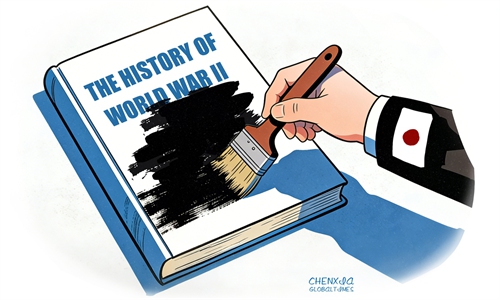
After the war, right-wing forces in Japan have long sought to obscure the truth and downplay, or outright deny, responsibility, allowing historical revisionism to spread. A survey conducted by Japanese newspaper Asahi Shimbun revealed that only 30 percent of the 85 WWII-related museums across Japan have long-term exhibits regarding the nation's history of aggression. None of them has exhibits dedicated to Unit 731. More extreme voices go so far as to dismiss these crimes as "fabrications" by other countries.
Yet no amount of distortion can erase the truth. The atrocities of Japanese militarism stand in defiance of both history and humanity. After the war, some former members of Unit 731 lived with enduring guilt and psychological torment. Among them, Hideo Shimizu, in 2016, encouraged by Japanese civil peace groups, broke his silence and publicly revealed his identity, exposing the crimes of the Japanese army through speeches and interviews. Thanks to the efforts of the international community, increasing amounts of evidence related to Unit 731 have come to light.
Last December, the National Archives Administration of China published a batch of Russia-provided archives on Soviet interrogations of the Japanese Unit 731 in Khabarovsk. The records prove that the application of the experiments in the war aimed at the large-scale destruction of humans.
Recently, Japanese media revealed materials describing "heterologous blood transfusion" experiments conducted in China in the autumn of 1938 under the pretext of studying how to respond to battlefield blood loss. These experiments included repeatedly injecting animal blood into human bodies, such as large-volume injections of horse blood. These pieces of evidence mutually reinforce one another, continually deepening global understanding of Japan's crimes and providing irrefutable proof that its bacteriological warfare was an organized, premeditated and state-led enterprise.
As more evidence continues to emerge, global calls for Japan to confront its past and for its right-wing forces to acknowledge responsibility are growing louder. The international condemnation of Unit 731's crimes has torn apart the façade of denial and revisionism.
The choral work The Devil's Gluttony is adapted from the long-form reportage novel by Japanese writer Seiichi Morimura. The piece is about Unit 731. For many years, some Japanese civil society groups have continued to use music as a way to mourn and denounce the atrocities committed by Unit 731, exposing the truth of history.
Forgetting or silencing these atrocities would not only betray history and desecrate justice - it would also plant dangerous seeds for future instability. The Japanese public must clearly recognize the dangers of militarism, and the international community must work together to expose the falsehoods of right-wing forces and demand a full reckoning with Japan's militarist past. Only then can the hard-won postwar order be preserved, peace safeguarded and the reemergence of "new militarism" prevented - ensuring that tragedies like those of Unit 731 never happen again.
The author is an international affairs observer. opinion@globaltimes.com.cn
RELATED ARTICLES