Photo: VCG
The Japanese government claimed in a white paper on the international economy and trade released on Tuesday that China's expansion into emerging markets has been remarkable, with ASEAN countries increasing their dependence on China for intermediate goods imports.Then, the white paper shifted to hype that this structure allegedly exposes the region to "supply disruption risks" due to potential export restrictions, claiming that in order to enhance its presence, Japan needs to expand its exports to emerging market countries, Kyodo News reported.
This narrative is self-contradictory. It recognizes the deep, extensive economic and trade ties between China and emerging markets, yet attempts to override market-driven choices with geopolitical rhetoric, a contradiction that cannot help with Japan's export competitiveness.
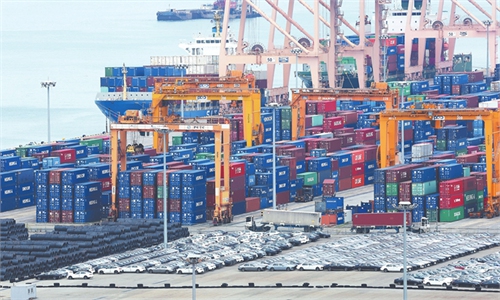
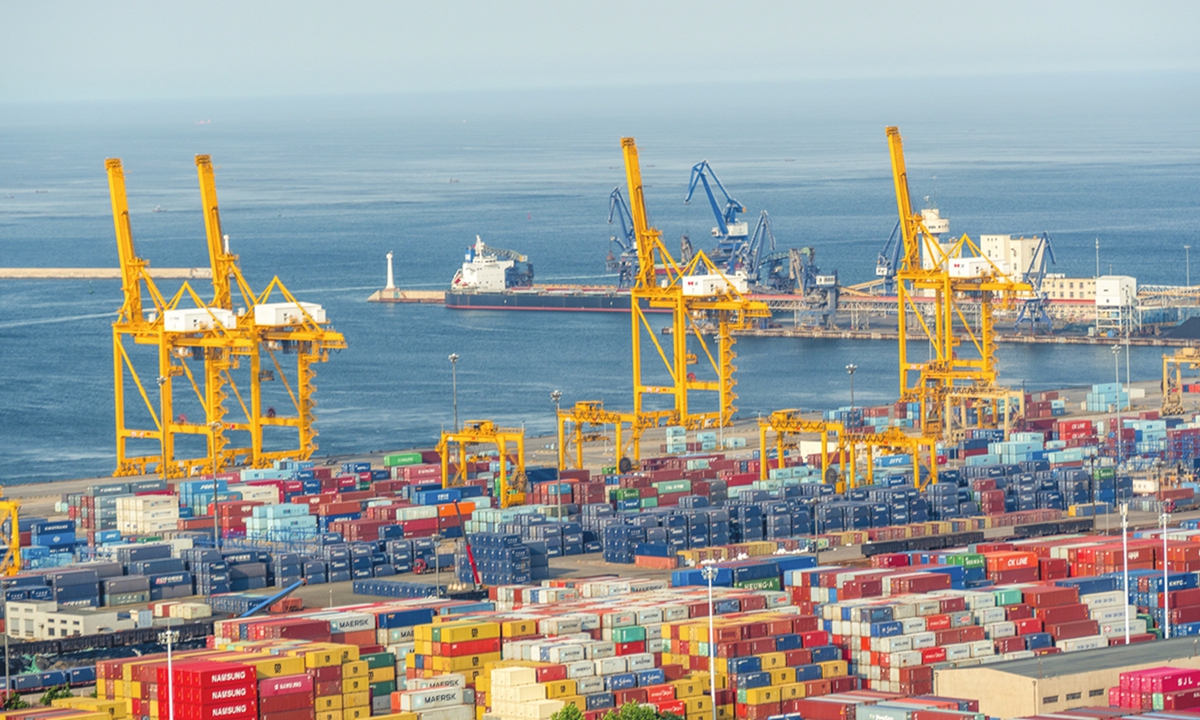
The so-called "supply disruption risk" is fundamentally unfounded. The deeply intertwined industrial chain between China and ASEAN is the mature outcome of years of industrial relocation and iterative regional division of labor, driven by market efficiency and comparative advantage. Over the past five years, China's trade with ASEAN has achieved leapfrog development, with total trade successively crossing the 6 trillion yuan ($884 billion) and 7 trillion yuan marks, reaching 7.55 trillion yuan in 2025, according to Chinese customs data.
Meanwhile, from the implementation of the Regional Comprehensive Economic Partnership (RCEP) to the upgraded China-ASEAN Free Trade Area 3.0, the China-ASEAN industrial chain collaboration has evolved far beyond simple merchandise trade into a complete coordination system covering upstream supply, processing and manufacturing, and global distribution. Chinese components and raw materials have become an important support behind the growth of manufacturing added value across ASEAN nations.
Ironically, even as the Japanese government hypes the "risk of dependence on China," Japanese businesses are flocking to Beijing these days. Ten Japanese business chambers attended the 4th China International Supply Chain Expo (CISCE) in Beijing in late June. According to Yuyuantantian, a social media account affiliated with the China Media Group, Japan fielded the largest presence in terms of group participation among countries in Asia. Apparently, Japanese companies still see enormous potential in the Chinese market and hope to expand cooperation opportunities. The practical choices of Japanese businesses speak far louder than the geopolitical narratives in Japan's white paper.
Japan's anxiety over expanding its footprint in emerging markets stems essentially from its declining industrial competitiveness. For decades, Japan dominated ASEAN's industrial chain with its technological advantages in fuel vehicles and precision mechanical components, securing an overwhelming market share in Southeast Asia. However, amid the global industrial transformation toward new energy, intelligence and green development, Japan has fallen comprehensively behind in core areas such as power batteries, electric motors and electronic controls, and intelligent driving. Similarly, in emerging industries like photovoltaics, lithium batteries and the digital economy, Japan's pace of technological iteration and its industrialization capability have noticeably lagged. Relying solely on existing strengths in precision machinery and conventional components will hardly sustain a continued expansion of exports to emerging markets.
Currently, ASEAN and other emerging economies are at a critical stage of manufacturing upgrading and economic development, with an urgent demand for stable, cost-effective and efficient industrial and supply chain support. Their market choices are guided by tangible industrial strength rather than by empty geopolitical slogans. Japan cannot achieve export growth by discrediting China to elevate its own status. The China-ASEAN industrial partnership is underpinned by solid market foundations, institutional guarantees, and the shared interests of people across the region.
Their economic and trade cooperation is rooted in mutual benefit and win-win results, and market competition ultimately depends on industrial strength and credible reputation. Slandering competitors and fabricating risks is a speculative tactic that can never win recognition from emerging markets. ASEAN nations are fully capable of distinguishing facts from hype. They clearly recognize which partner provides cost-effective industrial supplies, which participant delivers tangible infrastructure progress, or which country takes the lead in emerging sectors like new energy and digital economy. Geopolitical manipulation can never overrule the irreversible trend of market-oriented industrial cooperation.
RELATED ARTICLES