IN-DEPTH / IN-DEPTH
How Xinjiang's 'money-losing' train market delivers warmth and hope across the Gobi
The Unprofitable Bazaar on Wheels
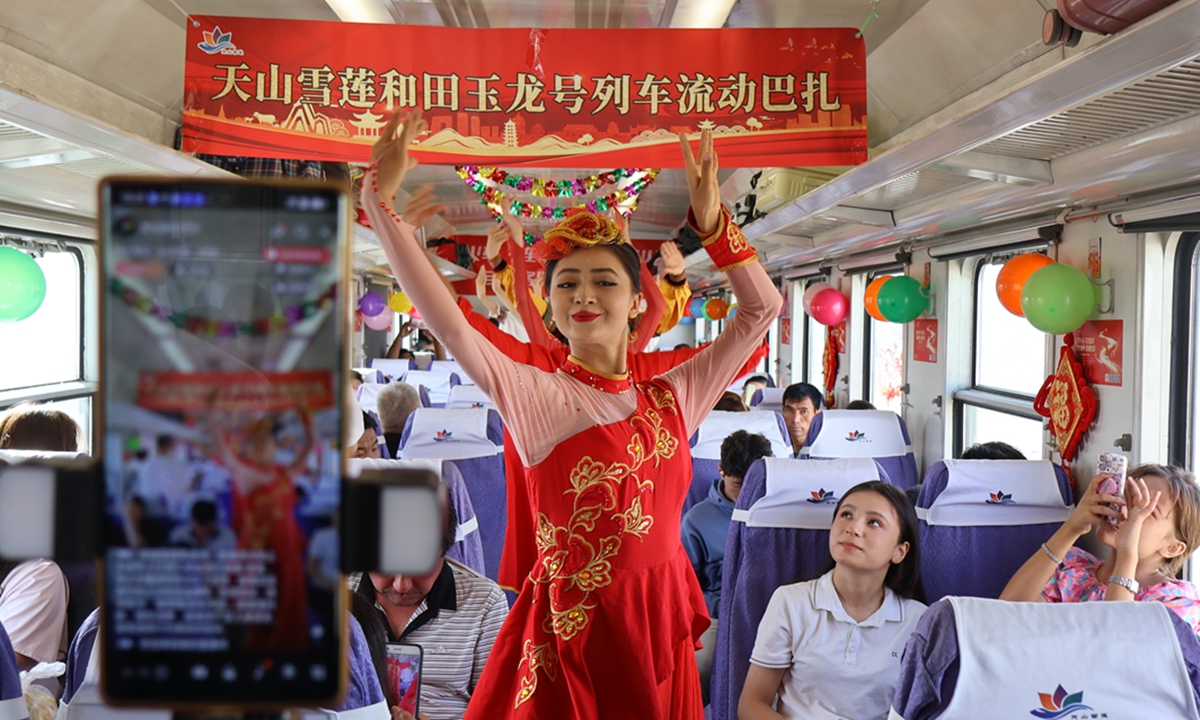
Dance and singing performances are staged at the mobile bazaar on the slow train No. 7558 in Northwest China's Xinjiang Uygur Autonomous Region, on June 25, 2026. Photo: Lin Xiaoyi/GT
Editor's Note:The year 2026 marks the 105th anniversary of the founding of the Communist Party of China (CPC). For years, some Western media outlets have adhered to a narrowly market-driven framework, interpreting China's governance solely through the lens of short-term economic returns and questioning the country's large-scale public welfare investments in remote, underdeveloped regions. Recently, Global Times reporters traveled to the Gobi Desert, snow-covered plateaus and remote mountain regions to document three livelihood projects that may appear financially unviable: subsidized slow trains serving farmers across the vast Taklamakan Desert in Northwest China's Xinjiang Uygur Autonomous Region; a high-altitude highway linking the valleys of Medog in Southwest China's Xizang Autonomous Region; and school retention programs that keep children in classrooms in the Daliang Mountains of Southwest China's Sichuan Province.
Behind these outlays that defy profit-and-loss logic lies a distinctly Chinese philosophy of governance: wherever the people are, the state's protection follows. Through the human warmth of these seemingly unprofitable endeavors, one glimpses the enduring commitment of the Party to stay rooted among the people and to build social cohesion through inclusive welfare.
"Dear passengers, welcome aboard the Hotan Yulong Train. We are about to launch our mobile bazaar event on this service. Carriage 11 features intangible cultural heritage handicrafts from Hotan, alongside local baked buns, peaches, walnuts, dried apricots, honey and more. We invite all passengers to join us in Carriage 11 and wish you a pleasant journey."
Soft announcements echoed through the carriages as a lively mobile bazaar unfolded across the Gobi Desert alongside the railway tracks. Farmers wheeled stalls laden with peaches, cherries and traditional nut cakes down the aisles. Polatkhan, chief conductor of the train, held up a microphone and called out to passengers: "Taste our produce - if it's not sweet, you pay nothing!"
Passengers leaned forward from their seats, some filming the bustling scene on their phones, others asking about prices. One traveler bit into a fresh peach handed to him by a local farmer and gave a thumbs-up.
Amid the laughter, cultural performances followed one after another. To the melodies of "Xinjiang is a wonderful place" and "Seeing China by high-speed rail," passengers danced with performers from the Hotan City Cultural Troupe, filling the train with a festive atmosphere.
According to China's Ministry of Transport, by December 2025, China's high-speed rail network had surpassed 50,000 kilometers in operation - longer than the combined high-speed lines of all other countries. High-speed trains now handle 80 percent of the country's rail passenger trips and 69 percent of passenger turnover.
In stark contrast to these high-speed intercity services, the Hotan Yulong Train, also known as No. 7558, connects Urumqi, capital of Northwest China's Xinjiang Uygur Autonomous Region, with Hotan in the region's far south and travels at less than 80 kilometers per hour over a nearly 2,000-kilometre route. It makes 66 stops across 21 stations, stopping roughly every 30 minutes. Tickets are exceptionally affordable: the full hard-seat fare costs just 165 yuan ($24.20), with the cheapest short-distance ticket priced as low as 4 yuan.
Behind these low fares, however, are steep operating costs. The recent upgrade of the train cars alone cost 25.74 million yuan. Measured purely by short-term market returns, keeping this train running is a clear "money-losing program." Yet this seemingly impractical public investment has never been suspended.
In late June, Global Times reporters rode this train. Through this mobile bazaar on the Gobi Desert, what we wanted to understand was not just why this "loss-making venture" continues to operate, but also the deeper warmth of state care behind it - and the original aspiration of staying deeply rooted among the people.
A new sales channel for local farmers
Under the blazing June sun in southern Xinjiang, Hojiaabudula Maitiruze and his father began their work at 4 pm. In the peach orchard, his father climbed the branches to pick fruit while Hojiaabudula stood below with a fine mesh net, catching the tossed peaches and rolling them gently to remove the fuzz. It's an old local method, clean and gentle on the fruit. Basket by basket, they packed the peaches into plastic crates. This was his carefully prepared harvest for the train bazaar.
The next morning, before dawn, Hojiaabudula loaded several crates of fresh fruit and boarded Train No. 7558. As the train rolled north from Hotan station and picked up passengers along the way, his sweet, juicy local peaches were quickly snapped up.
In the past, he had to sell his peaches in bulk at low prices by the roadside, with narrow market access and thin margins. The train bazaar opened a new sales channel for southern Xinjiang farmers, bringing quality produce from deep in the desert directly to travelers from across the country. Today, thanks to this "slow train," his annual income has increased by 70,000 to 80,000 yuan.
Maimaitijiang, a handmade nut-cake maker, is another beneficiary. Now 58, he runs a small workshop in Hotan. In March 2025, his daughter saw news about the train bazaar online and suggested he give it a try. The first time he boarded, he wheeled a cart full of nut cakes, honey and rose jam into the aisle. But as he opened his mouth, he couldn't get a word out.
"He was really shy," train attendant Ayinigaer told the Global Times. "A few of us attendants stepped in and helped promote his products," as several passengers sampled his cakes. In just over a year, Maimaitijiang's WeChat contact list grew to more than 1,000 people - mostly passengers he met on the train - while his annual earnings jumped by 70,000 to 80,000 yuan, reaching a total of 120,000 yuan.
Throughout the carriage, farmers who have expanded their incomes through local specialties were everywhere. They greeted each other like old friends, setting out their products in the aisles as the carriage filled with the fragrance of fresh fruit.
Yu, a passenger from Chengdu in Southwest China's Sichuan Province, was drawn by the bustle in Carriage 11. After sampling the peaches and cherries, he bought some on the spot. "I've been to the International Grand Bazaar in Urumqi and the livestock market in Kashgar," he told the Global Times. "But this is my first time visiting a bazaar on a train. Bringing Xinjiang's culture and specialties onto the railway adds so much fun to the journey."
'They are my fellow villagers'
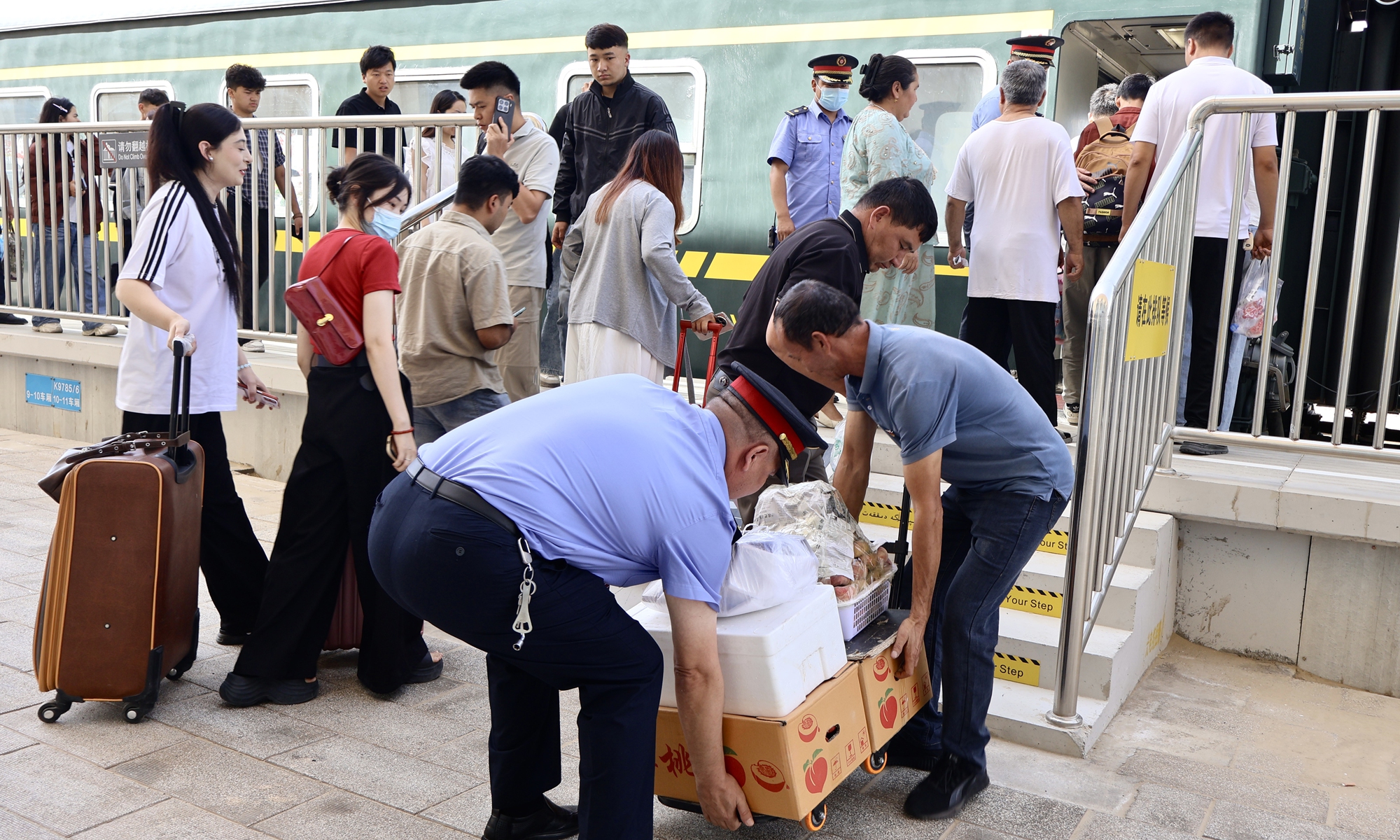
Polatkhan, chief conductor of Train No. 7558, helps vendors from Hotan Prefecture carry products onto the train on June 25, 2026. Photo: Lin Xiaoyi/GT
As the train pulled into Pishan station, conductor Polatkhan stepped off briskly. On the platform, he spotted another farmer, also named Maimaitijiang. The two walked quickly toward each other and shook hands warmly, like old friends reuniting. Polatkhan bent down, lifted a crate of fruit from the ground, and carried it back into the carriage. This conductor, who brought the train bazaar to life, affectionately calls the farmers who regularly ride his train, including Maimaitijiang, "my fellow villagers."
Polatkhan has worked this southern Xinjiang route for 14 years. "I've been on this line ever since the Kashgar-Hotan railway opened," he said. Over the years, he watched farmers board the train every day with baskets and sacks, many heading to night markets in Kashgar to sell their goods. The carriages were piled high with walnuts, dates, and pomegranates, as farmers relied on the "slow train" to turn a year's harvest into their families' livelihood.
In 2020, an idea struck Polatkhan: why not turn the carriage into a marketplace and give farmers a stable sales platform? He reported the idea to his Party branch and received support. In 2021, the train bazaar became a regular operation.
At first, few believed it could work. "In the beginning, only one or two farmers joined; others were skeptical," Polatkhan recalled. "On my days off, I went to villages along the line, door to door, persuading people one by one. Gradually, some were willing to give it a try. Later, those who benefited spread the word, and more and more farmers came aboard."
Five years on, the bazaar has grown from two to over 180 participating farmers. Polatkhan showed Global Times reporters a WeChat group made up of farmers living along the route. "Whenever I'm on duty or we have an event, I notify my fellow villagers in the group and invite them to join the train bazaar."
From June to August, the peak fruit harvest season in southern Xinjiang, the number of tourists surges, and the train bazaar is held four to five times a month. Polatkhan and his colleagues also livestream on video platforms; their highest viewership reached 240,000.
In 2025, the train bazaar generated over 650,000 yuan in new sales of southern Xinjiang specialty agricultural products, benefiting thousands of farming and herding families along the route, the China Media Group reported.
An invaluable public service route
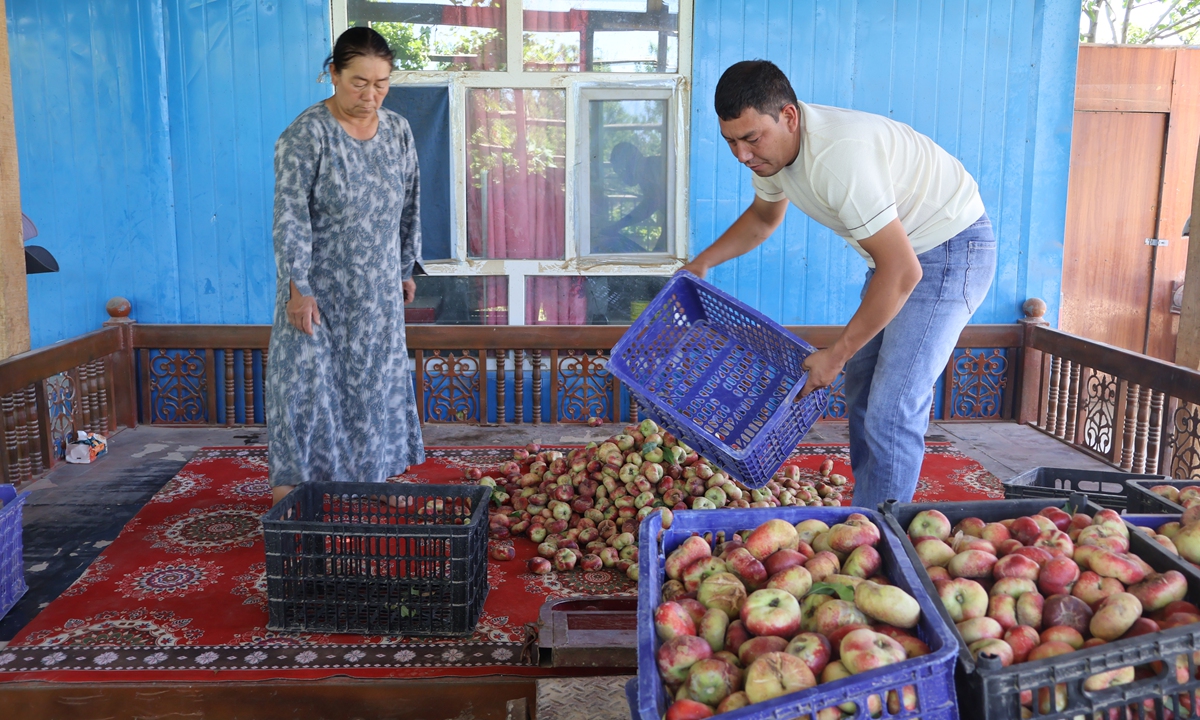
Hojiaabudula and his family carry peaches in the greenhouse beside the orchard in Hotan Prefecture, Xinjiang Uygur Autonomous Region, on June 24, 2026. Photo: Lin Xiaoyi/GT
The thriving mobile bazaar exists thanks to the sustained public welfare mission of this "slow train service." In 2023, China Railway Group issued guidelines requiring all viable public welfare slow train routes to remain operational. Currently, 81 such train services run across 21 provinces, autonomous regions and municipalities, primarily serving remote rural areas and former revolutionary base regions. Train No. 7558 is one of these subsidized routes, receiving special government operational funding to guarantee stable ticket prices for a decade and continuously improved public services.
Why don't they raise the fare price? Polatkhan told the Global Times that they keep fares unchanged because this train is the "commuter bus" for farmers and herders, the "school bus" for students along the route, and the "convenience bus" for local communities.

Passengers aboard Train 7558 wave goodbye to Polatkhan, the chief conductor, before alighting on June 25, 2026. Photo: Lin Xiaoyi/GT
Today, the mobile bazaar is not just a market stall, it's also a window for cross-regional exchange. Hojiaabudula pointed out that tourists are curious about Xinjiang, and through these encounters, he's also learning about life in other parts of China. "I also tell them about my hometown and introduce them to our fruit," he said.Cultural services have also expanded. The people's government of Hotan Prefecture, together with the China Railway Urumqi Bureau Group Co., Ltd. and the local publicity, culture and tourism authorities, has turned the "slow train" into a mobile platform for a series of events called "Slow Train · Bridge of Hearts," which brings art performances, tourism promotions, specialty goods exhibitions and book recommendations onto the train on a regular basis. Zeng Wenfeng, head of the Hotan City Cultural Troupe, said that since 2025, 46 events of this kind have been held. In 2026, the plan is to run 100 events, scheduled every Friday.
Zeng told the Global Times that the team has designed multiple intangible-heritage-themed souvenirs and plans to distribute them free to passengers starting in mid-July. "Everyday items can remind travelers of Hotan long after they leave," he said. "Through these small cultural products, we hope to tell the story of Hotan, a place where the Silk Road has fostered exchanges and connections for millennia."
For Zeng, the mobile bazaar itself is a moving meshrep, meaning "gathering" in the Uygur language, and is a vibrant tradition that combines music, dance, drama, folk arts, acrobatics, storytelling and games. Suddenly, the conductor called out to the carriage: "Friends, everyone, get up and dance! If you don't dance, you're not getting off!" Laughter filled the carriage.
Yu had originally planned to sleep through his journey from Hotan to Kashgar, but the constant stream of lively activities chased away his tiredness. "Time passes surprisingly quickly on this slow train, not because the journey feels short, but because the warmth and joy along the way make you forget how far you have traveled," he said.
RELATED ARTICLES