Indian strategic community grows concerned about ties with the US; is India going to learn a hard lesson this time?
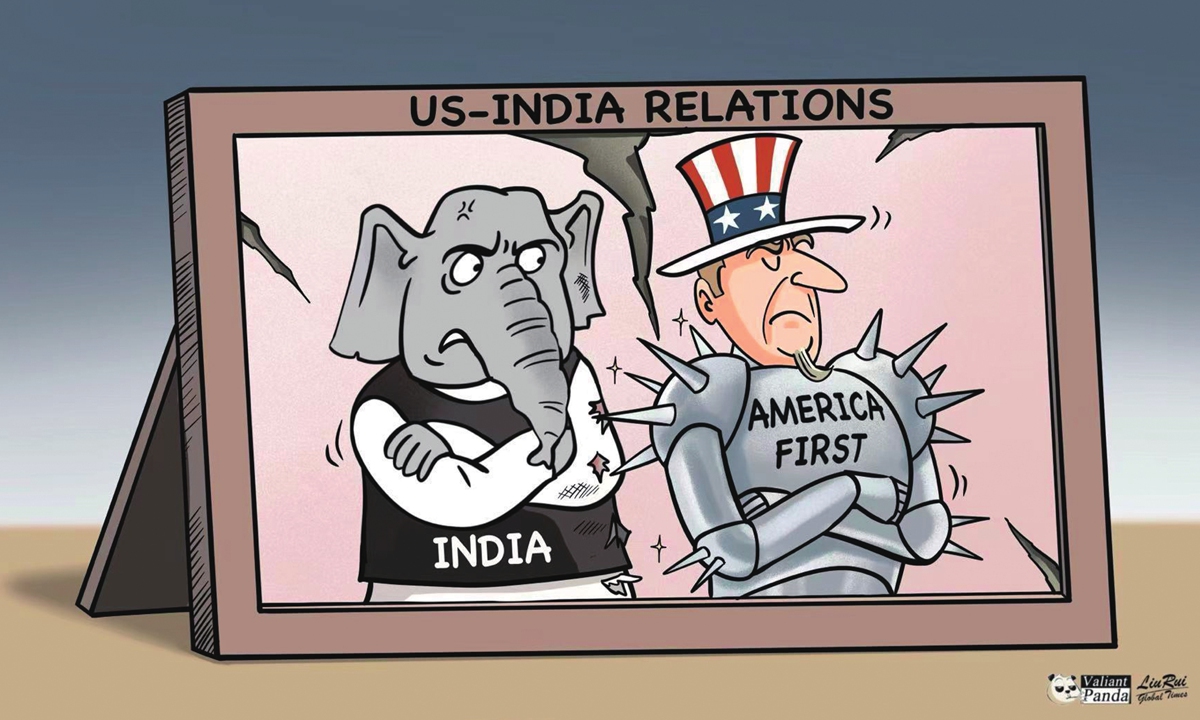
Illustration: Liu Rui/GT
Since US President Donald Trump took office for a second time, US-India relations have continued to deteriorate, affected by a series of issues such as tariff disputes and restrictions on Indian labor visas.
In recent months, the increasingly close ties between the US and Pakistan over the Iran issue, along with the US War Department's announcement to rename its Indo-Pacific Command back to Pacific Command, have deeply worried India's strategic community, which feels that it has been "abandoned" or even "betrayed" by the US.
Against this background, an article that calls for "de-Americanising" of India's grand strategy has been circulating and triggered heated discussion online.
The article, titled "A Case for 'De-Americanising' India's Grand Strategy" and written by Indian strategic affairs scholar and public intellectual Happymon Jacob, was published by India's World, an Indian foreign policy magazine, on June 22.
According to the article, New Delhi's closeness with Washington began neither as a calculated strategic choice nor a happy experience. Rather, it was born of anxiety, insecurity, and a fear of isolation, and much of it was a function of the American pressure at the dawn of this century.
"Wherever the question concerned the strategic shape of the wider world, we converged: on China, on the regional balance of power beyond South Asia, on the Indo-Pacific, on India's place in the global order. It made sense to have a bigger power on our side to offset the negative influence of a big power next door," the article said.
The article went on saying, "Our trouble was never that we lacked the capacity for an independent foreign policy; we have practised one for decades, even when our interests and America's parted company. Our trouble is that while we kept our own counsel in the backyard, we borrowed Washington's eyes for the wider world, and for China above all. We did not buy American eyes like its allies did, but we borrowed them as partners with mutual interests would do. It is the borrowed sight that is now failing. We want different things today... We got used to freeriding on the hyperpower or a US-led system."
Another piece published by India's First Post on June 27 by its columnist Sreemoy Talukdar is also representative of India's view.
In the piece titled "Thoughts on India's grand strategy: Rise can't be achieved at a bargain, and it's time for a new modus vivendi with China," Talukdar wrote that "A much more mercenary US - worried about its own relative decline - won't have the bandwidth or patience to provide the stable international order needed for India's rise, much less ensure global public goods such as a stable financial system, freedom of navigation or security umbrella that great power aspirants rely upon."
He differs from Prof Jacob's formulation that India "outsourced its view of the wider world, and China, to Washington" and "borrowed Washington's eyes for the wider world, and for China above all," and believes that a better compact with China may actually help in India becoming more Aatmanirbhar (self-sufficient).
Retired Lieutenant General Raj Shukla wrote on his X account, "Capacity is fundamental to Strategic Autonomy. But, till we build the same, we have to be close to one of the two - USA or China... Strategic Cunning may be a good resort for now."
In another X post, former Indian ambassador to the US Nirupama Menon Rao wrote, "The challenge before India is neither de-Americanisation nor the adoption of a Chinese worldview. It is to recover a genuinely Indian view of the world, one that reflects our unique position at the intersection of oceans, regions and civilisations. For an omnidirectional country, no single axis can ever be sufficient."
According to Indian media outlet The Print on Tuesday, US Ambassador to India Sergio Gor brushed aside the row surrounding the re-designation of the US Indo-Pacific Command, asserting that emphasis must be placed on the core substance of the bilateral partnership rather than the "name on a letterhead."
A Chinese observer surnamed Liu who has been watching closely on India affairs told the Global Times that removing the "Indo" from the name of the Indo-Pacific Command, for the US, is obviously an internal affair that does not require consideration of India's views. However, the disappointment expressed by the Indian side highlights the unrealistic expectations that some in New Delhi have always placed on Washington.
The US ambassador's remark that "Don't care what name is on a letterhead" precisely shows that he has failed to fully understand the extreme importance Indians attach to "respect," the observer noted.
RELATED ARTICLES