Illustration: Liu Rui/GT
The Ethnic Unity and Progress Promotion Law officially took effect on Wednesday. What is the purpose of the law? This passage from its preamble offers a clear answer: "The Chinese nation is a big family formed by the cohesion of all ethnic groups. Ethnic unity is the lifeline of all Chinese people. Realizing the great rejuvenation of the Chinese nation is the shared aspiration of all Chinese sons and daughters and safeguarding national unity while promoting ethnic unity and progress is the common responsibility of all Chinese people."
Essentially, "the Ethnic Unity and Progress Promotion Law is a facilitative law that safeguards the fundamental and overall interests of the Chinese nation. It is a basic law for implementing constitutional provisions, handling ethnic affairs, and conducting ethnic work," noted Ma Rong, a professor at Peking University.
The implementation of the law will better leverage the role of the rule of law in consolidating foundations, stabilizing expectations, and delivering long-term benefits. It will advance high-quality development in ethnic unity and progress, encourage all ethnic groups to remain closely united like pomegranate seeds, and forge a powerful force in promoting Chinese modernization through the great unity of the Chinese nation.
Yet as the new law comes into force, some Western countries and media outlets, clearly driven by bias, have made unfounded accusations and deliberate distortions of China's ethnic affairs. Their claims, detached from facts and shaped by prejudice, amount to nothing more than one-sided rhetoric that ignores China's overall development and interferes in its internal affairs.
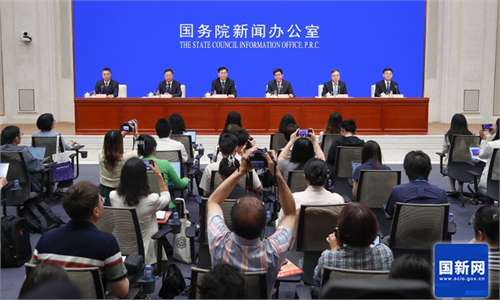
At a State Council Information Office press conference on June 24, Bayanqolu, member of the Standing Committee of the National People's Congress (NPC) and chairman of the NPC ethnic affairs committee, offered an indisputable pair of data: all 420 poverty-stricken counties in ethnic minority areas, and 31.21 million people in five autonomous regions as well as parts of Guizhou, Yunnan, and Qinghai have been lifted out of poverty as scheduled.
"What other country or political party has achieved such results? What is the point of fabricating stories and sensationalizing issues out of prejudice? These achievements are the very foundation of ethnic equality and common development. Can they really not see them?" Bayinchaolu said when responding to a media question about claims made by some foreign organizations.
Some foreign media outlets have long viewed China's ethnic affairs through a distorted lens, habitually misinterpreting and selectively framing its policies and development. These narratives are not based on objective facts but stem from entrenched bias. They politicize and smear normal governance practices, in an attempt to turn China's ethnic affairs into a containment tool in the international discourse arena.
But such political rhetoric cannot change facts on the ground. In 2025, the Global Times invited nearly 30 foreign experts who had personally visited Northwest China's Xinjiang Uyghur Autonomous Region and Southwest China's Xizang Autonomous Region to share their observations. What they witnessed firsthand effectively rendered foreign media accusations utterly baseless.
"China is a unified multi-ethnic country. Its 56 ethnic groups have jointly weathered challenges and built their shared homeland, forming an inseparable community with a shared future. Based on such historical traditions and fundamental national conditions, China has forged a development path for ethnic affairs that is tailored to its own realities," said Wang Yanzhong, a researcher at the Institute of Ethnology and Anthropology under the Chinese Academy of Social Sciences.
China's distinctive path is straightforward: ensuring that people of all ethnic groups truly enjoy equal political rights and jointly exercise their role as masters of the country, and achieving common unity and struggle among all ethnic groups, as well as shared prosperity and development. Looking ahead, China will remain committed to its chosen path.
The Ethnic Unity and Progress Promotion Law will further turn institutional and legal strengths into effective governance outcomes. External noise, no matter how loud they become, will never shake China's ethnic unity and progress.
RELATED ARTICLES