IN-DEPTH / IN-DEPTH
At the Party's birthplace, a grassroots historian tells how generations of CPC members lifted China from poverty and war to prosperity
From peril to ascendance
By in Shanghai Published: Jul 01, 2026 10:05 PM

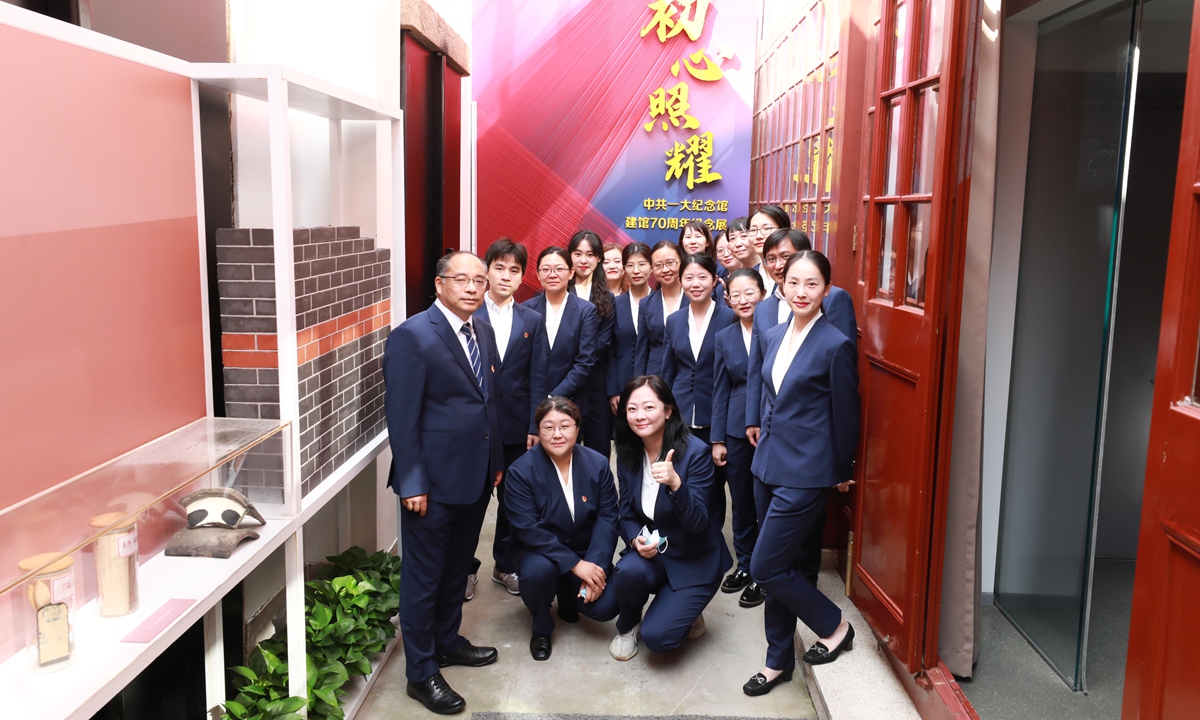
Zhang Yuhan (first from the left in the front row) poses for a photo with the staff of a themed exhibition at the Memorial Hall of the First National Congress of the CPC in Shanghai. Photo: Courtesy of Zhang
Editor's Note:
This year marks the 105th anniversary of the founding of the Communist Party of China (CPC). Over the past century, the Party has led China through profound transformations: from national peril to national rejuvenation, from bare subsistence to moderate prosperity, from technological catch-up to independent innovation, and from isolation and underdevelopment to greater educational equity. Generation after generation of CPC members, through their unwavering commitment, have written an epic of uplifting the destiny of the Chinese nation, the well-being of its people, and the course of national development.
July 1 marks the CPC's founding anniversary. On this occasion, the Global Times is launching a special series, "105 Years of Uplift," to explore the deeper answer to the question of why the CPC has succeeded. The first installment focuses on how the Party has uplifted the destiny of the Chinese nation, turning the attention to the Memorial Hall of the First National Congress of the CPC - the birthplace of the Party - where a grassroots Party history researcher, through her work, looks back on how the Party pioneers a century ago lit the flame of faith and led the nation from crisis and hardship toward the great rejuvenation.
White light falls across rows of iron-clad bookshelves, where the air hangs thick with the mingled scent of ink and passing years. Zhang Yuhan runs her fingertips along the spines of books chronicling the history and development of the Communist Party of China (CPC), pulls one out, and slowly turns its pages. Between the lines, a century of arduous struggle and historic breakthroughs unfurls in quiet majesty.
This is the working area of the Memorial Hall of the First National Congress of the CPC in Shanghai. Outside the window, the trees along the city downtown's Xingye Road sway in the wind, their shadows strewn across the red-brick walls of the traditional shikumen-style buildings. On a summer day, 105 years ago in 1921, 13 young people, with an average age of 28, gathered secretly in a room on this very road. Their meeting, later interrupted by a raid and moved onto a boat on Nanhu Lake in nearby city Jiaxing, would set in motion a historic turning point: the birth of the CPC.
More than a century later, the Party, which at its founding had just over 50 members, has grown into the world's largest ruling party with more than 100 million members. It has led the Chinese nation out of danger and hardship, step by step, onto the broad road of national rejuvenation and the rise of a great power.
To Zhang, director of the coordination office and a research curator at the memorial, this dramatic transformation is an epic "uplift": generation after generation of CPC members, through faith, sacrifice and hard work, have steadily lifted the fate of the nation and the well-being of its people to unprecedented heights.
"The generations of the Party members," she told the Global Times at the memorial, "are the weightiest backbone of the Party's century-long endeavor of uplifting a nation."
Admirable choices
In 2002, Zhang began working at the memorial after graduating. One of her first major assignments was to sort through all domestic and international scholarship since 1949 on the history of the CPC's founding. Through numerous historical materials, Zhang gradually understands more deeply the weight of the choice made by a group of young people a century ago - the choice to give up personal stability and go forward to save the nation.
One of Zhang's most vivid memories in those years was the 2004 preparations for a symposium on Wang Jinmei.
Wang, a delegate to the first national congress of the CPC from East China's Shandong Province, had once been admitted to a teachers' college on the strength of excellent academic performance. For him, a stable life as a schoolteacher, earning a modest living and supporting a family, would have been an easy and ordinary path. But witnessing a China beset by internal turmoil and foreign aggression, with the people struggling in hunger and cold, Wang embraced Marxism and resolutely set aside his private life, traveling across several cities to mobilize workers' movements.
After years on the road, Wang developed a lung disease and died in Qingdao at just 27. On his deathbed, he left behind a testament: All comrades must work hard, and struggle to the very end for the liberation of the proletariat and all humanity, and for the complete realization of communism!
Decades later, Zhang traveled to Shandong to visit a number of revolutionary sites once associated with Wang. Standing on the ground where that generation had once marched and labored, she was deeply moved. "Growing up in poverty, Wang could have chosen a stable life and easily supported his family, but instead he devoted everything to finding a way forward for the nation," Zhang said. "Against the backdrop of that era, such a choice was extraordinarily rare."
Wang Jinmei was not alone. In those difficult years, countless pioneers like him carried the fate of a nation in peril on their shoulders.
Zhang also shared with the Global Times a family letter written by Chen Tanqiu, another representative to the first national congress of the CPC. At the time, underground Party work was extremely dangerous. Chen and his wife, Xu Quanzhi, who was pregnant at the time, were unable to raise their child, so they made the heartbreaking decision to entrust the baby to relatives in their hometown.
"I have always been a wanderer, with no fixed place to stay," Chen wrote in a letter to his brother, asking him to take in and raise his child. Soon after their child was born, in early 1934, Xu was arrested and later killed, as was Chen in 1943 by reactionary forces.
"These Party members were also parents and children. They loved their own children and families, but in order to secure a better future for more families, they chose to sacrifice their own," Zhang told the Global Times. "That kind of choice made them truly brave and selfless."
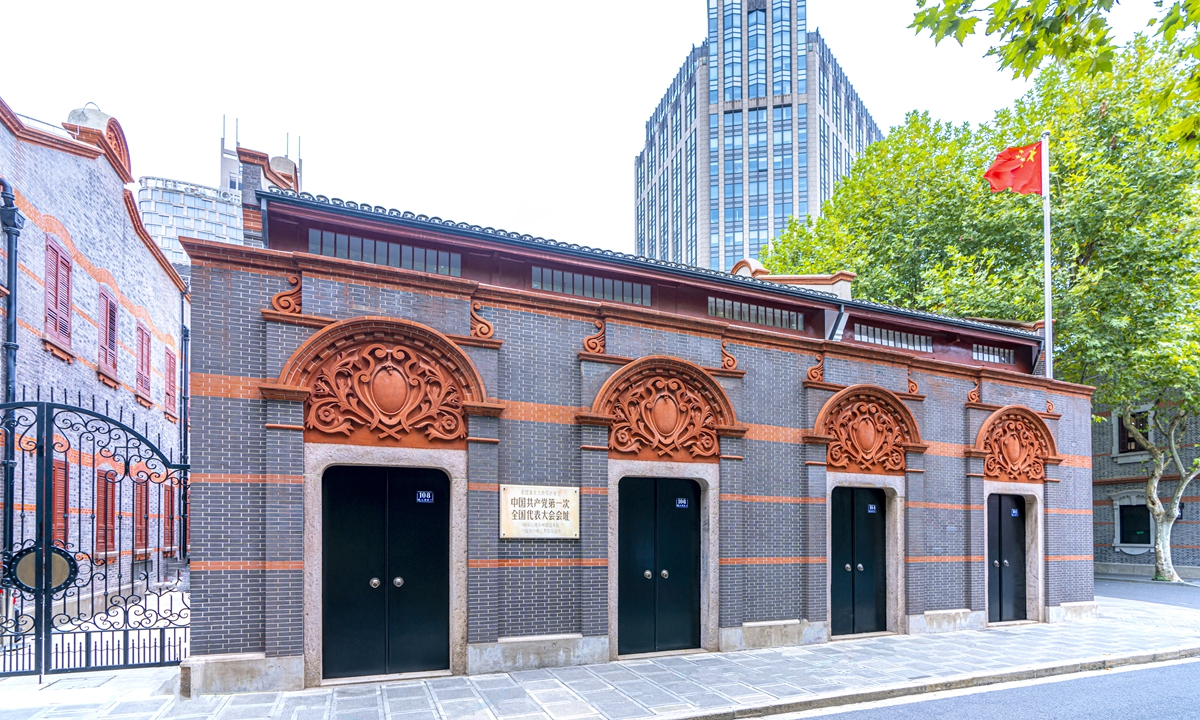
A view of the Memorial Hall of the First National Congress of the CPC in Shanghai Photo: VCG
Exhibits witness
In 2021, the new venue of the memorial opened to the public to mark the 100th anniversary of the founding of the CPC. Today, visitors continue to arrive in an unbroken stream, lingering in this shikumen-style building as they try to get closer to that momentous chapter of history.
The memorial houses a collection of nearly 130,000 relics and artifacts. Among the many exhibits, the first complete Chinese language translation of the Communist Manifesto, along with the first Party program and the first Resolution on the Present Task, stand as iconic witnesses to the Party's early years, Zhang said.
"The Communist Manifesto represented the Party's choice of Marxism," Zhang told the Global Times. She said that in that era, many progressive intellectuals repeatedly compared different ideas, before finally concluding that Marxism was the truth that could save the nation and the people.
If the Communist Manifesto was a "navigation chart," then the program and the resolution adopted at the First CPC National Congress were the "blueprint for construction," said Zhang. "Faith alone was not enough; a rigorous organization was also necessary. With such a party in place, people could think as one and work toward the same goal, helping to lay the foundation for uplifting a new China," she said.
For a century, the CPC's path of uplifting the destiny of the Chinese nation has been soaked in the blood of sacrifice. In 2025, the memorial held a special exhibition on archaeological findings related to martyrs of the Chinese People's War of Resistance Against Japanese Aggression (1931-1945). Among the exhibits were the remains of some martyrs, on whose bones rusted nails and traces of bullet holes were still clearly visible. These silent marks seemed to speak of the hail of bullets and shells they had endured while resisting invasion.
In the memorial hall's permanent exhibition, the tools used by martyr Li Ba to repair radio equipment and the radio once used by martyr Qin Hongjun rest quietly in display cases. On May 7, 1949, just some 20 days before the liberation of Shanghai and less than five months before the founding of New China, the two CPC members, who had worked in secret radio operations, were secretly killed by enemy agents.
"Whether faced with domestic turmoil or foreign aggression, CPC members have never given up their mission to carry the nation forward," Zhang told the Global Times. "Some fell on the front lines of battle, and some died in the shadows of the underground struggle, but the Party kept moving forward through setbacks."
A glorious path forward
Over the past two decades, Zhang has not only devoted her life to researching historical archives and designing exhibitions. She has also taken the stories of the Party's history into universities and out to the general public, spoken with ordinary visitors, foreign dignitaries and young students, and forged deep friendships with many descendants of the Party's revolutionary pioneers.
Zhang recalled one occasion when a descendant of Lin Boqu, one of the Party's early members, spoke of Lin's final all-night farewell with his old friend He Shuheng, a delegate of the first national congress of the CPC, before the Long March of the Red Army led by the CPC (1934-36). That night, He took off the sweater he was wearing and gave it to Lin. The sweater, made by He's daughter, later helped shield Lin from the bitter cold along the Long March.
He Shuheng later died after leaping from a cliff during a breakout attempt, and the sweater became a final testament to their parting. Decades later, when Lin's descendant spoke of that sweater, tears welled in her eyes.
Now on display at the memorial, the sweater carries not only the memory of a priceless wartime comradeship, but also the resolve of CPC members in those days: an unshakable conviction and dauntless devotion to sacrifice their lives at any moment, Zhang said.
Zhang believes that today the great founding spirit of the Party still resides in the ordinary yet steadfast choices people make, and the original aspiration of CPC members has never changed. "Just as the pioneers a hundred years ago set aside their own families to pursue a greater cause, Party members today continue to stand firm at their posts, day after day, turning the people's hopes into reality, continue to uplift the nation inch by inch."
In Zhang's view, "uplift" is never an abstract or grandiose word. It is something tangible, rooted in the everyday comforts of ordinary people's lives. "A warm meal on the stove, a home that shelters one from wind and rain, a school where children can study in safety, convenient transportation, security in old age... these are the most concrete expressions of how the Party and the country have uplifted this nation," she told the Global Times.
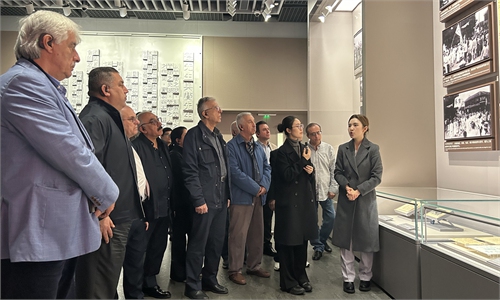
At the final section of the memorial's permanent exhibition, the scene is warm and bright: men, women and children gather before the camera, their faces lit with genuine smiles that fill an entire wall of display panels. The images stand in striking contrast to the sorrowful old photographs of ordinary people in earlier sections of this exhibition, creating a vivid visual span across a century.
Zhang paused there, gazing at those smiles, her eyes full of tenderness. "These radiant smiles are what all CPC revolutionaries devoted their lives to pursuing," she said. "The sacrifices made by countless people in those years were for one purpose: to ensure that the Chinese people would no longer struggle in misery, but could laugh freely from the heart."
"A century ago, the Party's pioneers uplifted the nation out of peril and survival crises; today, the Party continues to lead us in uplifting the people toward a better life," she said. "This glorious path has carried on, unbroken and unwavering."
RELATED ARTICLES