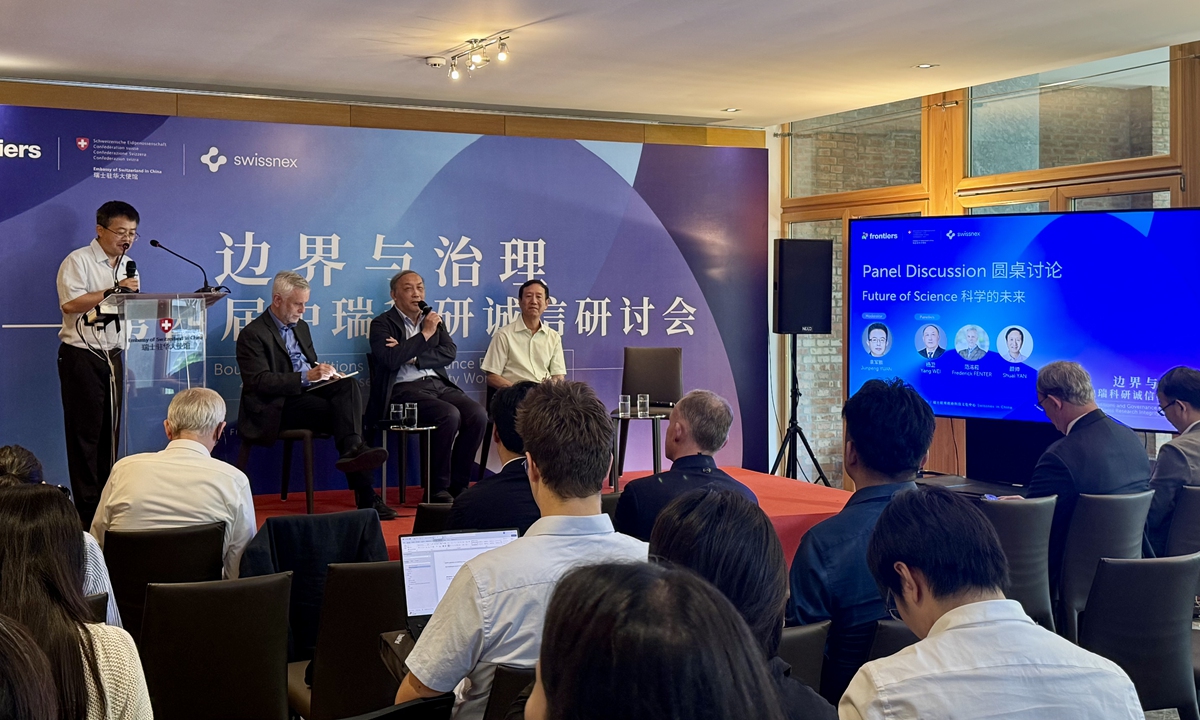
Chinese and Swiss delegates at a panel discussion at the fourth Sino-Swiss Research Integrity Workshop at the Embassy of Switzerland in China on June 26, 2026. Photo: Dong Feng/GT
The Embassy of Switzerland in China staged the fourth Sino-Swiss Research Integrity Workshop jointly with Swissnex in China, a platform that connects Swiss and Chinese representatives in education, research, and innovation, and Frontiers, a major open-access academic publisher, in Beijing on June 26.Raphaela Oliver, Consul of the Embassy of Switzerland in China, told the Global Times that under the theme "Boundary Conditions and Governance Framework," scientists from China and Switzerland concluded through their discussions that research data must be credible and that a responsible attitude is essential during the data collection process; meanwhile, the rapid application of artificial Intelligence (AI) emerged as a new topic of discussion this year.
The workshop brought together policymakers, academic leaders, and industry figures from both countries to discuss a question that grows more consequential each year: How research integrity must continually adapt to a research ecosystem increasingly shaped by AI?
The agenda is particularly important in cross-border research collaborations. As research collaborations in the age of AI tend to grow in both scale and complexity, navigating the relevant framework conditions can no longer be considered a simple task.
Frederick Fenter, chief executive editor of Frontiers, told the Global Times that during the workshop, there were two schools in AI applications - one sees AI as a real game changer. It is going to be able to help us achieve incredible new insights; while the other school, which is more skeptical, thinks that human interaction always has to be emphasized.
Jay Siegel, vice president of the University of Hong Kong, told the Global Times that AI can fully demonstrate its powerful statistics capabilities in data-heavy problems. "Whenever we find data-rich problems with complex pattern solutions and low signal to noise data sets, we will see the true statistical power of AI."
Siegel said that the obvious examples are medical diagnosis, climate forecasting and economic modeling, but the underlying principle of leveraging data with statistical analysis is paramount.
From Fenter's point of view in scientific publishing, AI will be extremely effective in terms of improving efficiencies and accelerating the whole publication process. However, not everybody sees things that way, and "some people do think that we're not paying enough attention to the need for human action in the areas that they work in. AI will always be a tool that helps people make good decisions," he added.
Talking about the common ground between Chinese and Swiss technological research, Oliver told the Global Times that it is definitely vital that "our data or research has to be trustworthy and responsible."
Oliver elaborated that the there is a lot of common ground when it comes to the ethical questions and around responsible research. After the workshop, an ethic delegation will work together.
Additionally, Oliver said that there will be startups programs, where Swiss startups can work on market validation and market entry camps to observe how to work in China.
2026 celebrates the 10th anniversary of the Innovative Strategic Partnership between Switzerland and China. By bringing together speakers from leading institutions in both countries, the workshop moves from frameworks to best practices, seeking to advance a shared Sino-Swiss contribution to a future-ready global research ecosystem.
Fenter said that he can see over the past three decades, Chinese scientists have witnessed dramatic shift in their global visibility.
"I started in scientific publishing in the 1990s and was in charge of a large program in organic chemistry in China. In Beijing, there was [about] one subscription to each of the journals for the entire country of China. This was something that was shown that China needed access to this information, but was really not yet a strong international player. Today, China has gone from trying to get a foothold in the information world to being the No.1 player in the generation of scientific knowledge. I think it's one of the most incredible stories of my lifetime," he reflected.
As for how China achieved this shift, he attributed the leapfrog change to the country's five-year plans.
China has been consistent in the long-term national strategy via five-year plans that prioritize research and development with sustained, steady policy focus without frequent priority shifts caused by political leadership. Plus, China has its substantial government investment that matches national scientific ambitions, said Fenter.
RELATED ARTICLES