IN-DEPTH / IN-DEPTH
Ecological restoration, smart upgrades power world’s highest railway after 20 years of operation
Riding the Plateau
By and Fan Wei Published: Jul 03, 2026 09:33 PM

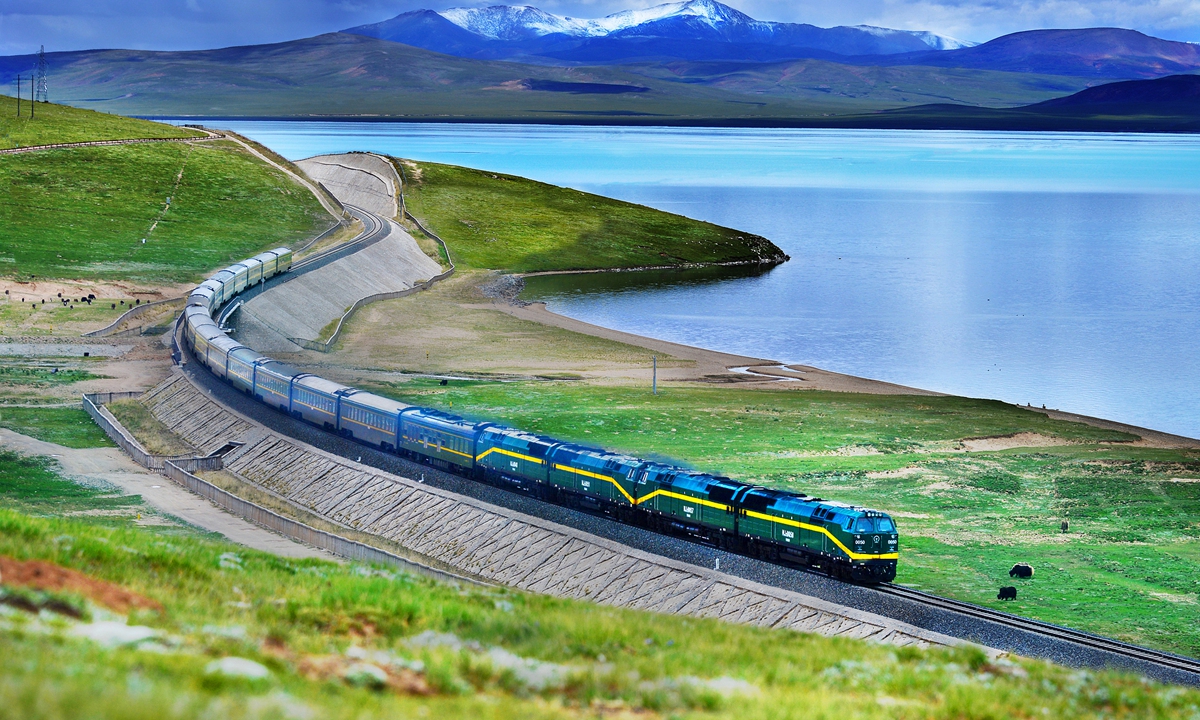
A view of the Qinghai-Xizang Railway Photo: VCG
The Qinghai-Xizang Railway marks its 20th anniversary of operation on July 1. As the world's highest and longest plateau railway, the line, since 2006, has opened a vital transport corridor across the Qinghai-Xizang Plateau, and helped accelerate ecological protection along its route.
Over the past 20 years, the railway has transported a total of 104 million passengers and 824 million tons of freight, according to China State Railway Group Co Ltd, the operator of the line.
The railway stretches 1,956 kilometers from Xining, capital city of Qinghai Province, to Lhasa, capital of Xizang Autonomous Region. It is a landmark project of China's Western Development Strategy and the world's highest-altitude railway in continuous operation.
Along the route, approximately 960 kilometers lie at elevations above 4,000 meters, where oxygen levels are only 60 percent of those at sea level. About 550 kilometers pass through permafrost regions, while strong winds and blizzards frequently create challenging operating conditions.
Over the past two decades, many vivid stories have emerged behind the railway's development. This report focuses on practical cases of ecological protection and technological innovation along the line, reflecting the railway's long-term exploration of plateau infrastructure development.
Green frontier
At an altitude of 3,300 meters, the Oulongshan maintenance work area lies in a barren stretch of desert along the railway line. It is an isolated island in the desert of Northwest China's Qinghai.
In 2013, maintenance worker Gan Shengqing and his colleagues began experimenting with tree planting after arriving at the site. Saplings were collected from settlements more than 100 kilometers away.
They were cultivated using a method of soaking cut branches to encourage root growth before planting. Once established, new saplings were further propagated through repeated cutting and cultivation.
To improve survival rates, sheep manure was transported from pastoral areas more than 20 kilometers away to be used as fertilizer. Given extremely limited water supply, which depended on weekly deliveries, workers carefully conserved water for irrigation and built simple irrigation pipelines to support vegetation.
Through years of continuous effort, vegetation coverage in the area has expanded from just a few trees to more than 200, with plants growing from several centimeters to over 10 meters in height, extending from the courtyard to surrounding areas. In summer, the green coverage stands out prominently against the surrounding desert landscape.
"Sandstorm occurrences along the railway have decreased from 20-30 times per year in earlier years to about five to six times annually," Gan said.
Alongside ecological restoration, infrastructure along the railway has been upgraded in support of China's "dual carbon" goals.
Delingha Railway Station, located in the Qaidam Basin in Qinghai, is surrounded by vast desert terrain. Known as the "solar thermal city," the station has in recent years integrated green development concepts into its operation. In April 2024, a rooftop distributed photovoltaic system was put into operation, covering approximately 0.19 million square meters with an installed capacity of 0.21 MW.
In winter, the system provides about 28 percent of the station's electricity demand, rising to 35 percent in summer, effectively reducing operational energy consumption and supporting a low-carbon operational model.
The Global Times learned from the China Railway Qinghai-Xizang Group Co that, over the past 20 years, approximately 1,000 kilometers of railway-side greening has been completed, accounting for 94.7 percent of all eligible sections. More than 3.5 million trees and shrubs have been planted, with a total green coverage area of 7.98 million square meters along the Qinghai-Xizang Railway.
Sandstorm risks affecting railway operations are now largely eliminated. In addition, most coal-fired facilities along the line have been converted to clean energy, reducing coal consumption by 86 percent.
Technology empowerment
Over the past two decades, the railway has increasingly adopted artificial intelligence, the Internet of Things and other technologies to modernize its maintenance and operation systems.
A track inspection robot (LU mobile wheel rim and wheel web ultrasonic inspection system), installed in maintenance pits, uses phased-array ultrasonic technology to conduct automated inspections and generate real-time diagnostic reports, China Railway Qinghai-Xizang Group Co said.
Compared with manual inspection, staffing requirements per vehicle have been reduced from seven or eight workers to two, while inspection time has been shortened from about two hours to just 40 minutes.
On the Golmud-Lhasa section, the most challenging part of the railway, there are 58 stations, including 53 unattended stations, accounting for more than 91 percent. Over the past 20 years, no service disruptions have been caused by equipment failure or extreme weather.
Behind this stable operation is an integrated system combining intelligent sensing, remote control and redundant power supply, enabling continuous monitoring around the clock.
A total of 1,892 high-definition cameras provide real-time monitoring of station equipment and track conditions. A wind monitoring and early-warning system covering 1,120 kilometers of track replaces manual inspection and automatically triggers speed restrictions when necessary.
Moreover, intelligent train control, centralized dispatch, snow-melting, backup power and rail-joint reduction technologies have together improved reliability and reduced maintenance pressure, laying the groundwork for unmanned operations across the high-altitude section.
This technological system has ensured safe and stable railway operations over the past two decades, while also reducing the need for manual overnight maintenance in extreme high-altitude conditions, becoming a representative example of China's independent innovation in plateau railway engineering.
As the Qinghai-Xizang Railway enters its third decade of operation, the plateau railway network is continuing to extend toward more remote areas.
Tashi Phuntsok, 44, from Ngari Prefecture in Xizang, was among the first group of local train drivers on the Qinghai-Xizang Railway.
Having witnessed the shift from diesel locomotives to Fuxing bullet trains, and from manual inspection to intelligent detection, Tashi said that he hopes to see the railway reach his hometown one day.
"My greatest wish is to drive a train one day and take passengers to Ngari in Xizang," he said. "The extension of the railway is not only about adding mileage, but also about passing on dreams."
RELATED ARTICLES