IN-DEPTH / IN-DEPTH
As Washington contracts its diplomatic footprint and reduces overseas commitments, the US’ goal of maintaining global hegemony remains unchanged
Hegemonic stubbornness

Reporters get their first look at budget information about the US Department of War's Fiscal Year 2027 budget at the Pentagon in Arlington, the US, on April 21, 2026.
Editor's Note:
"I just want their loyalty." On June 24, US President Donald Trump made this remark during a meeting at the White House with NATO Secretary General Mark Rutte. He singled out several NATO allies - Italy, France, Germany, and the UK - expressing disappointment that they had not provided assistance to the US in the war against Iraq, and stressed, "We're so loyal to them, we're always fighting for them."
In recent times, the US has become increasingly overt in adopting unilateralism and "law of the jungle" approaches in international affairs, frequently exerting pressure on other countries, including its allies. Such actions that disrupt the international order have eroded the trust of its allies and damaged the US' international reputation. Today, in the final installment of the series "250th Anniversary of Independence: America's Change and Constancy," we will recount several major shifts in US diplomatic strategy throughout history and analyze the motivations behind the current changes in US diplomatic tactics, revealing the unchanged ambition of pursuing global hegemony and maintaining its own dominant status.
US celebrates independence, allies seek self-reliance
British journalist Gideon Rachman argued in a Financial Times article that the atmosphere of relations between the US and its traditional allies is undergoing a change. "In this new atmosphere, close ties to America that were once seen as a strength increasingly look like a potential vulnerability," he wrote.
Washington's traditional partners have discovered that longstanding ties to the US do not buy them immunity from abuse and pressure tactics from the Trump administration, read the article.
European governments are now increasingly talking about "economic sovereignty" and hoping to reduce their dependence on US companies, products, and military equipment.
US pressure on its allies extends far beyond the economic domain. In February 2025, US Vice President JD Vance delivered an "inward-turning" speech at the Munich Security Conference, which surprised and angered European allies. He directly criticized what he called "the retreat of Europe from some of its most fundamental values - values shared with the US."
In December 2025, the White House released the new National Security Strategy, which explicitly incorporated the "Trump Corollary" to the Monroe Doctrine, stressing the importance of the Western Hemisphere to the US and shifting focus from global affairs to prioritizing the security of the US homeland and its immediate surroundings.
In action, the US has adopted selective participation in a series of international mechanisms, reduced the provision of public goods in areas such as addressing climate change and providing foreign aid, significantly cut military and diplomatic investments in non-core interest regions, and demanded that allies assume greater responsibility for regional security.
In January, the Pentagon released the National Defense Strategy, which states bluntly at the outset: "For too long, the US Government neglected - even rejected - putting Americans and their concrete interests first." The document criticizes European and Asian allies for relying on US defense subsidies for many years.
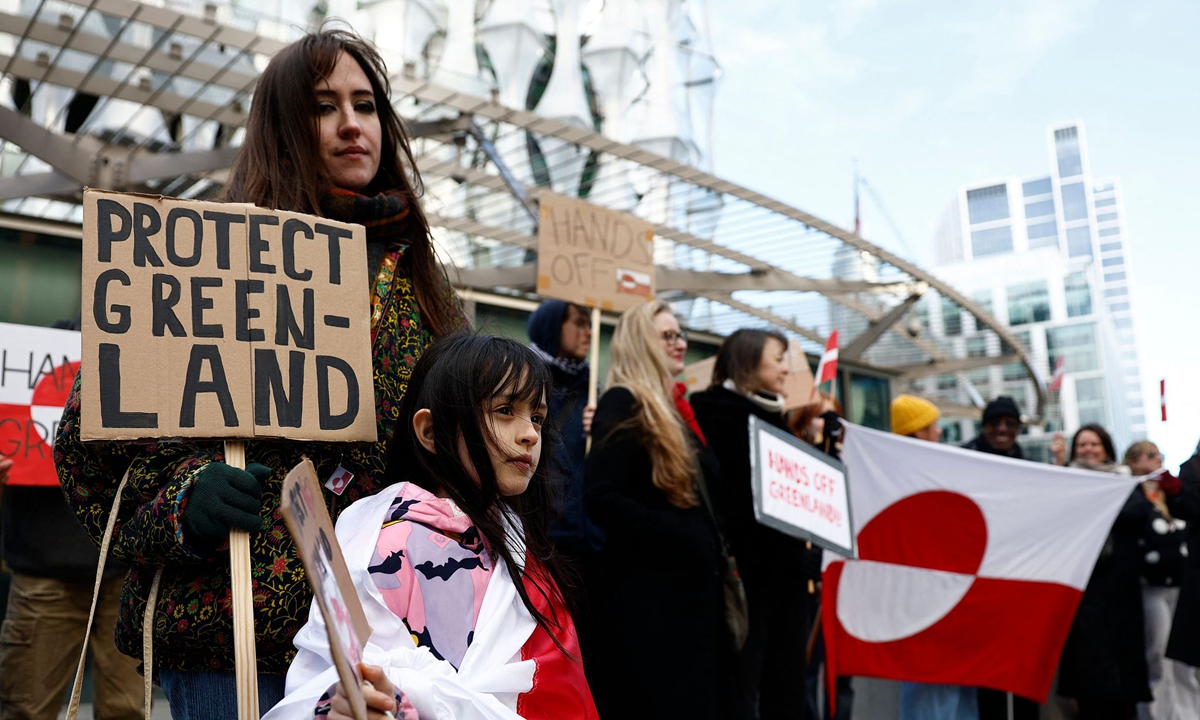
A mother stands with her daughter as they take part in a demonstration to protest against the US government's plan to take Greenland, outside the US Embassy in London on January 24, 2026. Photos on this page: VCG
Maintenance of global hegemony
In fact, the US pursued isolationism in the early years after its founding. It was only after several major adjustments in its diplomatic strategy that it gradually built up a global alliance and partnership system, completing its transformation from regional expansion to the construction of global hegemony.
Reviewing this historical process, Gong Ting, deputy director of the Department for International and Strategic Studies at the China Institute of International Studies, told the Global Times that the evolution of US diplomatic strategy can be broadly divided into six stages. The first stage was the initial phase from the early years of the founding to the early 19th century. In particular, the introduction of the "Monroe Doctrine" laid the core ideological foundation for the US to dominate the Americas and carry out geopolitical expansion across the American continent.
"The Spanish-American War at the end of the 19th century marked an important turning point in America's foreign strategy," said Gong. Thanks to its victory in that war, the US consolidated its dominant position in the Americas. Its foreign strategy thereby underwent a major upgrade, moving away from a single-minded focus on regional expansion confined to the American continent. This ushered in the second stage - the two-ocean expansion process - gradually extending its sphere of influence across the Atlantic and Pacific, and completing the transformation from a regional power in the Americas to a transoceanic expansionist state.
The third stage covers the period of the two world wars, which was a critical phase for the US to accumulate strength and lay the foundation for its global position. By leveraging the wars, it accumulated economic, industrial, and comprehensive national power, rising to become the world's leading economic powerhouse.
In 1944, when delegates from various countries gathered in Bretton Woods, a small town in New Hampshire, the US stood as the only nation capable of setting global rules for the post-WWII world. The International Monetary Fund, the World Bank and the General Agreement on Tariffs and Trade were established one after another, cementing the US dollar as the world's primary reserve currency. Meanwhile, the Marshall Plan launched in 1948 and the North Atlantic Treaty Organization founded in 1949 delivered vital economic aid and military protection to war-ravaged Western Europe.
The fourth stage came during the Cold War, the pivotal period when the US forged its global hegemonic system. As the leading power of the capitalist bloc, the US adopted a long-term containment strategy targeting the Soviet Union throughout this era. The US tightened its grip on allies, building two separate alliance frameworks across the transatlantic Europe and the Asia-Pacific region. These alliances evolved into a global partner network, laying the structural foundation for US hegemony.
Following the end of the Cold War, the US entered its fifth stage: the expansion of unipolar hegemony. Boasting comprehensive national strength far exceeding any other country, the US positioned itself as the "leading advocate of neoliberalism" and aggressively pushed unipolar hegemony worldwide. It also refined and strengthened its global alliance system to further expand its global influence and control.
Yet this relentless expansion exposed the US to severe overstretch risks. In the wake of the 9/11 attacks in 2001, the US launched prolonged military campaigns in Iraq and Afghanistan. The Brookings Institution described the unilateral foreign policies of George W. Bush's administration as a foreign policy disaster. Dragged into these two protracted wars, the US suffered massive losses in international credibility and fiscal resources.
In the 2026 fiscal year, the US defense budget topped $1 trillion for the first time. Though US troops withdrew from Afghanistan in 2021, military spending kept climbing instead of falling after the war's end. US voters are now growing increasingly weary of Washington's overseas military commitments; multiple polls show only a minority of citizens support deploying US armed forces to defend allied nations.
Gong pointed out that the US has now entered the sixth stage of foreign policy recalibration. "This adjustment began during Trump's first term and has taken shape during his second, with 'America First' as its core guiding principle. In essence, it is a fine-tuned maintenance of US global hegemony."
The key logic is to redefine the US' core national interests, prioritize the security and interests of the homeland and the Western Hemisphere, optimize the cost-benefit equation of running its global hegemony, and abandon what it deems inefficient or high-cost strategic commitments, according to Gong.
Gong noted this is reflected in two main ways: first, restructuring global strategic priorities, placing the homeland and the Western Hemisphere at the center while focusing on the so-called Indo-Pacific region; second, proactively shedding what it considers "burdens," pulling back from some global governance and multilateral obligations, and pressuring allies to take on more responsibility - a trend that has directly exacerbated tensions and disagreements between the US and many of its allies in recent years.

An engineer continues his work after being stranded aboard his cargo vessel for days due to the blockade of the Strait of Hormuz, on June 23, 2026.
External expansion hits a ceiling
In May, the US Council on Foreign Relations published an article titled "Overreach and Retrenchment." It said that "the biggest risk a downsized policy will face is the one it has so often faced in the past: a spreading perception that it is failing to counter some growing challenge to US interests. Over time, that perception, especially when bolstered by a sudden shock, will move policy back toward activism."
"The US has never changed its core objective of maintaining or even strengthening its unipolar global hegemony," Gong said. She pointed out that regardless of changes in diplomatic tactics, the US has always retained its instinct for military power projection in support of hegemony. Today, its frequent use of force has had a notable negative impact on global order and international relations, fueling a resurgence of the "law of the jungle" in international affairs, seriously violating the purposes and principles of the UN Charter, and continuously eroding the post-WWII international system centered on the UN.
Moreover, the US' unilateral, self-serving strategic approach has increasingly soured its relations with most other countries. The widening rifts with European allies over security arrangements, economic cooperation, and ideological coordination are a case in point. Recent polls also clearly reflect a steady decline in the US' international image and a continuing loss of international credibility, Gong said.
Li Haidong, a professor at the China Foreign Affairs University, told the Global Times that since its independence, the US has consistently displayed a strong expansionist character. In the 19th century, this was mainly seen as continental expansion across North America; in the 20th century, it evolved into global power projection. Even the current US government, often seen as deviating from traditional establishment lines, remains fundamentally indistinguishable from mainstream US establishment thinking when it comes to expansionist ambitions. Whether it is coveting foreign territories like Greenland or contemplating purchasing them as overseas outposts, these moves reflect the continuity of the US' expansionist inertia.
Li said that the US' current predicament is that its external expansion has gradually reached a bottleneck, facing the dilemma described by Yale historian Paul Kennedy in his thesis on imperial overstretch leading to decline. The imbalance between the costs and benefits of US overseas expansion is worsening, and its expansionist actions are encountering growing setbacks, making it increasingly difficult to sustain the momentum of the past.
RELATED ARTICLES