
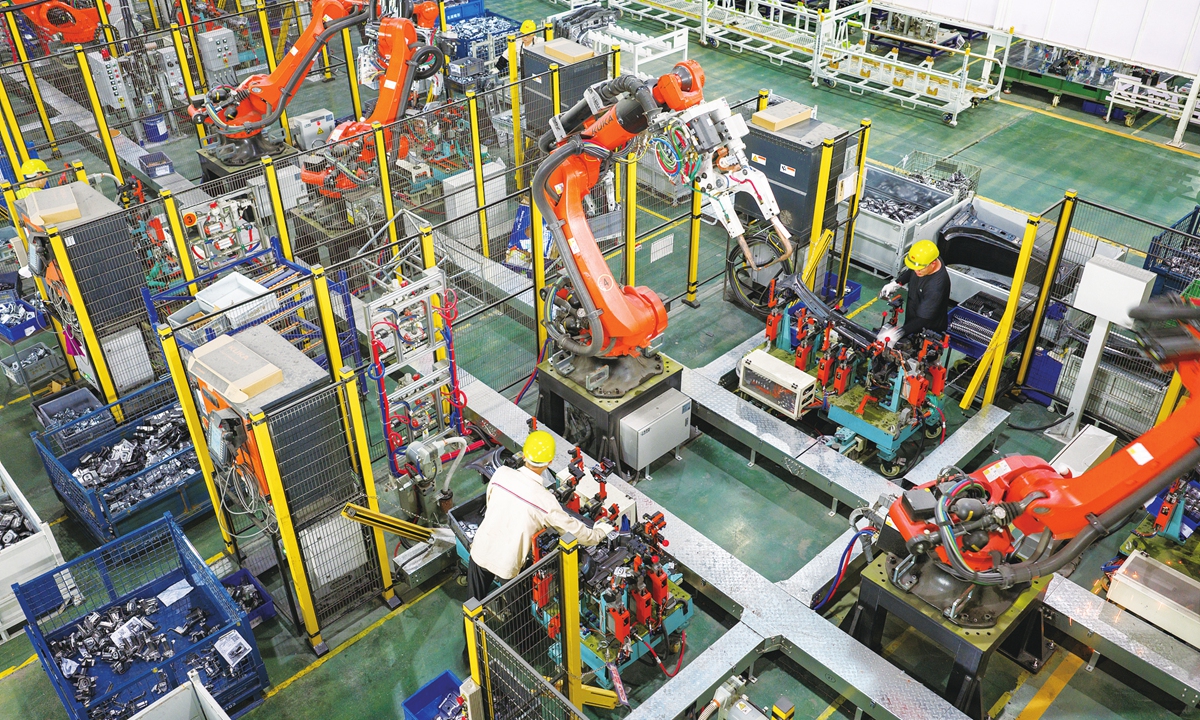
Industrial robot production lines run at full capacity at a new-energy vehicle parts company in Jinhua, East China's Zhejiang Province on June 22, 2026. Photo: VCG
As China's industrial profits for January-May 2026 reached 3.14 trillion yuan, up 18.8 percent year-on-year and accelerating from the first four months, the data reveals more than a cyclical rebound. It signals ongoing structural dynamics at work, as evidenced by a sustained reallocation toward higher-value sectors, supported by policy-driven liquidity and a shifting consumption landscape.
For policymakers and business leaders watching China's economy, this underscores an economy in the midst of "creative restructuring" — one where upstream and high-tech profitability outpace the rest, and where services consumption leads overall consumption demand, both of which point to an economic system on the path of upgrading.
Official data from the National Bureau of Statistics show clear winners.
The electronics and computer and communications equipment sector posted a remarkable 103.9 percent profit surge, contributing over 43 percent of total industrial profit growth. High-tech manufacturing overall rose 44.7 percent, while raw materials and non-ferrous metals benefited from elevated prices tied to AI, new-energy, and global demand. Equipment manufacturing also posted solid profit growth.
Downstream sectors, by contrast, faced pressure. Auto profits declined despite export resilience, and traditional consumer goods sectors tended to come in below average. This variability is not random, but reflects deliberate and ongoing industry restructuring — a shift from scale-driven, lower-value assembly toward technologically intensive, vertically integrated production.
High-tech and upstream segments are capturing gains from global AI investment and domestic policy priorities, improving profit margins.
This pattern aligns with China's long-term push for "high-quality development." Profits are not broadly diffused but concentrated where industrial and technological capabilities are deepening.
Underpinning these shifts is aggregate system liquidity expansion. Fiscal measures — special funds, interest subsidies and equipment renewal support — combine with targeted bank credit growth to priority sectors (tech, green, private firms and MSMEs).
This is targeted liquidity directed toward structural priorities, easing cost burdens for upgrading firms while profit differentiation weeds out less competitive segments. The result is improved efficiency metrics alongside sectoral reallocation.
For Chinese policymakers, the data affirms the strategy: persist with targeted support for high-tech, new-energy and services while addressing household income and confidence to broaden gains.
Further diffusion of productivity gains — via skills development, diffusion to SMEs, and service ecosystem development — will determine whether this upgrading becomes self-sustaining. Base effects and external shocks (e.g., commodities fluctuations and global AI demand) require careful monitoring, but the underlying direction is clear.
International businesses and investors should recognize the implications. China is repositioning within global value chains — leading in AI-powered electronics, new materials, and green tech while domestic demand for services grows.
Supply-chain strategies should account for this bifurcation: upstream exposure benefits from resilience and growth, while pure downstream consumer goods face more pressure. Opportunities lie in partnering for services, digital integration, and the "emotional economy" of experiences.
China's January-May 2026 industrial profits portray an economy successfully navigating the middle-income transition. Variability in profitability drives restructuring; liquidity expansion enables investment in non-fungible, higher-productivity techniques; and shifting consumption toward services reflects natural demand evolution. This is not flawless linear progress but a dynamic, uneven process of system upgrading.
Policymakers globally would do well to engage this reality rather than outdated and misleading aggregates. For China, sustaining the momentum requires balancing restructuring with inclusive gains — ensuring wages and services diffusion match upstream prowess.
For the world, it means preparing for a more technologically sophisticated, services-augmented Chinese economy that continues reshaping global competition and cooperation.

Warwick Powell Photo: Courtesy of Warwick Powell
The author is an adjunct professor at the Queensland University of Technology and former advisor to former Australian Prime Minister Kevin Rudd. bizopinion@globaltimes.com.cn
RELATED ARTICLES