Illustration: Liu Xidan/Global Times
A recent op-ed by Chinese Ambassador to Australia Xiao Qian, published in The Sydney Morning Herald and The Age, has stirred a hornet's nest among Canberra politicians and intelligence circles.
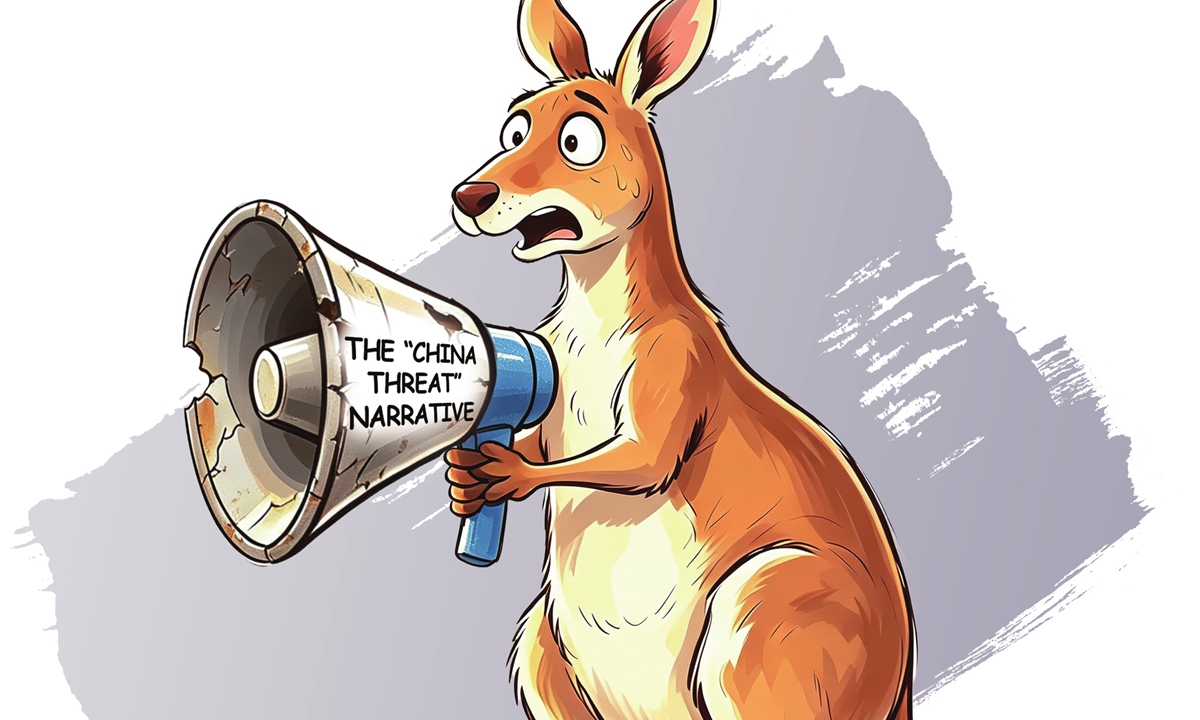
In the article, Ambassador Xiao systematically outlined Beijing's positions and offered a polite, measured pushback against the Cold War-style "China threat" narrative heavily promoted by Australia's security establishment.
Despite this measured take, the reaction from Canberra's political and media circle has been a masterclass in hyperbole.
The Australian Security Intelligence Organization (ASIO) has pushed back strongly on the criticism, while mainstream media outlets lined up to accuse China of "foreign interference."
Some politicians even demanded that the ambassador be summoned. What should have been a normal diplomatic dialogue was quickly spun into a theatrical display of self-victimization.
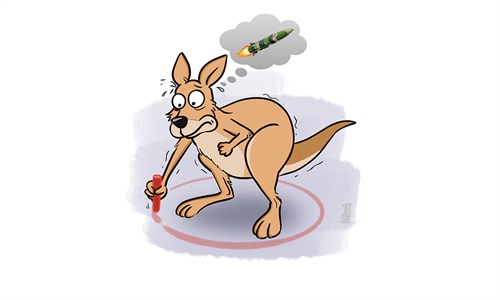
Observing the mixture of anxiety, grievance, and suspicion on the faces of Canberra's politicians, one cannot help but ask: what exactly is Australia so afraid of?
Since the establishment of diplomatic relations over half a century ago, China has never harmed a single hair on Australia's head. Beijing has never sent warships to threaten Sydney Harbor, scrambled fighter jets near Canberra, or posed any sovereign threat to Australia.
Yet, Canberra's defense budget continues to balloon, culminating in a commitment of hundreds of billions of dollars to acquire nuclear-powered submarines under the AUKUS pact - all in the name of preparing for a conflict at the nation's doorstep.
When pressed on these alleged "security threats," some Australian politicians and scholars explicitly or implicitly refer to China. However, a closer look at the "ironclad evidence" presented by intelligence agencies reveals how flimsy these claims are.
Normal community gatherings of the Chinese diaspora, standard corporate public relations by Chinese enterprises, and routine academic exchanges are placed under ASIO's magnifying glass and branded "sharp power" or "espionage."
If local sponsorships or PR are security threats, how do we view US lobbyists influencing Australian law? This hypersensitivity does not stem from anything China has done; it is a symptom of Canberra's own geopolitical insecurity.
The root cause of this anxiety is that Australia has not only misread China but has also completely lost its own sense of identity.
Canberra once championed a vision of acting as a "bridge between East and West." It was a highly pragmatic and sophisticated strategic concept: leveraging Australia's unique geography to link the Western world with Asia, and translating and mediating across different political systems and markets to secure the country's long-term prosperity.
Yet, a bridge cannot function if you treat the country on the other side as an existential enemy. It is a logical contradiction to enjoy massive trade surpluses and economic prosperity powered by China while simultaneously transforming the bridgehead into an artillery outpost for the United States.
When you turn the country on the far side into a foe, the bridge will naturally collapse. Once broken, the bridge loses its strategic value, turning into a useless piece of geopolitical debris.
Australia's predicament is that it is unaware it has already begun severing the most vital link to Asia. Should we destroy this bridge, or should we continue to reinforce it?
Washington's fear narrative has captured Australia's foreign policy. To preserve dominance, the US stokes strategic anxiety, and Australia readily follows, recedes to the other end of the bridge.
But Australia seriously overestimates its standing in the Western club. Canberra imagines itself a vital ally, but to Washington, it is primarily a provider of strategic depth, a buyer of expensive military hardware, and a proxy on the front line.
A country with a deeply confused self-identity is destined to lose its bearings in a changing global landscape. By reducing its foreign policy options to a single US-led security alliance, Australia has severely constrained its own diplomatic leverage.
If Canberra's politicians continue to indulge in self-inflicted paranoia, they must realize a simple truth: a bridge requires two sides. If Australia chooses to remain merely a megaphone for US containment strategies, it will eventually find itself isolated, watching the bridge that once connected it to prosperity crumble into irrelevance.
RELATED ARTICLES