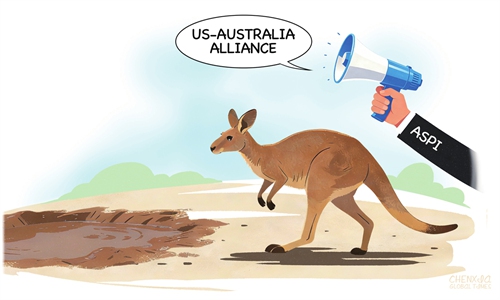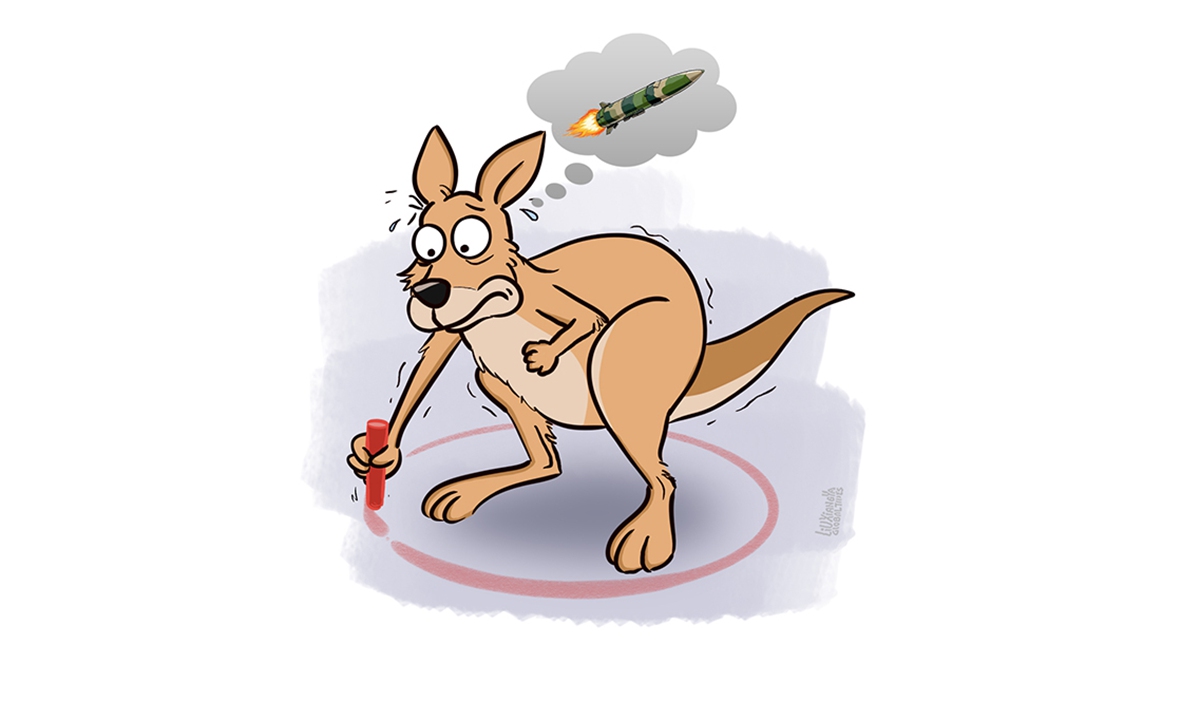
Illustration: Liu Xiangya/GT
Some Australian observers appear to have fallen back into a familiar pattern of self-generated security anxiety.
A recent Lowy Institute's report, "Understanding the Chinese military threat to Australia," released on Sunday, dramatically warns that China's capacity to strike the Australian landmass from Chinese territory will grow over the next decade as the DF-27 intermediate-range ballistic missile, and potentially a conventionally armed intercontinental ballistic missile, grow in service numbers.
The report tries to project an air of scholarly objectivity and professionalism, stressing that it "focuses on military capability, not China's intentions to use it." Yet this is precisely where its arguments become unconvincing. If one does not believe the other side harbors any desire to attack, why spend so much time obsessively measuring the range of its missiles? To hype the threat on one hand, while piously disclaiming judgment on intent on the other, is a glaring contradiction that the report wears plainly on its sleeve.
Reality offers a sharp rebuttal. In Chinese strategic discourse and public conversation alike, the idea of launching missile strikes against Australia is virtually nonexistent. Around the time the report surfaced, searching for "Australia" on Chinese social media mostly brought up discussions about the World Cup and the Australian team's performance. Against this ordinary backdrop, the alarmist report feels almost surreal.
This is hardly new. Three years ago, Australia's mainstream media rolled out the heavily promoted "Red Alert" series, warning that war with China was imminent within three years - by March 2026. That deadline has now passed. None of the dire predictions happened, something the authors likely knew even as they wrote them. The simple reason? China has no intention of going to war with Australia.
Geographically distant and lacking any core territorial disputes or historical grievances, China and Australia have, for most of their diplomatic relationship, managed to maintain mutually beneficial ties despite ideological and geopolitical differences. That makes the persistent fear-mongering by some people in Australia's political, academic, and media circles more regrettable.
In previous years, they actively hitched themselves to US' anti-China agenda: dispatching warships through the South China Sea and Taiwan Straits, expanding US military bases on its soil, and hosting strategic bombers. Now they turn around and accuse China of posing a threat - a classic case of reversing roles and shifting blame. In fact, China-Australia relations are slowly warming. Bilateral trade is recovering, and the current Australian government is making efforts to put ties back on track.
Meanwhile, these analyses rarely ask the obvious question: why is China strengthening its defenses? Among many reasons, this cannot be missed: the increasingly tight military encirclement by the US and its allies - including Australia - through new bases, joint drills, and intelligence cooperation right on China's doorstep.
Parts of Australia's strategic community are obsessed with calculating Chinese missile ranges and war-gaming hypothetical attacks on the homeland. The more they hype the threat, the easier it is to justify bigger defense budgets, deeper AUKUS ties, and full alignment with Washington's "Indo-Pacific" agenda. This manufactured hostility is making tensions more likely - a textbook case of a self-fulfilling prophecy.
That's why some rational Australian observers have marveled at China's restraint and patience in preserving the bilateral relationship.
Australia needs to see China as a rising power focused on development, not on attacking other countries. Otherwise, Australia might lock itself in a self-made cage. By repeatedly treating a partner as a potential adversary, it risks losing the chance for mutual benefit, regional stability, and its own long-term interests.
RELATED ARTICLES